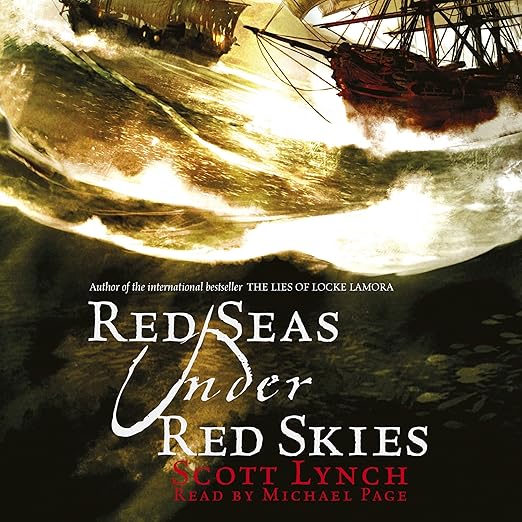
Quick Take
- Narration: Michael Page is as essential to the Gentleman Bastard Sequence as Lynch’s prose itself, he captures Locke’s slippery charm and Jean’s blunt loyalty with equal precision, and his Zamira Drakasha is one of the series’ narration highlights.
- Themes: Friendship under pressure, the cost of ambition, the comedy of catastrophic planning
- Mood: Swaggering and propulsive, with genuine darkness underneath the wit
- Verdict: A worthy second act that trades Camorr’s labyrinthine streets for high seas mayhem, not quite the revelation of the first book, but still sharper and funnier than almost anything else in the genre.
I started this one on a long train journey, telling myself I’d listen to just the first hour to reacquaint myself with Locke Lamora and Jean Tannen after the gut-punch of the first book. Somewhere between the port of Tal Varrar and the magnificent absurdity of The Sinspire, a gambling house so impregnable that not a single coin has ever been stolen from it, I forgot I had a destination. That’s the Scott Lynch effect: you get on, and you don’t get off until he’s good and ready to let you.
Red Seas Under Red Skies is the second installment in the Gentleman Bastard Sequence, a planned seven-book series that announced itself with The Lies of Locke Lamora to considerable acclaim. Sequels to beloved debut novels carry an unfair burden, and this one is not immune to the weight. But it earns its place in the sequence through sheer inventiveness, a significant expansion of its female cast, and a willingness to strand its protagonists so far outside their comfort zone that watching them improvise becomes the whole pleasure of the thing.
A Heist That Won’t Stay a Heist
The core setup is bracingly simple: Locke and Jean have fled the Bondsmagi’s wrath and arrived in Tal Varrar with designs on the Sinspire, the most exclusive casino in the known world. The problem is that every scheme they construct keeps getting hijacked by circumstance. Specifically, by Stragos, the city’s archon, who conscripts them into tracking down and dismantling the pirate fleet captained by Zamira Drakasha. Locke’s response to learning he must become a convincing sailor from scratch, under threat of slow poisoning, is one of the funniest sustained sequences Lynch has written. The humor here is situational rather than punched, it emerges from watching two extraordinarily competent criminals become extraordinarily incompetent sailors, and the gap between their self-regard and their actual seamanship is where most of the laughs live.
Lynch is also doing something structurally clever with the parallel timelines. Chapters set two years before the main narrative intercalate throughout the book, gradually clarifying the events that precede the opening. It is a technique that demands patience, and reviewer Matthew noted that the female characters receive meaningfully more page time here than in the first book. That is correct, and Zamira Drakasha, a pirate captain, mother, and tactician of genuine stature, is the best argument for that expansion. Her presence reframes the book’s moral stakes in ways the synopsis only hints at.
What Michael Page Brings to Twenty-Five Hours
This is a long listen, twenty-five and a half hours, and Michael Page is the reason it holds together as an audio experience rather than simply a read novel. Page has been the voice of Locke Lamora since the beginning, and by this point the performance is less narration than inhabitation. He finds distinct registers for Locke’s slippery gentleman-thief mode, his genuine anguish in the more emotionally exposed moments, and the blackly funny asides that Lynch embeds in the prose. His Zamira Drakasha is authoritative without being theatrical. His Jean Tannen remains understated in exactly the right way, Jean’s depth is always revealed through understatement, and Page understands that.
The Bondsmagi subplot, which runs as a threat along the margins of the story, benefits from Page’s ability to make cold menace feel genuinely unsettling. Sequences involving their scheming are among the grimmer passages in the book, and Page threads the shift in register without making the tonal jump feel awkward against the heist comedy surrounding it.
Where the Sequel Stumbles
One reviewer accurately noted that this is not quite as good as the first book, and honesty requires agreeing. The structural complexity that made The Lies of Locke Lamora so satisfying, that sense of interlocking schemes where every planted detail paid off, is looser here. The dual-plot structure (casino heist plus pirate mission) creates genuine tension in the middle section, but the two threads do not weave together as elegantly as Lynch’s plotting suggested they would. The ending resolves one thread with more emotional force than the other, and listeners who prefer clean narrative satisfaction may find the closing chapters slightly unbalanced.
There is also an argument, made with varying degrees of generosity by different readers, that the book’s middle section trades pace for atmosphere. The nautical sequences are vivid and sometimes genuinely funny, but they accumulate length. Page’s narration helps considerably, a lesser narrator would make this section feel like homework.
Who Should Listen and Who Should Skip
Listen if you have already read or heard The Lies of Locke Lamora and want more time with these characters. The Gentleman Bastard Sequence is a commitment, and this book deepens rather than redirects the series, it will not convert skeptics, but it will reward existing fans. Also listen if you have a high tolerance for sprawling fantasy comedy with genuine dark edges and want a narrator who has fully grown into a role across fifty-plus hours of material.
Skip if you have not read the first book. Red Seas assumes full familiarity with the events of Camorr, the Bondsmagi, and the central friendship, starting here would be disorienting. Also skip if nautical sequences are not your thing; a significant portion of this book takes place at sea, and Lynch puts in the world-building work.
Frequently Asked Questions
Do I need to have listened to The Lies of Locke Lamora first?
Yes, without exception. Red Seas Under Red Skies opens two years after the events of the first book and assumes full knowledge of Camorr, the Bondsmagi, and what Locke and Jean have been through. Starting here would mean missing substantial emotional context for the central friendship and the antagonists’ motivations.
Is Michael Page the same narrator as in the first book?
He is, and the continuity matters. Page has developed such a specific and inhabitated voice for Locke Lamora that switching narrators partway through a series would be jarring. His twenty-five-hour performance here is one of the most consistent things about the listening experience.
How does the pirate storyline connect to the casino heist? Are they separate plots?
They begin as separate pressures on Locke and Jean, the Sinspire job they want to do, and the pirate mission they are conscripted into, but they converge in the second half of the book. The tension between the two is a large part of what drives the middle act. The resolution of one thread is considerably more emotionally satisfying than the other.
Is the Bondsmagi threat resolved in this book or does it carry into later volumes?
The immediate Bondsmagi subplot from the first book develops here, but the wider conflict with them extends into the third book, The Republic of Thieves. Lynch is building a longer arc across the series, and listeners who want full closure on that particular thread will need to continue beyond this installment.