Quick Take
- Narration: Alex Hyde-White brings a composed, understated authority to Abdulin’s firsthand account, letting the soldier’s own words carry the weight without theatrical amplification.
- Themes: Infantry combat on the Eastern Front, Red Army soldier experience and humanity, survival and comradeship under extreme duress
- Mood: Unflinching and humane, with unexpected moments of dark humor
- Verdict: A rare and irreplaceable ground-level account of the Eastern Front that fills a genuine gap in how Western listeners encounter this history.
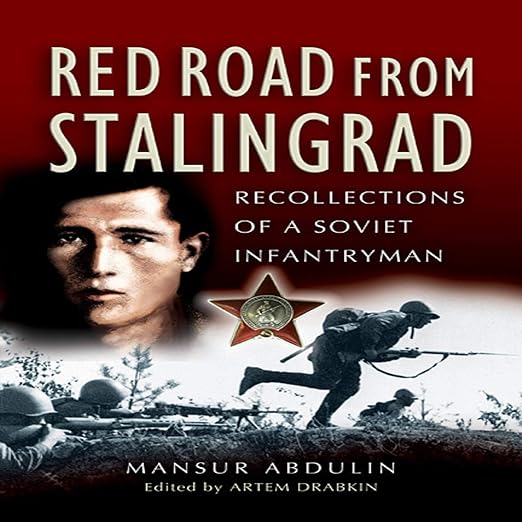
There is a specific problem with how most English-language readers understand the Eastern Front in World War II. The scale is represented but the experience is not. We learn the casualty figures for Stalingrad, for Kursk, for the crossing of the Dnieper, and the numbers are large enough to lose their meaning. What tends to be missing is the close-up view: what it felt like to be inside those numbers, in the mud, in the cold, with a rifle and a position to hold and orders that arrived too late or not at all. Mansur Abdulin’s Red Road from Stalingrad is one of the very few books that fills that gap from the Soviet side, and it does so with a plainness and humanity that more carefully crafted narratives often fail to achieve.
Abdulin was born in 1923 and fought as a frontline Red Army infantryman at Stalingrad, Kursk, and on the banks of the Dnieper. He survived the war and wrote his memoirs with what reviewer DACHokie described as a void of firsthand Soviet soldier accounts in Western literature being partially filled by this work. That reviewer is right that the gap is real. Most of the canonical English-language infantry memoirs from the Second World War are German, American, or British. Russian soldiers wrote about their experience, but relatively little of that writing has been translated and published for Western audiences. Abdulin’s book is a genuine contribution to that small body of work.
The Ground-Level View Pohl’s Strategy Cannot Provide
What makes Abdulin’s account valuable is not strategic insight, which he readily acknowledges he does not have. He is a private soldier who sees his immediate sector and the men around him. What he describes is the texture of combat: the specific fear of a particular moment, the physical reality of moving forward under fire, the sometimes absurd details of army organization that soldiers everywhere have always mocked. Reviewer James E. Egolf noted that Abdulin’s book contains amusing anecdotes of humor and wit alongside the carnage, and that tonal range is part of what makes it feel true rather than performed. People under extreme pressure do not stop noticing the ridiculous. Abdulin’s narrative remembers that.
The sections covering Stalingrad are the most intense. Abdulin describes what combat was like on the ground, face-to-face with an enemy who was skilled, deadly, and increasingly desperate. He writes about casualties with a directness that avoids both sentimentality and the kind of numbing enumeration that strategic histories can fall into. Each death he records was a person he knew, and the weight of that specificity accumulates over the course of the book in ways that statistics cannot replicate.
The Humanity That Persists
Reviewer I Say Moo, writing from the United Kingdom, observed that the author’s humanity and decency pervade through the text, making this book not only an interesting read for history buffs, but also an inspiring lesson. That is a precise observation. Abdulin does not write like someone performing heroism or justifying ideology. He writes like someone trying to recall, as honestly as possible, what happened and what it cost. His father, a Communist Party member with a strong sense of fair play, appears briefly in the memoir’s opening, and that background gives context to Abdulin’s own ethical sensibility without turning the book into a political document.
Reviewer andrea hutchinson noted that the guy did some crazy things and is modest to a fault about it. That modesty is one of the memoir’s most distinctive qualities. Abdulin does not claim more than he knows or more credit than he believes he is due. He describes acts of courage and moments of fear with equal plainness, and the effect is a portrait of an ordinary man inside extraordinary circumstances rather than a hero retrospectively assembled.
Alex Hyde-White and the Translation Challenge
Hyde-White’s narration handles a particular difficulty that memoirs in translation present: maintaining the voice of the original author through someone else’s prose. The English version of Abdulin’s memoirs carries his sensibility but in translated language, and Hyde-White reads with a composed, slightly formal register that suits the material well. He does not attempt a Russian accent or any theatrical approximation of Soviet military speech. He simply reads Abdulin’s words with care and respect. Reviewer andrea hutchinson mentioned that the editor adds metric-to-English conversions for every reference, which can be distracting in audio; Hyde-White reads these insertions without interrupting the narrative flow, which is about the best you can do with them. The nearly nine-hour runtime is appropriate for the scope of the material.
Who This Is For and Why It Matters
If you have spent time with the English-language Eastern Front canon, Sebastian Faulks or Antony Beevor or Max Hastings, Abdulin’s memoir offers the corrective of the person who was actually there. It is not comprehensive. It is not strategic. It is one man’s account of a war that consumed tens of millions of people, and it carries the specific value of authenticity that no secondary source can replicate.
Skip it if you are looking for a broad operational history or a narrative that covers the entire Eastern Front. Come to it for what it uniquely provides: the uncommon experience of understanding one Soviet soldier’s war from inside his skin, with all the limitation and illumination that specificity brings.
Frequently Asked Questions
Is Red Road from Stalingrad suitable for listeners with no prior knowledge of the Eastern Front?
The publisher provides editorial notes that contextualize Abdulin’s personal experience within the broader strategic picture, which helps orient listeners who are approaching this history for the first time. That said, readers who already know the shape of the Stalingrad and Kursk campaigns will have a richer appreciation for what Abdulin’s close-up account adds.
How does this memoir compare to Guy Sajer’s The Forgotten Soldier, another frontline Eastern Front account?
Sajer’s book covers the German side and is written with a more literary, emotionally intense style. Abdulin’s account is plainer and more modest in register, which some readers prefer as it feels more documentary. Reviewer andrea hutchinson described Sajer as having greater depth and emotion, though she found Abdulin’s account still good and worthwhile.
Does the book deal with Soviet military ideology or the political dimension of the Red Army’s experience?
Abdulin mentions his father’s Communist Party membership and the ideological context of the war, but he does not write as a propagandist or an ideological commentator. The book’s focus is on the physical and human experience of infantry combat rather than political justification.
Are there moments of humor or lightness in an otherwise brutal account?
Yes, and they are not forced. Abdulin describes absurdities of army organization, moments of unexpected camaraderie, and the dark humor soldiers use to process impossible circumstances. Several reviewers specifically noted this tonal range as one of the memoir’s distinguishing qualities.