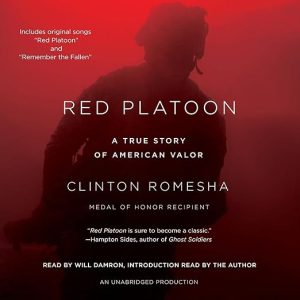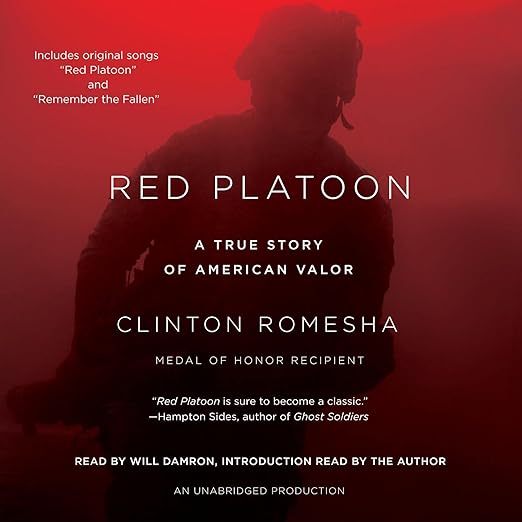
Red Platoon is Clinton Romesha's own account of the thirteen-hour firefight at Combat Outpost Keating, and this audiobook, read by Will Damron rather than by Romesha himself, runs 12 hours and 28 minutes covering the battle that earned him the Medal of Honor.
It Doesn't Get Better, the Book Opens
In 2009, the Black Knight Troop, Romesha's unit, was preparing to shut down Command Outpost Keating, the most remote and inaccessible in a string of bases the U.S. military had built across Nuristan and Kunar to slow Taliban movement between Afghanistan and Pakistan. The Army had already concluded what soldiers on the ground had known for years: the position was too isolated and too dangerous to hold. On October 3, 2009, after years of smaller attacks, the Taliban committed everything to Keating at once, and the fourteen-hour battle that followed cost eight men their lives before Romesha's unit drove the attackers back beyond the wire. The book's opening line sets the tone for everything after it: "'It doesn't get better.'"
Its single most compelling piece of context does not come from Romesha at all. It comes from a reviewer identified as D.M., who taught history at West Point, served 24 years on active duty, has published a book of their own, and estimates having read more than a thousand military memoirs over roughly fifty years. That reviewer calls this the most "powerful, gripping, and vivid" account they have ever encountered, a genuinely unusual level of comparative authority for an audiobook review to carry.
Two Original Songs and a Firearms Company
Its synopsis positions the book explicitly "for readers of Black Hawk Down by Mark Bowden and Lone Survivor by Marcus Luttrell," a comparison the reviews back up rather than undercut. TEC's review praises how directly the narrative pulls a reader into "the battle scenes and the many, many acts of valor" without softening the material, and that directness is exactly what the genre's best entries share: firsthand testimony over analysis, specific soldiers and specific decisions over abstraction rather than a wide-angle strategic summary handed down from headquarters.
D.M.'s review is worth returning to a second time for how specifically it locates what makes this account stand apart from the shelf of memoirs it is being measured against. That reviewer describes the narrative structure itself as unusually strong, built with "personal depth, fluidity, and originality of presentation," a description that suggests Romesha's account avoids the flattened, after-action-report tone that can make even genuinely harrowing combat memoirs read as procedural rather than personal.
The audiobook edition carries an unusual bonus most military memoirs do not: two original songs, "Red Platoon" and "Remember the Fallen," performed by Michael Connors, credited to a small group of writers that includes Romesha himself alongside Jim Kinsey, Mike Hartnett, James Breedwell, and Billy Dawson. Nemo Arms is listed as executive producer, a firearms company backing the production, which is worth naming plainly as a data point about who financed this specific release rather than something to editorialize about.
Super sport's five-star review captures the emotional register most reviewers land on: hard to put down, written "with a sense of humor, along with heart, wrenching sadness," closing with a direct salute to the young men who died. Ron G's review adds a simpler, blunter endorsement, calling it a book that gave "a whole new perspective on what our servicemen and women go through."
Long Winded, Yet His Heart Goes Out
Victor Stark's four-star review is the lone dissent among the visible ratings, calling the book "long winded at times" even while still recommending it, and closing with a note that "my heart goes out to the lives lost" regardless of the pacing complaint. Weighed against four other five-star reviews, including D.M.'s extraordinarily well-read endorsement, this reads as a minor pacing note rather than a structural problem, but it is worth flagging for listeners who generally prefer tighter, leaner combat narratives over one that takes its time setting up years of context before the battle itself arrives.
This is unflinching material by design: an active firefight described in detail, eight confirmed deaths, and the psychological weight of survivors who kept fighting anyway once the outcome was already in doubt. Nothing in the visible reviews suggests the book softens any of it for a general audience, so listeners newer to war memoirs than D.M. or TEC should go in with that expectation already set correctly rather than discovering it mid-listen.
Nemo Arms as executive producer is a detail worth sitting with rather than skating past, since it is not the kind of backing most audiobook listings advertise. It does not change the content of Romesha's own testimony, which the reviews describe as detailed and specific rather than promotional, but a listener who cares about who funds the media they consume should know it going in rather than discovering it afterward.
Songs That Exist Only in the Audiobook
Military history and memoir readers, especially fans of Black Hawk Down or Lone Survivor looking for a comparable firsthand account, will find exactly what they want here, and D.M.'s review alone, coming from someone who has read roughly a thousand entries in this exact genre over five decades, is a strong enough endorsement on its own to move a skeptical listener toward giving it a chance.
Listeners drawn to the two original songs included in this edition, or curious about how a modern battle account translates into music alongside prose, add another reason to choose the audio format specifically over the print edition, since that bonus material only exists here.
Skip it if unfiltered combat memoir material is not something you want sitting in your ears for twelve-plus hours, or if Victor Stark's "long winded" complaint about pacing is enough on its own to steer you toward a shorter, more compressed account of the same war instead.
Before You Listen
Does Clinton Romesha narrate this audiobook himself?
No. Red Platoon is narrated by Will Damron, not by Romesha. The account is still entirely his own firsthand story of the Battle of Keating, but the reading voice belongs to a professional narrator rather than to the author himself, unlike some memoirs in this genre.
How long is the Red Platoon audiobook?
The audiobook runs 12 hours and 28 minutes, covering the full account of Combat Outpost Keating and the events leading up to the October 2009 battle. Reviewers describe the pacing as gripping throughout, with one dissenting note calling parts long winded.
Does the Red Platoon audiobook include any bonus audio content?
Yes. This edition includes two original songs, 'Red Platoon' and 'Remember the Fallen,' performed by Michael Connors and co-written in part by Romesha himself, an unusual addition for a military memoir audiobook that a print edition simply cannot offer a reader.