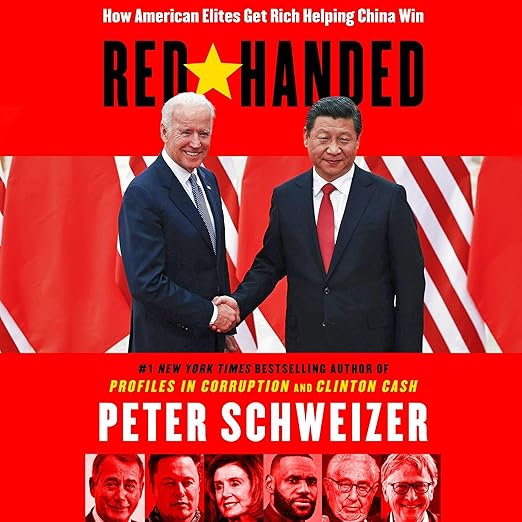
In Brief
- Narration: Charles Constant reads with clean authority, measured and clear, which prevents the material from tipping into outrage theater.
- Themes: Chinese influence operations, elite corruption, geopolitical power
- Mood: Alarming and prosecutorial, with a cumulative weight
- Verdict: Whether you agree with Schweizer's politics or not, the documented financial relationships he uncovers here are worth knowing about.
I listened to Red-Handed across a long weekend, partly because the chapters kept ending on disclosures that made it difficult to put down and partly because I felt a responsibility to hear it out before forming a view. Peter Schweizer is a polarizing figure. His previous books, Clinton Cash and Profiles in Corruption, attracted both serious praise for their research and serious criticism for their political deployment. He goes out of his way in this book to note that bad actors appear on both ends of the spectrum, and the chapters bear that out, covering Republican-aligned figures alongside Biden family members and Silicon Valley executives with strong ties to Democratic circles.
The central argument of Red-Handed is that the Chinese government has found in American elites willing partners, not merely targets. The distinction matters. Schweizer is not describing covert infiltration in the traditional spy-thriller sense. He is describing something arguably more alarming: a class of American politicians, financiers, academics, and athletes who have entered into financial relationships with Chinese state-linked entities and who have, in some cases, subsequently adopted positions favorable to Chinese government interests. His team spent over a year on corporate records and legal filings across multiple jurisdictions to assemble the documentation.
Where This One Lands
The quality of the research is the book's strongest asset. Schweizer's team works from primary sources, corporate registrations, financial disclosures, lobbying records, legal filings, and the footnote apparatus, reportedly running to 89 pages, grounds the claims in verifiable documentation rather than anonymous sourcing. One reviewer notes that the book functions as a reference as much as a read: usable as an index to look up names as they appear in current news cycles. That is not a bad description of what Schweizer has built here.
The most unsettling material concerns not the obvious suspects but the institutional patterns. The sections on Ivy League universities, on the defense contractor class, and on retired military officers moving into paid advisory roles for Chinese state entities suggest a systemic problem that extends well beyond any individual family or politician. Schweizer's framing of this as bipartisan corruption is, on the evidence he presents, defensible.
Why Listen to Red-Handed
Charles Constant's narration keeps the temperature controlled, which is important. This is the kind of material that invites a narrator to lean into outrage, and Constant resists that temptation consistently. He reads the financial disclosures and the corporate relationship charts with the same careful neutrality he brings to the more explicitly damning passages, and that restraint serves the book's credibility. The audiobook runs just under eight hours, which is appropriately compact for the amount of ground it covers.
The bipartisan framing is worth noting for listeners who might approach with skepticism about Schweizer's political orientation. The chapters on Republican figures, including Bush family members and defense-adjacent officials, are not perfunctory. They receive the same forensic treatment as the chapters on Democratic targets. One reviewer summarizes it bluntly: it does not matter which side of the aisle you come from, they all are taking cash from China. That is the book's conclusion, supported by documented transactions rather than inference.
What Gives Us Pause
The book does not attempt to explain why these financial relationships translated into policy positions, it documents that they exist and notes the temporal correlation with favorable statements or actions. Readers who want causal mechanisms fully established will find the book frustrating. Schweizer presents patterns and lets readers draw conclusions, which is both a methodological choice and a limitation.
The sections on Silicon Valley are particularly dense with corporate entity names and investment round structures. Listeners may find it helpful to treat those chapters as reference material rather than narrative, returning to specific sections as relevant names appear in news coverage.
Should You Listen to Red-Handed?
This is for readers who want the documented financial record of American elite engagement with Chinese state-linked entities, without ideological filtering. It is useful for anyone tracking US-China policy debates, corporate governance, or the academic freedom debate around Confucius Institutes. Listeners who require fully established causal arguments, or who are unwilling to engage with research produced by a conservative-aligned institution, will likely not find this satisfying.
Before You Listen
Is Red-Handed genuinely bipartisan in its criticism, or does it favor one political side?
Schweizer explicitly covers figures from both parties, including Bush family members and Republican-aligned defense officials alongside Democratic politicians. The preponderance of named Democratic figures reflects, per Schweizer, which administration's financial records were most accessible. Listeners will need to evaluate that claim for themselves.
How does Schweizer's sourcing in Red-Handed compare to his earlier books like Clinton Cash?
Red-Handed is built primarily on corporate registrations, legal filings, and financial disclosures rather than anonymous sources, which makes its claims more directly verifiable. The 89-page footnote apparatus is the strongest version of Schweizer's methodology to date.
Does Charles Constant's narration handle the density of corporate and financial terminology well?
Yes. Constant reads with precision rather than performance, which suits material that frequently involves entity names, investment structures, and regulatory terminology. He does not editorialize, which keeps the focus on the documented record.
Can Red-Handed be read as a stand-alone, or does it require familiarity with Schweizer's earlier books?
Fully stand-alone. The research here is distinct from Profiles in Corruption or Clinton Cash, and Schweizer provides enough context for each case that no prior reading is necessary.