Quick Take
- Narration: Susan Hanfield handles the devotional and reflective passages with sensitivity, composed and warm without overselling the spiritual content.
- Themes: Christian life transitions, midlife calling, intentional purpose beyond career
- Mood: Reflective and gently challenging, grounded in faith throughout
- Verdict: A thoughtful, toolkit-rich guide for Christian listeners navigating the shift from career-defined identity to a deeper sense of vocation.
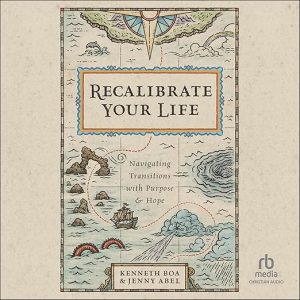
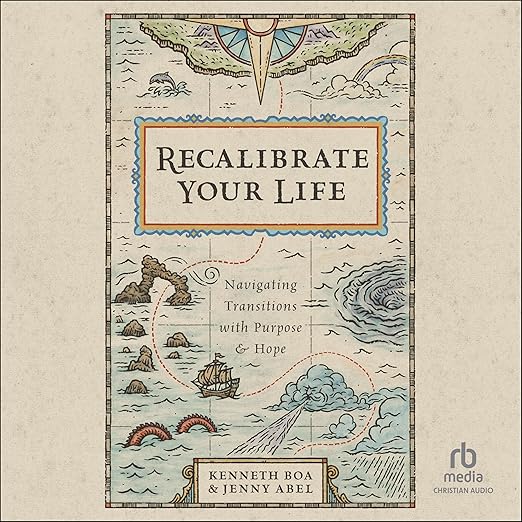
I finished the last section of this one on a Thursday evening, and I spent the next half hour just sitting with the question it closes on: what would it look like for the best to genuinely still be ahead? Not as an inspirational platitude, but as a seriously examined possibility. Ken Boa and Jenny Abel are not writing for people in crisis. They are writing for people who have built something and are starting to wonder what building was for, and whether the next stage requires a different kind of architecture entirely.
Recalibrate Your Life opens with an honest acknowledgment that living well does not happen automatically, not for anyone, but particularly not for followers of Christ who have spent decades in demanding careers and are now approaching or entering the transition out of them. The book’s core argument is that transition moments, especially in midlife and later life, are not disruptions to be managed but opportunities to recalibrate: to examine priorities, gifts, and calling with fresh eyes and updated maps.
The Toolkit of Eighteen Instruments
The book’s practical centerpiece is what reviewer D. Wood calls the toolkit, eighteen distinct assessment and reflection exercises that Boa and Abel use to help listeners identify what they actually have to offer in the next season of their lives. These range from traditional spiritual disciplines like examining God-given gifts and talents through the lens of scripture, to more practical inventories of knowledge, skills, experience, and relational capital. Reviewer D. Wood notes that you will revisit this gem in the years and seasons to come, a description that reflects how the material functions: not as a one-time read but as a recurring reference for ongoing recalibration.
The toolkit format is well-suited to audio in some respects and less well-suited in others. Boa and Abel have clearly structured the exercises so that they can be engaged with through listening and reflection, and Hanfield’s pacing gives space for the questions to land before moving forward. That said, listeners who want to actively fill out responses or take structured notes will benefit from having a notebook alongside the audio, as some of the exercises invite specific written reflection rather than internal processing alone.
The Shift from Demands to Calling
The conceptual move that gives the book its distinctiveness is the distinction Boa draws between career and calling. Career is described as predominantly responsive to external demands, what the market wants, what the organization requires, what provides financial security. Calling is framed as the unique configuration of gifts, experience, and divine purpose that each person carries and that does not expire when a career does. The midlife or retirement transition, in this framework, is not a conclusion but a promotion: movement from a phase shaped largely by demand into a phase where the question of what you were uniquely made to do and contribute can finally be answered with fewer external constraints.
This framing will resonate deeply with readers for whom faith is a genuine organizing principle rather than a decorative backdrop, and it will feel thin or alien to secular listeners. Boa is a theologian and spiritual director, and the book’s biblical integration is thorough, not in a way that requires the listener to share specific doctrinal commitments, but in a way that assumes faith as the primary lens through which purpose and meaning are understood. Reviewer Michael Philliber’s reflection on his own two retirements at sixty-two is a good illustration of the book’s intended audience: someone with decades of achievement behind them and genuine uncertainty about what the next chapter is for.
Recalibration Across Life Stages
One of the book’s more ambitious claims is that the recalibration process it describes is not a one-time event but a recurring practice applicable across multiple transitions, not only retirement but also career shifts, empty nesting, health changes, and the ordinary passage between decades. Reviewer D. Wood’s note that the book invites revisiting in different seasons validates this claim. Boa and Abel include enough structural variety in the eighteen instruments that different exercises will carry different weight at different life stages, which gives the book longer shelf life than a single-phase guide would have.
Susan Hanfield’s narration serves the material well throughout. She navigates the theological passages and the practical assessment sections with equal composure, and her voice has a quality of settled maturity that is appropriate for content aimed at listeners in the second half of life. At nine and a half hours, this is a substantial listen that rewards a slower pace, an hour at a time rather than marathon sessions, with space between chapters for the reflection the content invites.
Who Should Listen, Who Should Skip
This is a book for Christian listeners approaching retirement, post-career transition, or significant midlife reorientation who want a structured, theologically grounded framework for thinking about purpose and calling in the next season. It is also well-suited to anyone who has found secular transition literature insufficient because it leaves out the dimension of divine calling and eternal perspective.
Skip it if you are secular or if faith is incidental rather than central to how you understand your life and purpose. The book does not work on purely pragmatic terms, the theological framework is load-bearing rather than decorative, and removing it would leave little of the structure intact. Secular readers would be better served by purpose-focused transition literature that works within a different frame.
Frequently Asked Questions
Do you need to be approaching retirement for this book to be useful, or does it apply to midlife transitions more broadly?
Boa and Abel explicitly address multiple transition types, midlife career shifts, retirement, empty nesting, health changes, and frame recalibration as a recurring practice across life stages rather than a one-time late-career exercise. The retirement context is prominent, but the framework has broader applicability.
How practically focused are the eighteen toolkit exercises, can they be done while listening, or do they require separate written work?
Some exercises can be done through listening and internal reflection, while others invite written responses. Having a notebook alongside the audio is recommended if you intend to engage fully with the assessments rather than just absorbing the framework conceptually.
How explicitly Christian is the content, does it assume a particular denominational tradition?
The faith integration is thorough and assumes Christianity as the primary framework, but it does not appear to presuppose specific denominational commitments. Reviewer Michael Taylor’s praise mentions topics including making God and other people important in your life, which reflects the broadly evangelical Protestant orientation of Boa’s other work.
Does Susan Hanfield’s narration handle both the devotional and the more practical assessment sections effectively?
Yes. Hanfield maintains a consistent tone that suits both registers, she does not dramatize the spiritual passages or turn clinical when the content becomes practical. Her pacing is well-judged for material that invites reflection, giving listeners time to engage rather than simply receive information.