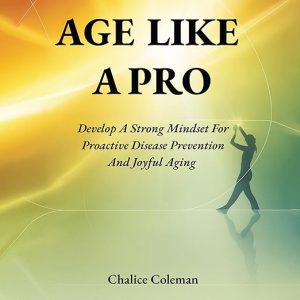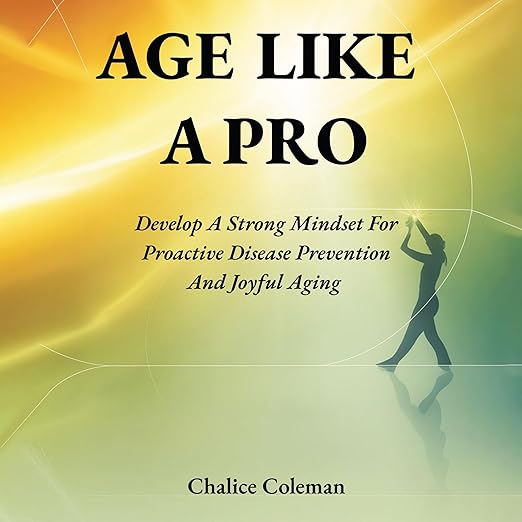
Longevity books usually arrive with one mechanism attached, a single diet or supplement or protocol, and this audiobook does something less fashionable. It lists six things and insists that all six matter. Movement, nutrition, sleep, connection, dental health, and purpose. Five of those appear on every list of their kind. The sixth does not, and the decision to seat teeth beside sleep and friendship is the most interesting choice Chalice Coleman makes across five hours and forty-six minutes.
Dental Health Joins Five Familiar Longevity Pillars
Coleman's framing arrives in the opening line and repeats throughout: aging well is not luck, it is a choice you can make starting today. The claim has an obvious failure mode, since a great deal of decline is chosen by nobody, and the book stays close enough to that edge to be worth watching. What it promises is not immunity but direction, described as small, realistic daily choices that build strength, protect the mind, and lower disease risk at any age. That last qualifier does an enormous amount of work, and it is what keeps the argument usable rather than punitive.
Practice is where the column lands. A January 2026 five-star pins down how the approach feels, calling the strategies genuinely helpful for navigating the aging process and singling out a personal approach that treats mental, physical, and spiritual ingredients as one system instead of three. That is an accurate reading of the structure. The six pillars never function as a menu you pick from; they behave like legs of the same table, which is precisely why dental health can sit beside purpose without the book pausing to justify itself.
Seradwyn's Reading Comes With a Companion PDF
Blue Zones material is what most listeners will recognize on arrival, and Coleman puts it to work as evidence rather than as scenery. Lessons taken from populations that live longer and better get folded into the same six-pillar frame instead of standing apart as a chapter of admiring anecdotes. That is the right use of it. Longevity research becomes considerably more useful when somebody translates it into what a person could plausibly do this week, and translation is the labor most books in this category skip.
Five hours and forty-six minutes is a manageable ask for a book you are supposed to act on, and the length supports the repeat listening this material actually needs. A five-star calls it a road map for living a healthy, full life as we mature, notes that it is written for all ages rather than for the already retired, and lands on the phrase that best catches the tone: you are in the driver seat, holding every tool you need. Encouragement without flattery is a hard register to hit, and that response suggests the book hits it.
A companion PDF travels with the audio, which the description states plainly, and for this kind of book that detail carries real weight. Six pillars, a set of mindset shifts, and a stack of practical guidance all want to exist somewhere you can return to, and spoken audio is a poor container for a checklist. Knowing the document is included changes the arithmetic of the purchase: listen straight through once for the argument, then keep the file open for the parts you actually intend to use.
Publisher Field Just Names the Book's Author
Familiarity is the honest caveat, and it surfaces from inside the praise. A February 2026 five-star says the author comes across as somebody speaking directly to you, describes the material as easy to take in with nothing pitched over anybody's head, and then concedes the point that counts: a lot of this has been heard before, and hearing it again from a different angle does no harm. Both halves are correct. Anyone who has read widely in this category will meet very little that is new, and the value on offer is arrangement and tone rather than discovery.
Provenance is the second thing to weigh. The publisher field on this record carries the author's own name, which makes this a self-published title standing outside the editorial checks a trade imprint would apply. The copy promises clear, science-backed guidance, and that is a sentence a publisher writes rather than a bibliography you can follow. Nothing about the record suggests bad faith, and plenty of self-published health writing is careful. It does mean the work of verification has quietly been handed to you.
Timing is the last thing worth checking. All five written responses on this record were filed before the audio edition appeared in March 2026, some of them nearly two months earlier, so the 4.9 average across twenty-four grades belongs to the text rather than to the recording. Every entry talks about reading. Not one talks about listening. Anyone weighing the audio specifically is buying from a page that has been enthusiastically reviewed in a different format.
Front-Edge Listeners Worried About Independence and Memory
Listeners standing at the front edge of a health decision are the core audience: the listener worried about losing independence, worried about memory, or simply worn down by advice that contradicts itself every week. One of the five-stars captures what a book like this does when it works, reporting that a daughter read it next and a mother after that. Titles that circulate inside a family are almost always titles that avoid shaming anybody, and this one appears to manage that trick.
Specialists and skeptics should look elsewhere without hesitation. Anyone wanting trial data, mechanisms, and references will find the standard of proof far too light, and anyone already three books deep in longevity research will recognize most of the terrain on sight. Somebody who has read nothing at all, or read everything and acted on none of it, will get the entire picture here in one pass, from an argument built end to end on small choices.
The Short Version
- Read by: Suzenne Seradwyn holds the reader credit on a self-published title whose written column was filed before the recording existed
- At its heart: Six pillars of active aging, Blue Zones lessons brought home, mindset ahead of mechanism
- Vibe: Encouraging and practical, closer to a coach than a clinician
- Short version: Almost nothing here is new, and the arrangement is good enough that it barely matters.
Good to Know
Does the audiobook cover brain health specifically, or only physical fitness?
Brain health has its own strand. Protecting cognitive function and slowing decline is one of the stated learning objectives, sitting beside lowering the risk of the major diseases of aging. The treatment stays at the level of daily habit rather than clinical intervention, which is consistent with how the rest of the book operates.
Is this audiobook aimed at people who have already retired?
No, and it says so repeatedly. The pitch is explicitly any age, and the copy names three situations it expects to find you in: busy, caring for somebody else, or starting fresh. The framing assumes a listener with decades still to allocate rather than one auditing what is left.