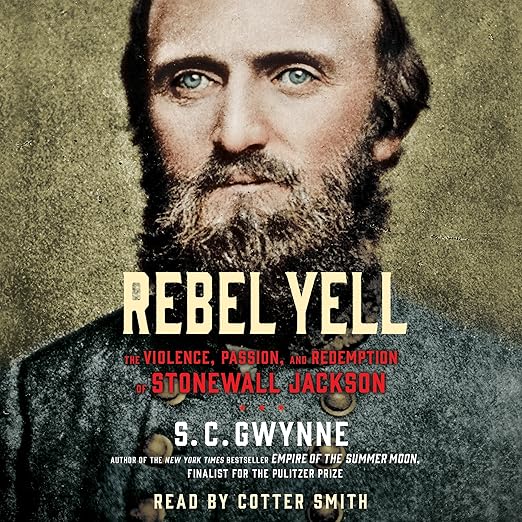
Stonewall Jackson earns a rare thing in Rebel Yell: a biography willing to hold both his brilliance and his myth up to real scrutiny without collapsing into either hagiography or takedown. S.C. Gwynne, who also wrote the Pulitzer-finalist Empire of the Summer Moon, spends nearly 25 hours in this audiobook tracing exactly 24 months, April 1862 to May 1863, when an obscure Confederate general became one of the most famous military minds in the Western world.
I came to this with a general sense of Jackson as a Civil War name attached to a highway exit sign, and left with something much more specific: an understanding of exactly how strange and driven a person he actually was. Gwynne does not let the legend do the work for him.
The Myth the Postwar South Needed Him to Become
Gwynne's real subject is the gap between Stonewall Jackson the tactical innovator and Stonewall Jackson the myth the postwar South needed him to become, what the synopsis itself calls the romantic Southern notion of the virtuous lost cause. Gwynne treats that mythology as something to examine, not repeat, tracing how a genuinely brilliant, deeply strange man got flattened into a symbol almost immediately after his death.
The military detail is dense, Gwynne walks through the 1862 Valley Campaign in real tactical depth, but Cotter Smith's narration keeps the human throughline audible underneath the troop movements. Smith, whose earlier audiobook credits I could not track down, favors a measured, unhurried delivery that treats both the strategy and the personal material, Jackson's odd private habits, his religious intensity, with the same careful attention.
Gwynne is careful to render Jackson's religious devotion as central rather than incidental, constant prayer, deep interpretation of battlefield success as divine favor, a faith that shaped his command decisions directly. Understanding that all-consuming devoutness is essential to understanding his decision-making, and Gwynne treats it as a serious biographical fact rather than a curious footnote.
The Plain Facts Carry Their Own Weight
Cotter Smith's pronunciation of the dense roster of Confederate and Union officers throughout stays consistent across the full runtime, a small but real technical achievement given how many names this kind of military history requires listeners to track.
Jackson's death itself, shot accidentally by his own men at Chancellorsville in May 1863, is one of the war's most famous ironies, and Gwynne resists the temptation to over-dramatize it, letting the plain facts of a friendly-fire wound and a slow decline from pneumonia carry their own weight rather than reaching for tragic grandeur the moment does not need.
The Awkward Cadet Nicknamed Tom Fool
Reviewer Jill S. described going in expecting insight into a Civil War general and coming away having learned about a nation instead, its soldiers, its sacrifice, and what she calls Jackson's deeply admirable character. That expansion from single-subject biography to something closer to a portrait of a country at war is exactly what a 25-hour runtime allows Gwynne to build.
Reviewer Kate made a point worth repeating for anyone hesitant about a long Civil War biography: this works equally well for committed history buffs and for listeners unfamiliar with the details of Jackson's life, since Gwynne, per Kate's review, writes with enough narrative drive that the book reads like a novel despite being thoroughly researched.
The book was a finalist for the National Book Critics Circle Award, and that recognition tracks with what the audiobook delivers: real scholarly rigor married to genuine narrative momentum, rare enough in Civil War history that it is worth calling out specifically.
The book also spends real time on Jackson's pre-war life as an awkward, sickly, orphaned cadet at West Point and later as an unpopular artillery instructor at Virginia Military Institute, nicknamed Tom Fool by his students. That unpromising beginning makes his sudden wartime transformation into a feared commander even more striking, and Gwynne uses it to undercut any sense that greatness was inevitable.
Appearing From Nowhere, Then Suddenly Vanishing
At nearly 25 hours, this is a serious time investment, and Gwynne does not rush toward Jackson's death at Chancellorsville, choosing instead to sit with the buildup, the campaigns, and the surrounding political context in full. Listeners wanting a compact overview should look elsewhere.
Reviewer Stone Dog's description of Jackson appearing out of nowhere to shine brightly and then suddenly vanishing captures the book's emotional shape well, but also signals what it is not: a broad survey of the entire Civil War. This is a tightly focused character study of one general's rise and fall, with the wider war as backdrop rather than subject.
Listeners already familiar with James I. Robertson's earlier, even longer Jackson biography will find Gwynne's approach brisker and more narrative-driven, prioritizing momentum over exhaustive documentation, a meaningful difference for anyone choosing between the two.
Cotter Smith Makes 25 Hours Feel Earned
This audiobook is built for Civil War readers and for anyone drawn to biography that treats its subject's legend as something to investigate rather than celebrate uncritically. Fans of Gwynne's Empire of the Summer Moon already know what to expect from his prose, and Rebel Yell delivers the same rigor applied to a very different subject.
Skip it if you want a single-volume overview of the entire war rather than one general's specific, intensely detailed story, or if 25 hours feels like more time than you want to spend with Confederate military history specifically. For everyone else, Cotter Smith's steady narration makes the length feel earned rather than padded.
Roughly a Third of the Book Is the Valley Campaign
This is also a strong choice for listeners specifically interested in the 1862 Shenandoah Valley Campaign as a standalone subject, since Gwynne's account of it, roughly a third of the book, stands as one of the clearer single-source explanations of that campaign's tactics available in narrative nonfiction.
Gwynne also wrote Hymns of the Republic, covering the war's final year, and listeners who find his approach to Rebel Yell compelling have a natural next audiobook already waiting in his catalog, covering adjacent Civil War territory with the same narrative-driven method.