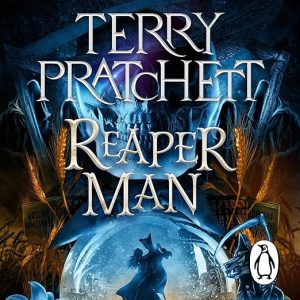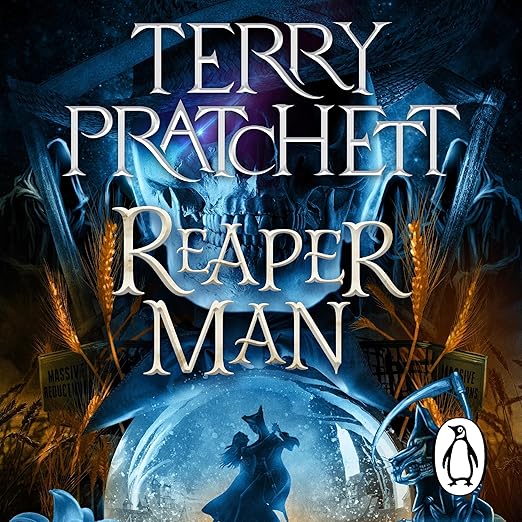
Reaper Man is the Discworld audiobook where Terry Pratchett asks what happens when Death gets fired. Not metaphorically - the Auditors of Reality have determined that Death has developed a personality, which constitutes a form of professional negligence in their accounting, and so he is summarily dismissed, sent to live as a mortal among the people he has been collecting, and replaced. The production decision for this audiobook edition matches the material exactly: Sian Clifford narrates, Bill Nighy reads the footnotes, and Peter Serafinowicz voices Death. This is not a modest casting choice, and it pays off completely.
The eleventh Discworld novel and second in the Death sub-series, Reaper Man sits in an interesting position within Pratchett's larger project. It's a book about what it means to be mortal, written by an author who would later face his own mortality with extraordinary public honesty and grace. Pratchett gives Death - who takes a new name, Bill Door, and begins working as a farmhand with his scythe already conveniently in hand - an inner life built from observation and accumulation. The character has been watching humans his entire existence without being one of them, and now he's living among them, and the gap between his enormous knowledge and his complete inexperience creates comedy of a particular quality: warm, genuinely funny, and haunted by something the book never quite names directly.
Reviewer Bruce Kendall describes Reaper Man as his introduction to Pratchett, and notes that he immediately ordered four more novels upon finishing it - which is about as useful a testimony to a first Discworld experience as exists. The novel works as a standalone, but it also carries the depth of the Death sub-series arc begun in Mort, and returning listeners will feel the character's development across both books in a way new arrivals won't. Either way, the combination of comic set-piece and genuine feeling that Pratchett achieves in the farmhand sections is exceptional even by his standards.
Why Listen to Reaper Man
The production design of this audiobook is worth examining seriously as a creative choice. Pratchett's footnotes in the Discworld novels are part of the intellectual architecture, not decorative asides - they often contain the actual philosophical payload that the main text circles around obliquely. Giving them to Bill Nighy adds a layer of tonal authority they can't easily carry in a single-narrator format. Nighy's specific quality of wry, layered delivery - the sense of someone who has considered what he's saying and still finds it worth saying - means the footnotes land as they're intended: as parallel commentary that enriches rather than interrupts the main narrative.
Serafinowicz as Death is equally well-judged. His voice carries contained gravitas tempered by comic timing that suits Death's arc across this specific novel, which moves from the inhuman certainty of an anthropomorphic force toward something resembling attachment and, ultimately, something resembling loss. The character's development from pure function to felt personhood is the emotional engine of Reaper Man, and Serafinowicz communicates each stage of that development without overplaying it. Clifford leads the production with the BAFTA-level craft you'd expect, and she handles the Ankh-Morpork subplot - involving undead energy building up in the city because the replacement Death is completely inadequate - with the broad comic precision that subplot requires.
What to Watch For in Reaper Man
Reaper Man runs two narrative tracks simultaneously: the Death-as-farmhand story, which is quieter and more formally beautiful, and the Ankh-Morpork undead-energy story, which is notably more chaotic and broader in its comedy. These tracks move at different paces and in different registers, and the contrast between them is deliberate - Pratchett is exploring the same theme from opposite ends of the emotional spectrum simultaneously. Some listeners respond more warmly to one thread than the other; reviewer Christopher M. notes Pratchett's "humor, empathy for, and understanding of the human condition" shine throughout, which suggests the tonal difference between threads doesn't undermine the novel's coherence.
The Discworld novels are explicitly designed to be accessible in any order, and Reaper Man works as a standalone listen with full internal coherence. That said, the Death sub-series has an internal arc that builds across Mort, Reaper Man, Soul Music, and Hogfather, and the character's relationships in later books are richer with this novel's experience behind them. First-time Pratchett listeners can begin here without confusion, but Mort makes a slightly more conventional introduction to the Death character and his particular corner of the Discworld.
Who Should Listen to Reaper Man
Pratchett readers who have been waiting for the right audiobook edition of this novel will find this full-cast production the definitive one to commit to. The Discworld audio catalog has grown substantially, and the newer full-cast productions represent a different listening proposition than single-narrator readings - they suit certain novels better than others, and Reaper Man, with its multiple distinct vocal characters and the Death-footnotes structural feature, benefits from the ensemble format more than most.
Listeners new to Discworld who want to enter through the Death sub-series can begin here or with Mort; both work as entry points. Anyone who has already encountered Serafinowicz's Death in earlier full-cast Discworld productions will find his return in Reaper Man an immediate pleasure, and the novel's treatment of Death's developing inner life is the most emotionally rich of the sub-series. Reviewer Kendall's response - immediate acquisition of four more Pratchett novels - remains the most useful metric available for what this book does to readers encountering it for the first time.
Common Questions
Is the Reaper Man audiobook accessible to first-time Discworld listeners?
Yes - Pratchett designed the series to be entered at any point, and Reaper Man establishes what you need within its opening sections. However, the Death sub-series is richest when started with Mort, which introduces the character before Reaper Man develops him further.
Does the full-cast format of this audiobook improve the Reaper Man experience significantly?
Substantially. Pratchett's footnotes are structural elements, not decorative ones, and Bill Nighy delivering them adds tonal authority they can't carry in standard narration. Serafinowicz as Death is specifically well-cast in ways that amplify the character's arc across this novel's emotional journey.