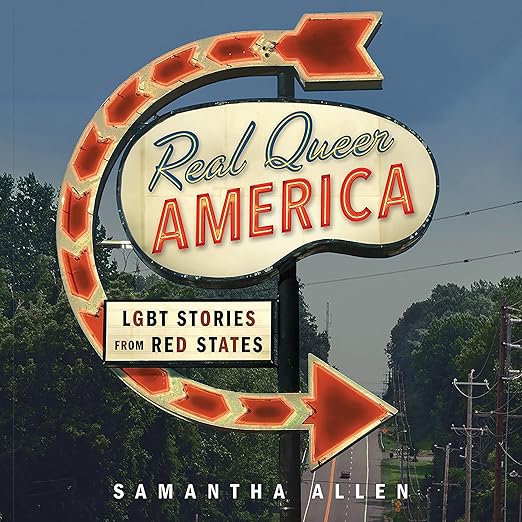
- Read by: Allen reads her own book, so the reporter and one of her subjects share a single voice.
- At its heart: Queer life in red states, trans memoir, chosen family, road-trip reportage
- Vibe: Warm, argumentative, deliberately hopeful
- Short version: A road book with a thesis, and the rare political memoir that grows more persuasive the more specific it gets.
Something gay every day was the rule Samantha Allen set herself on the road, and that motto tells you nearly everything about the method behind this audiobook. Not a survey, and not an argument first: a reporter driving out of Provo, Utah, down to the Rio Grande Valley, then into the Bible Belt and the Deep South, obliged every single day to find the thing she came for. Seven hours and twenty-six minutes of that discipline yields something no think piece about red-state America could reach.
Allen’s own biography does structural work throughout. A decade before writing, the description says, she was a "suit-and-tie-wearing Mormon missionary"; by publication she was a GLAAD Award-winning journalist married to another woman. What did not change, in the book’s telling, was her love of Red State America and of the queer people who stay in what the copy calls "flyover country" rather than moving to the coasts.
Provo to the Deep South is a route rather than a thesis, and the distinction matters enormously. Along the way the book stops at drag shows, political rallies and the hubs of queer life across the heartland, and it introduces named individuals, among them "the first openly transgender mayor in Texas history" and "the manager of the only queer night club in Bloomington, Indiana." One reviewer lists the itinerary as running "From Provo to Austin, Bloomington, East Tennessee and beyond," while another was absorbed enough not to stop until finishing "the chapter on Johnson City."
Portraits are the unit of construction, and the pool grasps that immediately. A five-star notice credits Allen with "offering her readers intimate and loving portraits of local activists" and with giving us "hopeful sites of collective action and activism." The four-star reader describes the identical thing more coolly, as a book where "the author covers her own personal journey intermingled with intimate portraits from others in key 'red' areas." One enthusiastic reader and one measured reader agree about what the book is made of.
Reading her own memoir puts Allen in two chairs simultaneously, and that is the production decision worth sitting with. This is reportage and it is also a transition story: the description names her former life as a missionary, and one reviewer singles out "the elevator where she met her now wife" among the sweet moments. The voice saying I therefore belongs both to the journalist conducting the interviews and to one of the people the book is about. A hired reader would place a professional between a listener and that testimony, which on a book whose central claim is belonging would be a strange thing to insert.
The Queer Girl in Tennessee Who Stays
Road-trip structure is why this works in audio better than most reported nonfiction manages. Each stop is a place, a person and a scene, so the book advances by arrival rather than by argument, and a listener can rejoin it anywhere without discovering a dropped thread. One reviewer describes the effect as a story that "invites you in like a warm bath," an odd compliment for political journalism and an accurate one.
Counter-narrative is the intellectual payload, and a reviewer states it better than any blurb: "If the dominant LGBT narrative of the twentieth century was a gay boy in the country buying a one-way bus ticket to the Big Apple, the untold story of the twenty-first is the queer girl in Tennessee who stays put." Another supplies the political version, arguing that "local LGBTQ efforts may be transformative in ways that national/international initiatives on the coasts cannot reach."
Hope is offered on purpose rather than by accident, and the description says so, calling the book "a treasure trove of uplifting stories" and a source of hope in divided times. A reviewer confirms that register from a specific moment, writing in January 2021 that "especially in light of this week’s events" the reminder that red states are not uniformly hostile was one they needed. Whether that consoles or frustrates you is worth establishing before you start.
When Only Five of 258 Scores Have Text
Currency is the largest caveat, and none of it is the author’s fault. Recorded for a March 2019 publication, the book reports a moment: a specific political climate the reviewers keep naming, and a set of local victories fixed to that year. One notice refers to interviews about what it is like to be queer under the administration of the day. Take this as history and as method rather than as a current map of where it is safe to live.
Defensiveness is the one substantive criticism, and it arrives from the lone dissenting reader. That reader found Allen "a bit defensive of the metropolis/coastal cities, but I can understand why," which is a fair and generous way to name a genuine tension: a book arguing that the heartland deserves attention keeps having to explain that it is not attacking the coasts. The same reviewer nonetheless calls it "Compassionate, well written, enjoyable to read overall."
Scale of the evidence needs stating plainly. Two hundred and fifty-eight scores average 4.5, while text exists for only five of them, and those five run higher than the aggregate, so the silent raters are the ones holding the number down. The pool also skews literary: one reviewer describes the book landing "on my doorstep" as a physical purchase, another arrived having already read a different Allen title, and a third writes in the register of a scholar weighing a contribution to public debate. That is a book-buying readership, and not the same population as the silent majority of scores. Award attention brings that kind of reader in early, and it shapes what gets written down.
A Network of Chosen Family, Spoken in Her Voice
Queer listeners outside the major metros are the people this was written for, especially anyone who has been told that living openly requires leaving. Add readers of American road-trip nonfiction, anyone drawn to trans memoir that doubles as journalism, and listeners who want a political argument carried by people rather than by statistics. A Lambda Literary Award nomination and the New York Times Book Review calling it "powerful, profoundly moving" are both fair signposts.
Set it aside if you want current political reporting, policy analysis, or a comprehensive survey of LGBTQ life in every red state, because this is one reporter’s route and never claims otherwise. Set it aside too if uplift reads to you as evasion, since the book chooses hope deliberately and any coastal listener wanting an indictment will feel gently corrected throughout. What Allen built is a network of chosen family spoken aloud in her own voice, and seven years on that remains the rarer accomplishment.
Is the audiobook still worth hearing given a 2019 publication?
Yes, as history and as method rather than as a current guide. The political climate it reports is fixed to that year, and reviewers reference it directly. What lasts is the argument that queer people who stay in red states are building something the coasts cannot reach, plus the portraits themselves.
Which parts of the country does the road trip cover?
The description traces a route from Provo, Utah through the Rio Grande Valley to the Bible Belt and the Deep South, taking in drag shows, political rallies and heartland queer venues. Reviewers add Austin, Bloomington, East Tennessee and Johnson City, and one reviewer clocks the trip at six weeks.
Is this audiobook a memoir or a work of reportage?
Both at once, which is the point. Allen interviews activists, venue managers and a transgender mayor while also recounting her own path from Mormon missionary to married journalist. A four-star reviewer describes it as a personal journey intermingled with intimate portraits of others, which is exactly right.