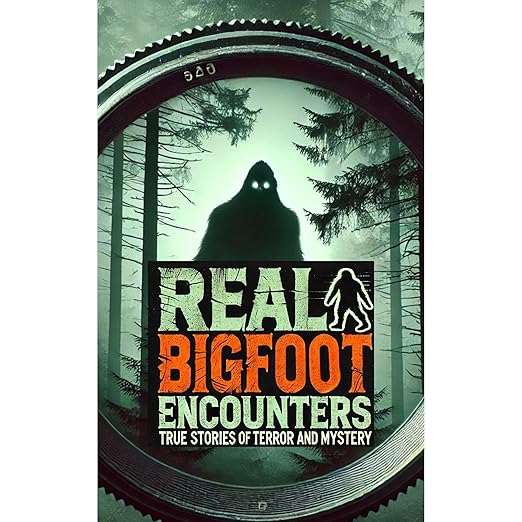
Footprints, torn gear and audio nobody can explain are the raw material here, and the promise attached to it is that every account came from someone who was actually standing there. Real Bigfoot Encounters is a just-under-five-hour audiobook collecting firsthand reports from hunters, hikers and law enforcement officers, and the listing files it under travel and tourism, in the North America subcategory, which is the first thing on this page that will not sit right.
Ethan Blackwood's structure is the anthology, and the description names four of the set pieces: footage shot on Memorial Day that the book weighs as real or hoax, a case in the Smokies where a camper vanished leaving torn-up gear behind, a siege in Alaska where witnesses said something enormous circled a cabin for days, and a claimed cover-up around Mount St. Helens in the wake of the 1980 eruption.
Alaska is the entry that tells you what kind of book this is. A creature stalking a cabin for days is not a sighting, it is a siege, and the pull of that story has nothing to do with evidence and everything to do with duration. The most effective material in this genre is always about being unable to leave, and the description knows it, which is why that case gets the strongest verb on the list. The Smokies entry works on the opposite principle, since nothing is witnessed at all. A camper goes missing, the gear comes back torn, and the account has to survive on an absence, which is a harder thing to hold a listener with and a much harder thing to fake.
Synthetic reading is what the credit signals. Virtual Voice sits where a performer's name would go, and on this material that matters more than it would on a study guide. Firsthand testimony is oral by nature. These are stories built to be told by somebody who was frightened at the time, and a text-to-speech pass strips out the one quality the whole format exists to deliver.
Why Listen to Real Bigfoot Encounters
Testimony collections work when the accounts are allowed to contradict each other, and this one at least gestures at that. It asks whether the Memorial Day footage is real or a hoax instead of asserting an answer, and it closes by telling the reader to decide for themselves. That is the correct posture for the genre, and it is not the posture most books in it adopt. The alternative, which is far more common, is a book that has decided in advance and then arranges every account to confirm it. Refusing that is the difference between a collection you can enjoy while remaining unconvinced and one that requires you to sign up first.
Bigfoot books split into two camps: believers assembling a case, and collectors assembling stories. This is firmly the second kind, which is the more durable kind. The description promises chilling details, unanswered questions and eerie evidence, and the honesty of that list sits in the middle item, because unanswered questions are the actual product and everyone involved knows it.
Ratings on this listing do something arithmetically odd. Eight ratings produce a displayed 4.2, and eight whole-star votes cannot average to 4.2, since that would require a total of 33.6 stars. The figure on the page is therefore weighted rather than a straight mean, which is worth knowing before anyone reads significance into a single decimal place on a sample this small.
What to Watch For in Real Bigfoot Encounters
Emoji run through the description: a footprint, a book, a magnifying glass, and a column of green checkmarks marking each case. That is a listing lifted from a retail page for a printed edition and never rewritten for audio. The clearest tells are the line asking you to read these true encounters and decide, and the closing instruction to get your copy today.
Filed under travel and tourism, this book will reach the wrong browser and miss the right one entirely. Nothing inside it is a travel guide. Someone searching North American destinations gets a cryptid anthology, and someone hunting cryptid anthologies never sees it at all, which is a shelving error that costs the book considerably more than it costs any individual buyer.
Zero written responses accompany those eight ratings. Nobody has explained what they liked or what they deducted for, which on a title carrying no author reputation is the whole problem. The sample is the entirety of your evidence, and with a synthetic reading the sample is unusually representative, because nothing about the delivery develops as the recording goes on.
Who Should Listen to Real Bigfoot Encounters
Cryptid listeners who collect encounter accounts are the audience, particularly anyone who already knows these stories in fragments and wants them assembled into named cases with detail attached. The Smokies disappearance and the Alaska siege circulate endlessly in shortened forms, and having them set out at length, with the timeline intact, is a real service even at this price of admission. Law enforcement witnesses are the other draw the description leans on, and for good reason: an account from somebody trained to write reports carries a different weight than one from a hiker, whatever you ultimately conclude about what they saw out there.
Skeptics will find less here than the framing implies. The description promises unexplained audio, eerie footprints and terrifying close encounters, and none of those things is analysis. If you want the Memorial Day footage examined properly, or the Mount St. Helens claim traced back to a source, this is a collection of accounts rather than an investigation, and it never pretends otherwise.
Approach this as campfire material with names and dates attached and it delivers exactly that, inside a running time short enough for one long evening. The synthetic reading is the genuine limitation, and on testimony it costs more than it would on almost any other kind of book. Sample it before buying, because with a machine reading the first two minutes are the entire product in miniature. If the voice works for you it will work for five hours, and if it does not, no later case is going to rescue it. That is an unusually clean buying decision, and it is the one useful side effect of a credit like this one.
Quick Take
- Subjects: Firsthand cryptid testimony, a disappearance in the Smokies, a claimed cover-up after an eruption
- Tone: Campfire dread, organized into named cases
- Bottom line: A decent collection of encounter accounts, undercut by a synthetic reading on material that lives or dies on a human voice.
Frequently Asked Questions
Does the audiobook argue that Bigfoot is real?
No. The description frames the material as accounts to weigh rather than a thesis to accept, asking whether the Memorial Day footage is genuine or a hoax and closing by inviting you to decide. Expect a collection organized around named cases rather than a case built for or against.
What does the Virtual Voice credit mean for this audiobook?
It means a synthetic reading rather than a human performer. On firsthand testimony, where hesitation and fear carry half the effect, that removes something the format depends on. The information survives intact and the atmosphere does not. Play the sample and decide whether that trade works for you.
Which cases does it actually cover?
Four are named in the description: footage shot on Memorial Day, a camper who vanished in the Smokies leaving torn gear behind, a siege in Alaska where witnesses said a creature circled a cabin for days, and a claimed cover-up around Mount St. Helens following the 1980 eruption.