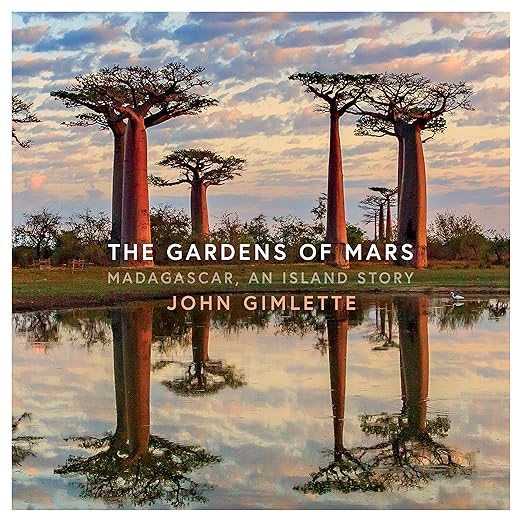
Key Details
- Narrator: Mark Elstob reads it solo, which suits a travel book that lives or dies on one writer's company.
- Subjects: Madagascar's history and present, encounters rather than scenery, an island that resists explanation.
- Tone: Dry, curious, faintly unsettling.
- Bottom line: Excellent literary travel writing that loses the maps and the photographs on the way into audio.
Few travel books earn their length. The Garden of Mars does, and the reason is that John Gimlette refuses to treat Madagascar as scenery. He goes looking for politicians, sorcerers, gem prospectors, militiamen, rioters, lepers and the descendants of seventeenth-century pirates, and he lays the island's history underneath all of them. Mark Elstob reads the audiobook for W. F. Howes, thirteen hours and ten minutes about a place the copy calls too big, too eccentric and too impenetrable to be truly understood.
Madagascar's Double Journey Through Present and Past
Gregory Antollino has been to Madagascar and confirms the portrait: eerie, often wonderful, exactly the place Gimlette describes. That February 2021 response went before reading the book, found a week barely enough to scratch the surface, took the lemur tour, saw the big trees, and came home wanting to return. It also picks out the detail that tells you what kind of traveler the author is, namely his attempts to learn and speak Malagasy, and how little success he had with them.
The structure is a double journey. Gimlette covers every corner of the island in the present while going down into its past at the same time, which is how a travelogue earns the word history on its own listing. The copy's claim is that we think we know Madagascar and do not, and the evidence it offers is genuinely disorienting: no trace of human life until roughly ten thousand years ago, and settlement eventually won by migrants who arrived from Borneo, three thousand seven hundred miles away.
Scale is the first thing a book like this has to communicate, and the copy does it with a comparison rather than a statistic. Stretch the island across Europe and it would reach from London to Algiers, yet its road network is barely larger than Jamaica's. That gap between size and access is the entire logistical story of the place, and it explains the shape of the journey. Gimlette does not glide between destinations. He grinds toward them, and the grinding is half the book.
Encounters With People Anchor This Travelogue
Captain K gives the most precise account of what the book delivers and what it withholds, in a four star from October 2025. That reader arrived fascinated by Madagascar since childhood, having read mostly scientific accounts of the island's oddities, and found this one weighted toward history and culture instead. The verdict is memorable: an unpretty picture, from an author who adroitly combines gravitas with drollness. The same response concludes that it is probably not a place that particular reader needs to visit after all.
The people are the reason to stay. Politicians, sorcerers, gem prospectors, militiamen, rioters, lepers and the descendants of pirates who settled three centuries ago, all of them met rather than researched. Travel writing that runs on encounters instead of on landscape holds up much better in audio, because it becomes a sequence of voices and situations rather than a description of a view, and a description of a view is where the form usually loses a listener's attention.
History is not decoration here either. Gimlette wants to explain how Madagascar became what it is today, which means colonial layers, migration from an improbable distance, and a political present containing riots and militias. Anyone who came for lemurs gets considerably more than lemurs, and the description is upfront about that. The island arrives as a country with a working past rather than as a nature reserve with a few people standing in the corners.
Buy the Book Too, for Maps and Photos
The most useful warning comes from a listener who bought the audio, loved it, and then went out and bought a physical copy as well. The reason given is specific: the printed edition carries maps and photographs, and the book is packed with detail that reader wanted to go over a second time. Both of those are format problems. Audio cannot show you an island's shape, and it cannot be skimmed backward. On a book this dense with unfamiliar names and places, that matters more than usual.
The only low grade on the page, a single star from August 2025, makes the fair version of the opposing case: this is more of a personal story than an account of Madagascar, and that reader found the approach annoying. It is a legitimate objection to the entire genre. Gimlette is present on every page, his curiosity sets the itinerary, and if you want a country explained without an author standing in the frame, this method will irritate you from beginning to end.
Small mysteries turn up in the description itself. It calls Madagascar the world's fourth island, which presumably means fourth largest, and one sentence later refers to the islands in the plural while describing a single one. Neither slip belongs to the author. What they signal is a print blurb transplanted without a second read, which is also why nothing here tells you what the audio edition does about illustrations. The 4.4 average across eighty-nine ratings, meanwhile, covers every edition of the book at once.
Thirteen Hours With Gimlette Before You Book
Travelers with Madagascar somewhere on the list should listen before booking anything, because this book will either double the determination or end the idea altogether, and both outcomes are worth having in advance. Readers of literary travel writing get the more durable pleasure: a curious, dryly funny writer working an under-covered place hard, and doing the historical homework most books in the genre skip entirely. I came away with a far longer list of things I did not know about the island than I expected to.
Readers after a natural history of the island should look elsewhere, since the lemurs and the big trees are scenery here rather than subject. Anyone who wants a country reported without a personality in the way will find the personality unavoidable. And anyone who reads travel writing for practical guidance, where to go and what it costs, is in the wrong section: this is a book about how a place got to be strange, not about how to visit it comfortably.
Buy it for Gimlette's company and for the history, and go in knowing that the format costs you the pictures. Thirteen hours is a long time to spend somewhere nobody can quite explain, which is exactly the argument the book makes for going in the first place. Whether you finish it wanting a flight or wanting to stay firmly at home, you will not confuse Madagascar with anywhere else again.
Questions Listeners Ask
Is this audiobook a travel guide or a work of history?
Both at once, and the listing files it under both. Gimlette walks the island as it stands now while digging into how it got that way. What it is not is a practical guide: no itineraries, no accommodation, no advice on seasons, nothing you could plan a trip from without other sources beside it.
Does the audiobook work if I know nothing about Madagascar?
It is arguably the better way in. Rick King, who read it before traveling there, reports that it gave a much clearer sense of what was happening beneath the surface of the culture visitors actually see. The book assumes no prior knowledge and builds the history as it goes, starting from first settlement.
How much of the book is about wildlife?
Less than the island's reputation would suggest. Lemurs and the big trees do appear, but the human cast takes almost all of the room, from sorcerers and prospectors to militiamen and the children of old pirates. Anyone shopping for natural history should treat that as the main finding.
How current is Gimlette's account of the country?
The recording dates from January 2021, so the political present it describes is the one that existed when the book was written. Riots, militias and the gem trade appear as recent history rather than as today's news. The deeper material, settlement, colonial layers and the state of the roads, does not date the same way.