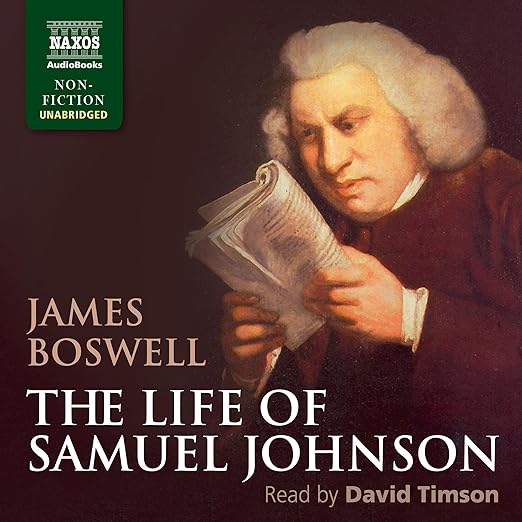
- Voice: David Timson is among the finest readers of 18th-century prose in the audiobook medium, and his narration of Boswell brings the conversational wit and rhetorical precision of the original into audible relief without modernizing or flattening it.
- Big ideas: Friendship and obsession, 18th-century London intellectual life, the complexity of representing another person's consciousness
- Atmosphere: Rich and unhurried, with the density of a great literary monument read aloud by someone who fully inhabits it
- Worth it?: At fifty-one hours, this is one of the most significant long-form listening commitments in the biographical canon, and David Timson makes it completely worth it.
James Boswell's The Life of Samuel Johnson is, by the consensus of most literary scholars, the greatest biography ever written in English. That assessment has held for two centuries and shows no sign of being revised. The audiobook narrated by David Timson is one of the few recordings of this work that can be recommended without qualification: at fifty-one hours, this is a Himalayan commitment, and the narration is the altitude that makes the climb possible.
The context that defines everything in this audiobook: Johnson was 54 when Boswell first encountered him, and Boswell spent the rest of Johnson's life accumulating the observations, conversations, and anecdotes that became this biography. The friendship between them is one of the strangest and most productive in literary history, marked by genuine devotion on Boswell's part and a rough but authentic affection on Johnson's. The biography that emerged from it is also a record of that friendship, which gives the whole work a dimension that pure biography does not typically have.
Boswell Could Record Conversations With Uncanny Accuracy
Boswell had a specific gift that no biographer before or since has matched in quite the same way: the ability to record complete conversations with uncanny accuracy and then reconstruct them on the page with dramatic fidelity. Reviewer Walter E. Hampton Jr. identified this precisely, noting that for biographies there is no equal when it comes to preserving the actual speech patterns and intellectual texture of a historical figure. Johnson's rough humor, his depression, his fear of death, his intellectual brilliance are not described by Boswell: they are demonstrated through accumulated speech and incident, which gives the portrait a phenomenological richness that summary analysis cannot achieve.
The London that Boswell populates alongside Johnson is peopled with Sir Joshua Reynolds, Oliver Goldsmith, John Wilkes, and David Garrick, among many others. The book functions simultaneously as a biography of Johnson, a social portrait of 18th-century London intellectual life, and a document of what it means to be fascinated by another person's mind for decades. That layered quality is what Reviewer Earache's description of the book as exceptionally footnoted and arranged for new readers captures: the editorial apparatus around Boswell's text, particularly in Penguin editions, makes the social world navigable for contemporary listeners.
Boswell's Prose Built for Reading Aloud
David Timson's narration is the specific reason to choose this audiobook over the print edition, or at least to treat them as different experiences rather than equivalents. Boswell's prose at its best is conversational and rhythmically precise, built for reading aloud, and Timson understands this in his bones. He gives Johnson's reported speeches their proper weight, the pause before the demolishing observation, the momentum of the famous Johnsonian repartee, without theatricalizing in a way that would break the biographical contract with historical reality.
A Voice as Clear as Good Typography
One of the audiobook's particular pleasures is Timson's handling of the anecdote form. Boswell structures the biography around accumulated incident rather than strict chronology, and anecdotes need to land with their full comic or emotional charge if the portrait is to accumulate properly. Timson's timing is consistently excellent, which matters more than it might seem: Boswell's humor depends on rhythm as much as content, and a narrator who cannot feel that rhythm flattens what should be vivid.
Reviewer VA Book Lover's account of seeking the right typography and editorial apparatus for reading a classic of this scale is instructive: the audiobook faces the same challenge in sonic terms, and Timson's voice is the equivalent of good typography, clear, beautiful, not obtrusive, allowing the content to be the primary experience.
Fifty-One Hours, Discursive Rather Than Argued
Fifty-one hours is an audacious commitment for modern listeners accustomed to sub-ten-hour audiobooks, and the expectation management here matters. The Life of Samuel Johnson is not structured like a contemporary biography with thesis, narrative arc, and driving argument. It is structured like a life actually is: discursively, through episodes and conversations and reflections, some of which illuminate Johnson in fundamental ways and some of which are simply present because Boswell was paying attention that day and wrote it down. The texture of the listening experience varies significantly across the fifty-one hours.
The early sections establishing Johnson's biography before Boswell met him are more conventional and somewhat denser than the later sections built from direct observation. Listeners who find the first hours slightly dry should push through: the point where Boswell actually enters the story, and the biography shifts from secondary sources to first-person account, represents a significant tonal transformation.
Johnson's famous dictionary and his work as a literary critic and poet are woven through the biography but are not treated in the depth that dedicated scholarly studies provide. For listeners whose primary interest is Johnson as a literary figure rather than Johnson as a personality and character, supplementary reading is worth pursuing alongside the audiobook. Boswell's interest is fundamentally in the man, not in a systematic assessment of the work.
Johnson's Company Is Genuinely Extraordinary
Readers with a serious interest in 18th-century literary culture, in the nature and practice of biography as a form, or in the texture of intellectual friendship as a subject will find this audiobook one of the most rewarding long-form listens available in any genre. Timson's narration makes the archaic register of Boswell's prose a pleasure rather than an obstacle, and the fifty-one hours are better understood as a sustained relationship with a text than as a single listening project. Those new to biography as a genre should start elsewhere and return to this when they have a sense of what it means for a biographer to be inside a life rather than outside it. Johnson's company, as Boswell preserved it, is genuinely extraordinary.
Frequently Asked Questions
Is this audiobook accessible to listeners without a background in 18th-century literature or history?
Yes, though some context helps. Boswell's prose is not modernized in this recording, and Timson reads the 18th-century register as Boswell wrote it. The social world of Johnson's London, populated by figures like Reynolds, Goldsmith, and Garrick, benefits from some prior acquaintance, but the dramatic energy of the conversations is accessible without specialist knowledge.
Is The Life of Samuel Johnson audiobook appropriate for listeners who have never read Boswell before?
It is an appropriate starting point precisely because Timson's narration makes the prose accessible, but expectations about the scale and pace of the experience should be set realistically. At fifty-one hours, this is a sustained project rather than a casual listen. First-time readers who complete it will have had one of the most significant literary experiences the biographical form can offer.