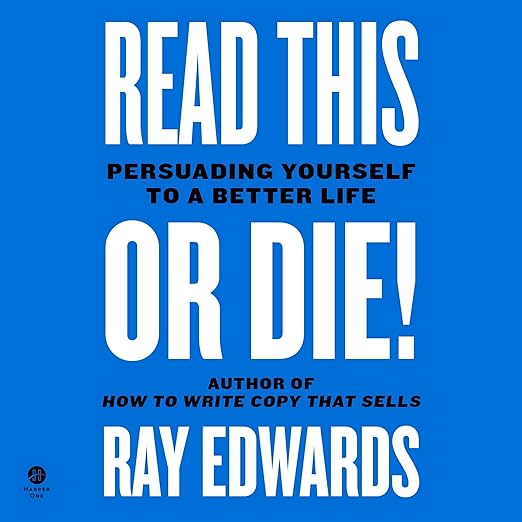
Can a professional persuader talk himself out of despair with the same techniques he sold to everybody else? That is the question this audiobook exists to answer, and it answers with receipts. Ray Edwards spent over four decades writing copy for clients the description names outright, among them Tony Robbins, Jack Canfield and Michael Hyatt, before a Parkinson's diagnosis brought the whole arrangement to a halt and sent him back through what he believed about his faith, his relationships and his own worth. What he found, the publisher says, was that the machinery he had built to move other people would also run on him. Edwards holds both the byline and the reading, and the file runs seven hours and five minutes.
Two books share this runtime and they are braided rather than stacked. One is an illness memoir about a diagnosis, a depression, and the relationships that had to absorb both. The other is a method book organized around an acronym, PASTOR, which stands for pain, amplify, story, transformation, opportunity and response, and which Edwards originally built to sell things to strangers. The May 25 response identifies the object that fuses them, a sales letter Edwards wrote to himself, and calls the result raw rather than comforting, adding that it is not quite a feel-good story. That letter is the book's real center of gravity, and it explains why the method chapters do not read like a seminar handout.
Self-narration matters more here than it does on most memoirs, for a specific reason. The document at the heart of this book was written by one person to persuade exactly one person, and the writer and the target were the same. Hearing it delivered by that same voice restores the original conditions of the act rather than dramatizing them, which is something no hired reader could supply and no page can reproduce. It also sets the terms of the whole recording: a listener is not being told a story about somebody's recovery, but overhearing the argument that produced it, which is a different and more uncomfortable position to occupy for seven hours.
It Will Both Scare and Inspire
Candor is the strongest thing on offer. The May 24 response draws the line precisely, observing that unlike self-help books built from uplifting stories, this one will both scare and inspire, and describing an arc in which the author masters a craft, climbs to the top of it and is then returned to reality and to depression. Books in this category usually arrange their disasters as prologue to a lesson. This one lets the disaster sit where it fell, and the effect on a listener is that the method chapters have to earn their optimism against material that has already refused to be tidy.
Method chapters earn their place too. The June 26 response praises the how-to advice as solid and reports laughing out loud in places, which is not a common combination in books about terminal diagnoses, and identifies the argument underneath the acronym: what we believe we deserve governs everything downstream of it. That is a persuasion insight rather than a therapeutic one, and it is why this works for listeners who go rigid at the phrase personal development. The vocabulary is sales, the target is belief, and the transaction is with yourself. Seven hours is also a merciful length for material this heavy, short enough to finish inside a week and structured so that a chapter of hard reality is usually followed by something you can do about your own week.
A Book You Walk Through Like a Process
This is a book people work rather than finish, which puts pressure on the format. The June 28 response describes walking through the chapters, using them to identify what had been blocking progress in life and business, and treating the book as a tool rather than a read. Audio gives you nothing to write in. Six steps hiding behind an acronym are easy to nod along to and hard to apply from memory, so anyone intending to actually run the process will want paper beside the file, or a text edition to mark up, and should expect to stop and restart rather than listen straight through. The upside of that friction is that the exercises are personal rather than generic, and the answers are worth keeping once written.
Two smaller things deserve flagging before you buy. Every response in the column lands within eight weeks of the May 2023 release, and the July 14 write-up opens by describing years of following the author's work online, which is what a launch column looks like for a writer who already has an audience: enthusiastic, early, and thin on the doubts a later reader might raise. The description also compares the book to The Last Lecture and to Tuesdays with Morrie, which sets a pure memoir expectation that the method chapters interrupt. Faith is load-bearing here as well, since the diagnosis sent the author back through his Christian beliefs rather than away from them.
Edwards Reading the Pitch Out Loud
Anyone facing a diagnosis, or living beside somebody who is, will recognize the mental furniture: the bargaining, the shame about reduced output, the private accounting of what a life is still worth. Marketers and copywriters get a second reason to listen, since watching a practitioner turn a professional instrument on his own beliefs is a rare piece of trade writing. It rewards listeners who like their encouragement delivered with an edge, because the title itself is a piece of direct-response copy pointed at the buyer. Anyone who has stalled halfway through a change they genuinely wanted will find the diagnosis of that stall unusually specific, and unusually unwilling to blame circumstances for it.
Skip it if you want an illness memoir with no framework attached, or a business book with no illness in it, because the whole design refuses that separation. Skip it too if Christian language in a self-help context grates, since it appears throughout rather than in one bracketed chapter. What remains is unusually honest for its shelf: a man selling himself on staying alive, reading the pitch out loud, and letting you hear how it was built.
The Short Version
- Narration: The byline and the narrator credit carry one name, so the sales letter at the heart of the book reaches you in the voice that wrote it.
- Themes: terminal diagnosis, persuasion turned inward, faith under pressure, depression and recovery
- Mood: Raw and pointed, with more jokes than the premise promises
- Verdict: Strong for listeners who want a method attached to their memoir, awkward for anyone wanting only one of the two.
Frequently Asked Questions
How much of the audiobook is memoir and how much is method?
They alternate rather than divide. The illness story supplies the stakes and the PASTOR framework supplies the structure, with a sales letter the author wrote to himself sitting between them. Anyone who wants just the diagnosis narrative will run into process chapters, and anyone who wants just the process will run into the diagnosis.
Do you need to write anything down to use the PASTOR process?
In practice, yes. The description presents PASTOR as a process to run rather than a lesson to absorb, and its six steps hide behind an acronym that is easy to nod along to and hard to reproduce from memory. Keep paper nearby, or buy a text edition alongside the recording.
How much Christian content is in this book?
Enough that it should not surprise you. The description says the diagnosis pushed the author to question everything he believed about his Christian faith, and that reckoning stays in the frame throughout rather than being confined to a single chapter. Readers who want a purely secular recovery narrative should look elsewhere.
Does having the author read his own audiobook change what you get?
It changes the position you listen from. The central document is a letter written by one person to persuade that same person, so hearing it in the author's own voice restores the original transaction instead of staging it. Sample the opening first, since first-person delivery is always a matter of taste.