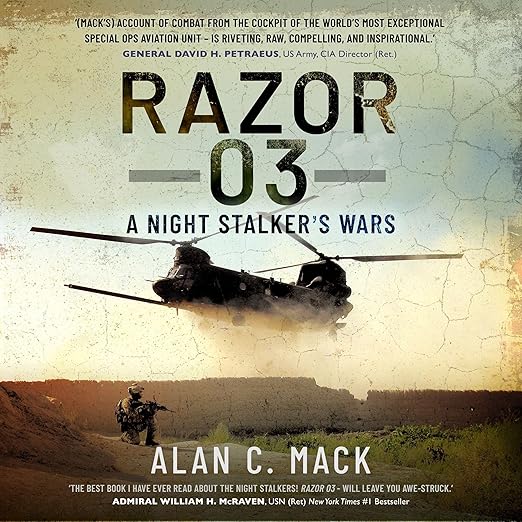
Alan C. Mack narrates his own combat missions with the same efficient, no-embellishment precision he presumably once used briefing a helicopter crew before a flight into contested Afghan airspace, and that aviator's cadence turns out to be exactly the right register for this audiobook. Callsign Razor 03, Mack led MH-47E Chinook and MH-60 helicopter teams within Task Force Dagger, the special operations force built in direct response to the September 11th attacks, flying personnel recovery and unconventional warfare missions in terrain and weather previously considered unflyable. His account moves through the hunt for Osama bin Laden at Tora Bora, his own helicopter's shootdown during Operation Anaconda, the pursuit of Bowe Bergdahl years later, and hostage rescues in Iraq, delivered with the same clear, information-first voice throughout.
Night Stalkers Don't Quit, at Home Either
What makes Mack's self-narration work is the consistency of his delivery across wildly different emotional registers. The even, controlled tone he brings to describing his own shootdown during Operation Anaconda is the same tone he brings to quieter, harder passages about his wife's opioid addiction, and that consistency reads not as flatness but as integration, a man who has genuinely processed difficult material rather than performing distress for effect. Warmth surfaces specifically in the family sections, a combination of warrior discipline and domestic tenderness that reviewers respond to directly, and that combination is difficult for a professional narrator without lived experience of both halves to convincingly replicate.
Task Force Dagger's two-fold mission, personnel recovery and unconventional warfare, structures the book's actual content more than a simple chronological memoir would: chapters move between rescue operations, the Lone Survivor extraction from the Kunar Valley among them, and the quieter, longer-running work of infiltrating and supporting unconventional warfare campaigns, giving listeners a fuller picture of special operations aviation than the rescue-mission highlights alone would provide. Mack's specific technical detail, the modifications made to push his Chinooks' flight envelope beyond standard limits, the particular demands of flying in terrain previously not thought possible, grounds the book in genuine aviation expertise rather than generic war-memoir drama.
Mack flew with the 160th Special Operations Aviation Regiment, known within the military as the Night Stalkers, whose motto, Night Stalkers Don't Quit, becomes almost a structural refrain across the book, invoked as much in the family chapters as in the combat ones. That repetition is a deliberate choice: the same refusal to quit that carried him through Tora Bora and a helicopter shootdown is framed explicitly as the same quality that eventually helped his marriage survive his wife's addiction, tying the book's two halves together with one consistent idea rather than treating them as separate stories.
Readers of Doug Stanton's Horse Soldiers, which covers the same initial Afghanistan infiltration from the ground perspective, will find real value in Mack's account as a companion piece told from the cockpit instead, flying the exact helicopters that inserted those Special Forces teams into the country. Hearing the same historical opening days of the post-September 11th campaign from an entirely different vantage point adds genuine depth for anyone who has already read the more famous ground-level account.
Callsign Razor 03 itself is worth pausing on: military aviation callsigns are rarely arbitrary, and Mack wears his throughout the book less as a nickname than as a second identity, the professional self who executes missions with detachment, distinct from the husband and father navigating the same years at home. The book's real achievement is showing how those two identities, Razor 03 and Alan Mack, eventually had to be reconciled rather than kept permanently separate.
The Consummate Warrior, the Compassionate Husband
Reviewer Mark R. Hasara, writing what he calls a bottom-line-up-front assessment, praises the book's mental, emotional, and physical behind-the-scenes look at how the men and women of the greatest helicopter organization on the planet do their business, a specific, insider-flavored endorsement given Hasara's own evident familiarity with military aviation culture. Another reviewer calls Mack the consummate warrior and the compassionate husband, explicitly praising how the book holds both halves of that identity without letting either one flatten the other, exactly the balance the self-narration itself reinforces through tone.
A 4.6 rating across 802 ratings is a genuinely strong number for a niche special-operations memoir, and one reviewer specifically describes buying it for both himself and his son, an aspiring pilot who reportedly cannot put it down, evidence this reaches beyond the usual military-memoir audience into anyone drawn to aviation and mission-driven storytelling generally, not just readers already steeped in special operations history.
Trusting Listeners the Way He Trusted His Crew
This book does not shy away from the cost of Mack's career on his family, specifically his wife's developing opioid addiction during his repeated deployments and near-death experiences, and the friction that secrecy created within the marriage. That material is handled with real honesty rather than glossed over for a cleaner, more heroic narrative, but listeners should know going in that this is as much a book about the toll of that lifestyle on the people left waiting at home as it is about the missions themselves.
Expect dense special-operations and aviation terminology throughout, specific aircraft designations, unit callsigns, operational codenames, delivered at the pace of someone who lived inside that vocabulary daily rather than someone translating it for a general audience. Listeners with zero prior exposure to military aviation or special operations structure may want to look up a few key terms beforehand; the book does not pause to over-explain, trusting listeners to keep pace the same way Mack trusted his own crew members to keep pace during actual missions.
The book's ending resists a simple, tidy resolution to the addiction storyline, tracking instead toward what the synopsis calls ultimate happiness after real tragedy, a slower and more honest arc than a redemption narrative wrapped up in a single climactic chapter. Listeners should expect the recovery material to unfold gradually alongside the later missions, Bergdahl, the Iraq hostage rescues, rather than resolved before the book moves on to more combat content.
A Well-Rounded Memoir Worth Nine Hours
Recommended for readers of special operations memoirs in the tradition of Lone Survivor and Horse Soldiers, aviation enthusiasts specifically curious about rotary-wing special operations flying rather than fixed-wing combat, and anyone interested in the full, honest arc of a military career, including its cost to family, rather than a sanitized highlight reel. Mack's self-narration is close to a mandatory recommendation here; his lived authority is the book's core asset and would be difficult for any other narrator to fully replicate.
Skip it if graphic combat detail and sustained military jargon are not for you, or if you specifically want a book focused only on missions without the personal cost material woven throughout. For readers wanting the complete picture, heroic flying and difficult homecoming both, Razor 03 delivers a genuinely well-rounded special operations memoir worth the nine-hour investment.
- Read by: Alan C. Mack narrates his own special operations career with aviator's-briefing precision that never loses its warmth in the family passages.
- At its heart: special operations helicopter aviation, the toll of deployment on marriage, resilience through tragedy.
- Vibe: Tense, intimate, hard-earned.
- Short version: A standout self-narrated military memoir that balances mission detail with real personal cost.
Frequently Asked Questions
Does Alan C. Mack narrate this audiobook himself?
Yes, and it works especially well here; his efficient, information-first delivery reads like an aviator's mission briefing, a register well suited to both the combat sequences and the quieter family material.
Do you need prior knowledge of special operations terminology to follow this audiobook?
It helps but is not strictly required. Expect dense aircraft designations, callsigns, and operational terms delivered without much over-explanation, so newcomers may want to look up a few basics beforehand.