Quick Take
- Narration: Marlon Lodge narrates the English guidance with warmth and clarity, while native German speakers deliver the target language within the musical scaffolding.
- Themes: German vocabulary through music, memory consolidation via rhythm, past and future tense conversational phrases
- Mood: Upbeat and surprisingly relaxed, more like a structured playlist than a language lesson
- Verdict: A genuinely distinctive approach to vocabulary retention that works better in motion than at a desk, and Volume 2’s social and self-expressive content makes it more conversationally useful than the survival-kit Volume 1.
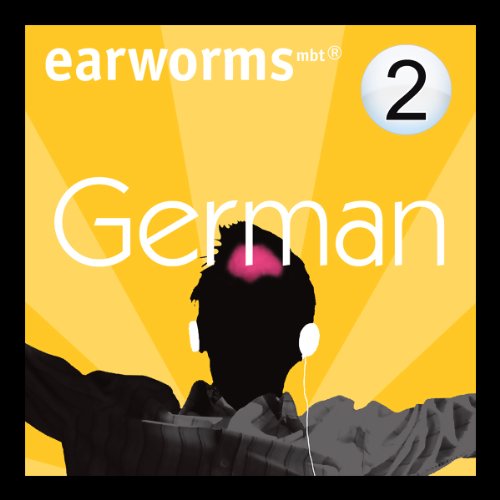
I ran a half marathon with Rapid German Volume 2 in my earphones somewhere around mile eight. This is not how Earworms Learning markets the product, but it is how I discovered what it is actually good at. The rhythmic structure of the method, German phrases woven into original music, with English translations anchored to melodic patterns, did something I did not expect: it made the phrases stick. When I reached the finish line, I found myself thinking in fragments of German I had absorbed during the run without actively trying to memorize anything.
Earworms mbt (musical brain trainer) is one of the more genuinely original approaches in the crowded language-learning audio market. Rather than the call-and-response architecture of programs like Pimsleur or the category-by-category vocabulary lists of textbook adaptations, Earworms embeds target language phrases into music. The theory is that music activates emotional and procedural memory in ways that declarative study does not, the same reason you can recall every word to a song you have not heard in fifteen years while struggling to remember what you studied last Tuesday.
Volume 2 Versus Volume 1: What Changes
The synopsis is accurate in characterizing Volume 1 as a survival kit and Volume 2 as a more socially expressive extension. Where Volume 1 focused on transactions, getting around, ordering food, basic requests, Volume 2 moves into talking about yourself across time. Past, present, and future constructions mean you can describe what you have done, what you are doing, and what you plan to do. That is a significant leap in conversational capability. The flirting mentioned in the description is not exaggerated; the course includes social and romantic register material that most language programs treat as advanced elective content but that comes up constantly in real conversation.
The 200 words and phrases covered in Volume 2 are chosen with this communicative emphasis in mind. Over sixty-six minutes, less than the duration of a feature film, you encounter vocabulary and structures that are among the highest-frequency items in actual German social conversation. The Earworms selection logic is sensible: if you are going to memorize 200 phrases with music, make sure they are the 200 that will do the most work in real interactions.
The Memory Science Behind the Music
The method’s claim is that musically embedded material gets encoded in long-term memory faster than rote repetition. The evidence for music-enhanced verbal memory is genuine, there is a meaningful body of research showing that melodic encoding improves recall for word strings. What Earworms is doing is a practical application of this, not a marketing fiction. The rhythmic repetitions of German and English mentioned in the synopsis are the core mechanism: you hear a German phrase, the English translation comes alongside it, the phrase recurs in a slightly different musical context, and the association between form and meaning consolidates.
It is worth noting what this method does not do. It does not teach grammar. It does not explain why a German phrase is constructed the way it is. It does not prompt active production the way Pimsleur does. What it does is give you a large set of high-frequency phrases in a form your memory is likely to retain. For many learners, that is exactly the bottleneck, not understanding German grammar but having nothing to say when a conversation starts.
A Word on the Companion Reference Material
The product description notes that a reference material PDF is available in your Audible Library desktop site alongside the audio. This is worth checking when you purchase. The written companion reinforces the audio content visually, and for learners who read German as well as speak it, having the phrases in text form anchors the musical memory to the written word. The sixty-six minute runtime means Volume 2 is an unusually compact audio product, but the reference material extends the utility beyond the listening session itself.
Who Should Listen, Who Should Skip
Listen if you have some basic German from Volume 1, a school course, or a prior study and want a distinctive method for consolidating conversational vocabulary. The music-based approach suits active learners, runners, commuters, anyone who absorbs things better in motion than sitting still. Listen also if you find Pimsleur’s intense recall demands fatiguing; Earworms offers the same language, considerably more gently. Skip if you need grammar explanation or structured progression; Rapid German is a vocabulary supplement, not a complete course system.
Frequently Asked Questions
Do I need to complete Rapid German Volume 1 before starting Volume 2?
The synopsis positions Volume 1 as the survival kit and Volume 2 as the next step, so Volume 1 first is the intended sequence. However, learners with basic German from another source (school, another course) may find Volume 2 accessible without Volume 1, since the content covers self-expression and social conversation rather than absolute beginner survival phrases.
How does Earworms’ musical method compare to Pimsleur’s active recall approach?
They address different learning challenges. Pimsleur is active, you are prompted to produce the target language under time pressure, which builds speaking habits. Earworms is passive absorption, phrases encoded in music consolidate in memory without active effort. The two methods complement each other well; Earworms builds vocabulary retention, Pimsleur builds production ability.
Is sixty-six minutes long enough to actually learn 200 German phrases?
The method relies on repetition across that runtime rather than a single exposure to each phrase. Earworms recommends listening multiple times, especially during the first week, which multiplies the effective instruction time. Most learners report that the phrases do stick after several listens, the music-memory association is genuinely functional.
What does the reference material companion include, and how do I access it?
The companion reference material is a PDF available through the Audible desktop library. It provides the written text of phrases covered in the audio, allowing visual reinforcement. Access depends on your platform; the Audible mobile app may not surface it as prominently as the desktop interface.