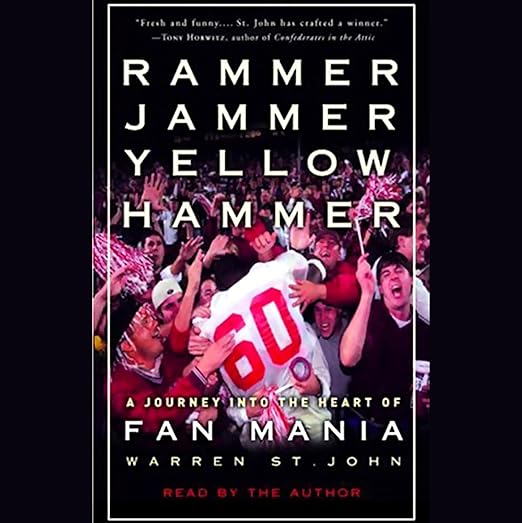
Quick Take
- Narration: Michael Kramer reads with the engaged energy of someone who actually wants to know these people, which keeps the book’s anthropological project feeling warm rather than clinical.
- Themes: Fan identity and belonging, American tribal culture, the neuroscience of loyalty
- Mood: Funny, curious, and surprisingly tender, sports journalism as cultural anthropology
- Verdict: One of the sharpest books ever written about why humans care about sports, and it works completely even if you have never watched a football game.
A colleague who knows I care nothing about college football handed me this book several years ago with the warning that I would enjoy it despite myself. She was right. I finished the audiobook version on a long drive and arrived at my destination annoyed that there was no more of it. Warren St. John set out to answer a question that sports fans have been asked by their baffled non-fan loved ones for as long as sports have existed: why do you care this much? He found his answer by buying a used RV he named The Hawg and spending a football season driving it with the community of Alabama Crimson Tide followers who travel to every away game, arrive on Wednesday for a Saturday kickoff, and have organized their lives around this thing to a degree that would look eccentric in any other context.
The book was published in 2004 and draws on St. John’s reporting from the 1999 season, which means the specific cultural moment is twenty-five years past. The freshness of what he found has not dated, because the subject is not really the 1999 season or even the Alabama Crimson Tide. It is the human need to belong to something, to take a side, to let another entity’s fortunes feel like your own. That is not a 1999 problem.
The People on the Road
The characters St. John finds among the RV caravan are the book’s best argument for itself. Freeman and Betty Reese, who skipped their daughter’s wedding because it coincided with a Bama game, are not presented as cautionary figures. They are presented as people who have made a choice about what matters to them that is, in its own way, as coherent as any other choice about what to structure a life around. Ray Pradat, the Episcopalian minister who watches games on a television next to his altar while performing weddings, is funny and also strangely moving. John Ed, whose ticket scalping operation gives him a kind of social power that nothing else in his life could, is a genuinely complex portrait.
The best character study is Paul Finebaum, described as the Anti-Fan, a radio host who has built his career on mocking the devotion he is surrounded by and who lives behind a gate because of the hatred that mockery generates. St. John uses Finebaum to examine what it means to be the outsider in a community defined by insiderness, and the portrait is more ambivalent and interesting than simple satire would allow.
The Science Behind the Devotion
What distinguishes Rammer Jammer Yellow Hammer from standard sports journalism is its interest in why, at a biological and anthropological level, the experience of fandom feels the way it does. St. John digs into the neuroscience of crowd psychology, the evolutionary history of group loyalty, and the anthropological record of something like tailgating appearing in eighth-century Greece. This material does not read as an intrusion into the human story but as an expansion of it. Understanding why the feeling exists does not diminish it. It actually makes the human figures in the RV caravan more interesting, not less.
The comparison to Bill Bryson and Tony Horwitz in the book’s marketing is apt in one important respect: this is travel writing disguised as sports reporting, concerned primarily with what people are actually doing and thinking and feeling, and only secondarily with scores.
Michael Kramer and What He Brings
Michael Kramer is one of the most recorded narrators in audiobook production, and his instinct for matching energy to material is on display here. He does not try to make Rammer Jammer Yellow Hammer sound more exciting than it is, which would be a mistake, because the book’s authority comes from its patience and its warmth rather than from manufactured excitement. His Alabama-adjacent characters land with enough distinctiveness to tell them apart without caricature. At five hours and two minutes, the listen moves quickly. Kramer’s pacing earns that speed, there is no dead air here.
Non-football-fan reviewers have been some of the book’s most enthusiastic readers, and the audio format removes one of the few remaining barriers, which is any anxiety about not being the intended audience. Kramer’s delivery makes clear that the intended audience is anyone who has ever wondered why human beings behave the way they do around the things they love. One reviewer who identified as an LSU fan and therefore an Alabama rival still found himself nodding along, the book transcends the specific team entirely, which is the whole point St. John is making and the whole achievement of the book.
A Book That Works Across the Fan Divide
This audiobook works for almost any listener with curiosity about human behavior, which is a broad category. Sports fans will recognize themselves in it and may find that uncomfortable. Non-fans will find it illuminating rather than alienating, as multiple reviews confirm. Listeners who enjoy the Bryson school of travel-as-anthropology, or who have read among the literary journalism of writers like John McPhee, will feel comfortable in St. John’s company from the first chapter. The only listener likely to be disappointed is one hoping for game-by-game analysis of the 1999 Crimson Tide season. That is not the book St. John wrote, and it is much better for the choice he made instead.
Frequently Asked Questions
Can someone with no interest in college football or the University of Alabama enjoy Rammer Jammer Yellow Hammer?
Yes, consistently and thoroughly. Several of the most enthusiastic reviews come from readers who identified as non-football fans going in. The book uses Alabama fandom as a lens for examining human tribal psychology, not as an end in itself. The football is context; the people and their devotion are the subject.
Is the 1999 season framing a problem given how dated the material is?
The specific season and its results matter very little. St. John is interested in the community and its psychology, both of which are as recognizable now as they were in 1999. The book has not aged in any way that damages what it is actually about.
How does Michael Kramer handle the distinctly Southern characters and dialect in the narration?
Kramer distinguishes the major characters clearly without overdoing the regional accent work. The reading feels lived-in rather than performed, which suits a book whose own relationship to the community it covers is affectionate rather than ironic.
Does the book take a position on whether extreme fandom is admirable or pathological?
Deliberately not. St. John presents the community with genuine curiosity and warmth, uses the science to understand rather than to pathologize, and ends up a partial convert himself, having bought the RV and driven it through a whole season. The book is generous to its subjects without being uncritical.