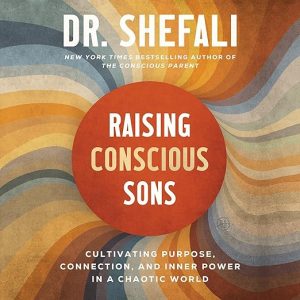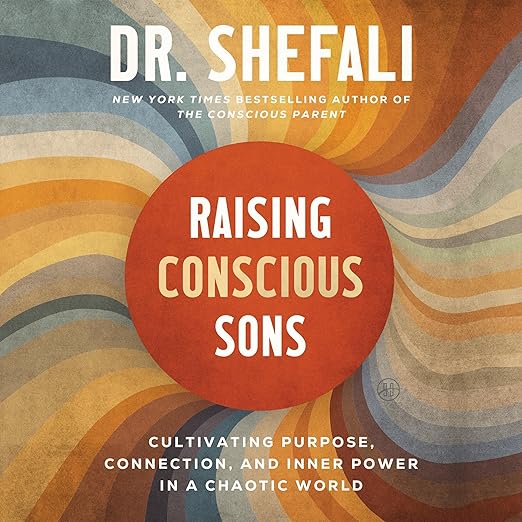
HarperOne has this audiobook dated September 15, 2026, and everything else about the page follows from that date. Nothing has been graded. No counter appears. Not a single buyer has written a word, and nobody is credited as narrator. Every signal a buyer normally leans on is missing, so the only honest assessment is one built from the argument itself, with the unverifiable parts named as unverifiable.
Dr. Shefali's case opens on a contradiction she states cleanly: boys are told to be tough but never vulnerable, sensitive but never weak, strong but never domineering. Three commands, each cancelling the one standing next to it. She reads the resulting damage in the outcomes the copy names, suicide, aggression, isolation, apathy, and treats those as symptoms of instructions that cannot all be obeyed rather than of boys failing to obey them.
Framing is the interesting part. Most parenting books about boys begin with behavior and work back toward feeling. This one begins with the mandate and works forward into behavior, which makes the parent the first subject and the son the second. That is consistent with the Conscious Parenting position the copy credits her with founding, and it is why the book will land as either a relief or an accusation depending on where a reader is standing.
Three outcomes are promised, and they repay close reading because they are more specific than this shelf usually manages: sons who feel emotionally secure and connected to their inner world, whose confidence is grounded in integrity rather than dominance, and who step into purpose with clarity, empathy, and self-discipline. The middle one carries the whole argument. Confidence grounded in integrity rather than dominance is a definition, and the practical guidance hangs off it.
Twelve Hours Suggests Room for Real Cases
The evidence base is described as real clinical cases plus interviews with children and parents, which is the right raw material for a recording. Case narrative survives being heard; a numbered list of techniques rarely does. If the balance leans toward those cases, this will work extremely well spoken. If it leans toward the prescriptive guidance the copy also advertises, parts of it will want a page you can mark up.
Twelve hours is a serious length for this shelf, and it suggests the clinical material gets room instead of being compressed into illustrative anecdotes. Parenting books that run short tend to be a framework with stories attached; ones that run this long usually carry sessions, transcripts, and follow-through. That is a reasonable expectation to hold going in, and it is one of the few things the page's own numbers actually support.
Timing helps as well. The parents who most need this book are not reading much of anything, and boys shaped by comparison, disconnection, and performative identity online generally have parents living inside the same feed. A long argument received while driving, walking, or folding laundry is a realistic way for that parent to get through a book of this size, and this is a single sustained thesis rather than a collection of tips.
Searching Two Names Splits the Author's Results
No narrator is credited. On a recording of this length that omission defines the product rather than decorating it: an author reading her own clinical work carries an authority a hired reader has to construct from scratch, and the founder of a movement reading her own manifesto is a different object from a professional performing it well. The page will not tell you which one is coming.
Two names for one person sit on this record. The byline reads Dr. Shefali Tsabary; the description says Dr. Shefali twice and never uses the surname at all. Both forms are correct, which is exactly the problem, because a reader searching the short name turns up a different set of results from one searching the long name, and neither set is complete. Nobody reconciled the two.
Duration reads as exactly twelve hours, with no minutes attached. Round figures on unreleased titles are ordinarily estimates rather than measurements taken off a finished file, so treat it as a signal of scale and not a number to schedule a week of driving around. It will firm up when the recording actually ships, and it can move in either direction when it does.
Shelving is wrong in a way that costs the book readers. This sits under politics and social sciences with a Social Sciences tag, and what it is, plainly, is a parenting book: clinical cases, interviews with parents, prescriptive guidance for raising one particular child. The masculinity argument underneath pulled it onto the wrong aisle, and the effect is that the parent who needs it browses somewhere else entirely.
Parents of Quiet Sons Are the Target
Parents of boys roughly between eight and eighteen are the obvious audience, and more specifically the ones who have noticed a son going quiet rather than the ones managing an explosion. The premise is that withdrawal and apathy constitute the same crisis as aggression expressed differently, and that equivalence is not on offer in most behavior-first parenting books, which treat the quiet child as the easy one.
Anyone working with boys professionally who has run out of language for what they are watching should reach for it too. Teachers, coaches, school counselors. The vocabulary of contradictory mandates travels well, and a clinician's case notes are more use to a coach than another set of communication scripts. HarperOne's involvement points toward a mainstream register rather than a specialist one, which helps that reader considerably.
Wait for the reviews if you buy on production quality, because nothing here tells you who reads it or how. Parents in acute crisis should also note that the copy names suicide among the outcomes it responds to, and a long book about a systemic problem is not the same thing as immediate help for one child tonight. Until a narrator credit and a first written response appear, a pre-order is a bet placed on the argument alone.