Quick Take
- Narration: Jonathan Turley reads his own work with a measured authority that suits the subject, though his cadence can become slightly uniform over the longer stretches of historical argument.
- Themes: Democratic fragility, constitutional culture, the lessons of revolutionary history
- Mood: Serious and historically grounded, with an undercurrent of genuine civic concern
- Verdict: A substantial and carefully argued examination of what makes American democracy distinct, written for readers willing to sit with complexity rather than partisan reassurance.
I picked this one up on a long weekend when I was trying to read around my anxiety about the current political moment rather than directly into it. That turned out to be the wrong expectation to bring to Rage and the Republic. Jonathan Turley is not offering comfort or condemnation. He is offering history, and the history he has assembled is unsettling in a more durable way than the daily news cycle: it suggests that what we are living through is not unprecedented, and that the question of whether republics survive their crises of faith is genuinely open.
Timed to the 250th anniversary of the Declaration of Independence, this is a book about what Turley calls the American difference. Why did the American Revolution produce a durable republic when comparable upheavals in France, ancient Athens, and elsewhere collapsed into violence, authoritarianism, or both? The answer he develops is specific, historically grounded, and deliberately non-partisan, which is both the book’s greatest strength and, for some readers, a source of frustration.
Our Take on Rage and the Republic
Turley’s central argument is that what saved the American experiment was not simply a good constitution but what he calls constitutional culture: the shared set of norms, habits, and commitments to process that make written laws something more than words on parchment. Laws and institutions alone, he argues, cannot sustain a republic. What sustains them is a citizenry that genuinely believes in the value of the processes, even when the processes produce outcomes they dislike. The erosion of that belief, which Turley documents through examples from across the ideological spectrum, is what he identifies as the current crisis.
The historical sections are the book’s strongest. His comparison of the American and French Revolutions, drawing on figures like Paine, Franklin, and Adam Smith alongside their French counterparts, gives the argument real intellectual texture. The observation that the American founders were acutely aware of how revolutionary movements tend to eat themselves, and that they designed the Constitution partly as a mechanism against that tendency, is not new, but Turley assembles it with care and specificity. One reviewer described the book as part philosophy, part history, and that is accurate.
Why Listen to Rage and the Republic
Turley narrates his own book, and the result is steady rather than electrifying. He is a practiced public speaker and his legal training shows in the way he structures arguments and anticipates counterpoints, but his cadence in the longer historical passages is fairly consistent, without the variation in pace and emphasis that would help a listener distinguish between the book’s most important claims and its supporting evidence. That said, there is something appropriate about hearing this particular argument in the author’s own measured voice. The book is not meant to inflame; it is meant to reason, and Turley’s narration reflects that intent.
What to Watch For in Rage and the Republic
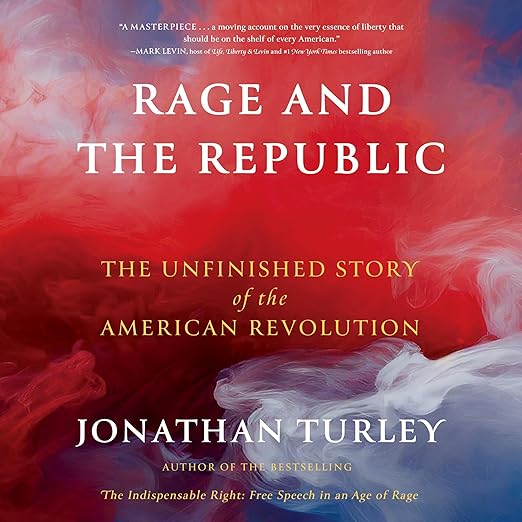
Several reviewers describe the book as required reading for American history and as urgently relevant to the current moment. The phrase instant New York Times bestseller on the cover is accurate as of its February 2026 release, and the book arrived in a political climate likely to give its argument immediate traction. What is worth noting is that Turley, who has been a prominent legal commentator on events across multiple presidential administrations, is making a structural argument rather than a partisan one. Some readers will find this evasive; others will find it exactly the kind of analysis the moment requires. The book’s intellectual honesty lies in its refusal to make the current crisis simply about one side or one figure.
Who Should Listen to Rage and the Republic
Listeners who are genuinely interested in American constitutional history and the philosophical underpinnings of democratic governance will get the most from this. It rewards careful listening rather than background listening; the historical argument is dense enough that it benefits from attention. Readers looking for partisan validation in either direction will be disappointed. Those looking for a serious, historically informed attempt to understand what is actually at stake in the current moment will find it here.
Frequently Asked Questions
Does Rage and the Republic take a partisan political position?
Turley explicitly avoids partisan framing. His concern is with constitutional culture and democratic norms as structural matters, and he draws examples of their erosion from across the political spectrum.
How does the book handle the comparison between the American and French Revolutions?
This comparison is one of the book’s central threads. Turley explores why the American founding produced stability while the French Revolution collapsed into the Terror, drawing on specific figures and decisions to explain the divergence.
Is this book primarily historical or does it address the contemporary political situation?
Both. The historical argument occupies most of the book, but Turley applies its lessons explicitly to current challenges, including the role of artificial intelligence, economic disruption, and what he describes as a crisis of faith in democratic institutions.
How does Turley’s self-narration compare to a professional narrator for this kind of dense historical argument?
His legal training produces clear, well-organized speech, and the delivery is authoritative. The limitation is tonal range: he maintains a fairly steady cadence throughout, which works for the argument’s logic but can make it harder to track which ideas are the most important in long passages.