Quick Take
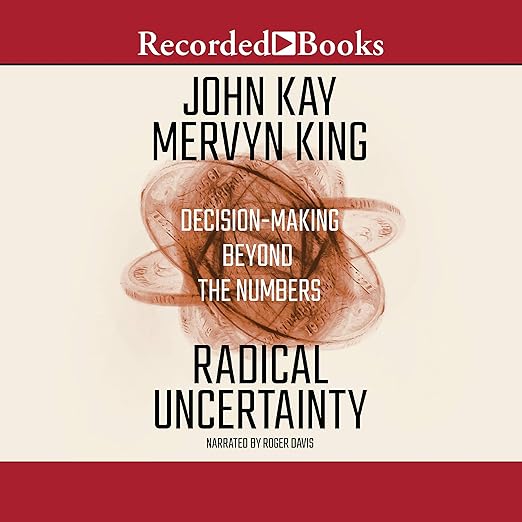
- Narration: Roger Davis delivers the dense academic material at a measured pace that respects the argument’s complexity without becoming soporific, serviceable and appropriate for the content
- Themes: the limits of probabilistic reasoning, narrative as a decision-making tool, the gap between economic models and lived reality
- Mood: Dense and intellectually rigorous, rewarding for patient listeners
- Verdict: A genuinely important methodological argument that runs too long for its core thesis, but the sections on narrative and corporate culture alone justify the investment for anyone who works with economic models or policy decisions.
I started Radical Uncertainty during a long international flight, which turned out to be an apt context. There is something clarifying about reading an argument against false certainty while suspended above the ocean in a metal tube, subject to weather patterns no model had predicted would be this turbulent. Kay and King would have approved of the irony.
The book is co-authored by John Kay, an economist and financial journalist, and Mervyn King, the former Governor of the Bank of England, a pairing that gives the argument both theoretical grounding and institutional credibility. Their central claim is straightforward to state but requires substantial excavation to support: the quantitative models that dominate economics, finance, and public policy are built on a foundational error. They treat the future as a known probability distribution, when in fact most of the decisions that matter most, in business, in markets, in policy, are made under conditions where we genuinely do not know what we do not know. This is what they call radical uncertainty, and it is a different category from the calculable risks that conventional probability theory is equipped to handle.
The Critique of Probabilistic Thinking
Kay and King are systematic in their dismantling of the orthodox view. They trace the history of how probability theory was imported into economics and policy, and they document the ways that importation has produced institutions and decisions built on what they call the false belief that the numbers provided by economic models give us the answer. The financial crisis examples are the most visible evidence, but the argument extends well beyond finance, into climate policy, medical decision-making, intelligence analysis, and any domain where numerical confidence intervals are mistaken for actual knowledge.
One reviewer noted the book seemed like a reaction to the financial crisis and thus ten years late on publication in 2020. That critique has some validity: the specific examples that anchor the argument are weighted toward 2008 and its aftermath, and certain sections feel like they are relitigating debates that were more urgent in 2010. But the methodological point is not actually time-bound, and the sections that move beyond the crisis examples into broader epistemological territory are where the book is at its most valuable and most original.
Narrative Over Numbers and Why That Matters
The book’s most productive contribution is its argument for narrative as the appropriate cognitive tool for conditions of radical uncertainty. The best managers in the public and private sectors, Kay and King argue, rely on narratives rather than numbers, they construct coherent accounts of what is happening and why, update those accounts as new information arrives, and use them to orient decisions rather than optimizing against a single numerical target. This is a significant claim that has practical implications for anyone who has ever been in a room where a spreadsheet was treated as a substitute for judgment.
The chapter on corporate cultures and how narrative shapes organizational decision-making drew particular notice from reviewers, including one who described it as insightful in ways that made them reconsider assumptions about how large institutions actually function. That section alone merits the listen for anyone in organizational leadership or policy work. The philosophical scaffolding around it is thorough, occasionally to the point of being repetitive, but the core argument is sound and the illustrations are well-chosen and illuminating.
What the Fifteen-Hour Runtime Costs You
The honest critique of this audiobook is length and repetition. At fifteen hours and fifty minutes, Radical Uncertainty is a substantial time investment, and multiple reviewers, including admirers of the argument, noted that it is a little long and a little repetitious. The core thesis could be advanced in ten hours without significant loss. Kay and King circle their central point with enough variation to feel like they are adding rather than merely repeating, but the impression that the book has been padded past its optimal length is difficult to shake in the later chapters.
Roger Davis’s narration handles the academic prose with professional competence. He reads at a pace that respects the complexity of the material without dragging it into somnolence, and his delivery is consistent across fifteen-plus hours. This is exactly the right approach for dense nonfiction, present but unobtrusive, letting the argument carry the weight without the narrator calling attention to themselves.
For Whom This Investment Pays Off
Radical Uncertainty rewards listeners who engage with economic methodology, financial theory, or policy analysis at a level where the epistemological critique has practical implications for their work. If you are in a profession where models are used to justify decisions that affect real people, the argument Kay and King make is directly relevant and worth the fifteen-hour commitment. If you are approaching this as a general reader interested in ideas about uncertainty and decision-making, the book will yield substantial value in its first half, and the back half may feel like diminishing returns.
Listen if you work with economic models, financial forecasts, or policy analysis and want a rigorous challenge to the epistemological assumptions underneath those practices. Skip if you want a tightly edited argument, this book is important but generous with its own length. Skip if you need audiobooks that sustain narrative momentum; this is fundamentally a work of sustained intellectual argument, and it is comfortable being exactly that for nearly sixteen hours.
Frequently Asked Questions
Is Radical Uncertainty accessible to listeners without an economics background?
It is more accessible than a standard economics text, and Kay and King write with journalists’ awareness of the general reader. However, several reviewers note it is not a book for the casual reader, familiarity with basic economics and some of the sources quoted will make the argument substantially more tractable.
How does Radical Uncertainty differ from other books critiquing economic models, like Nassim Taleb’s work?
Kay and King engage with Taleb’s framework and differentiate their concept of radical uncertainty from his notion of black swans. Their critique is more methodological and institutional than Taleb’s, and less aphoristic. They are more interested in what decision-makers should actually do than in cataloguing spectacular model failures.
Does the book offer practical guidance for making better decisions under uncertainty, or is it primarily theoretical?
Both, but weighted toward theoretical. The argument for narrative-based decision-making has practical implications, and the chapter on corporate culture is concretely applicable. Listeners expecting a self-help-adjacent framework for personal decision improvement will be disappointed, this is fundamentally a work of economic philosophy.
At nearly sixteen hours, is there a way to prioritize sections of this audiobook?
Reviewers consistently highlight the chapters on narrative and corporate culture as the most applicable and the most original. The opening theoretical chapters are necessary for the argument, but if you find the pace slowing in the middle, pushing through to the later sections on narrative decision-making is worth the effort.