Quick Take
- Narration: Peter Fenner narrates his own work, which is both a strength and a constraint, his workshop presence is genuine, but the format is closer to recorded teaching than produced audiobook.
- Themes: nondual awakening, unconditioned awareness, dissolving the Western ego’s barriers to contemplative experience
- Mood: Quiet and deliberate, oriented toward direct experience rather than intellectual summary
- Verdict: A serious, practitioner-oriented audio workshop that rewards sustained engagement but is not an introduction for the curious, it is a working tool.
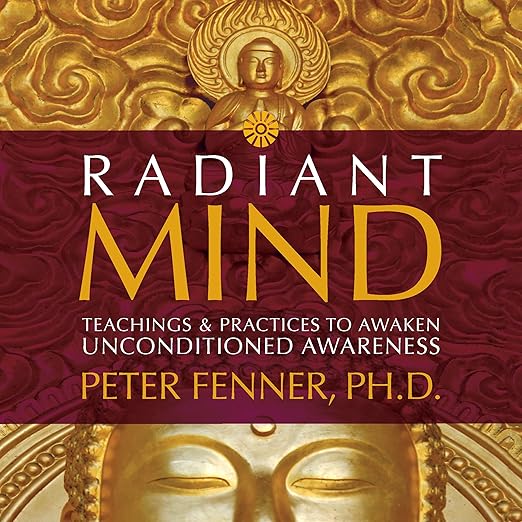
I came to this one in the middle of a stretch where I was reading a lot of commentary on nondual traditions, Adyashanti, Rupert Spira, some of the more accessible Dzogchen material, and I wanted something that moved from description to practice. Radiant Mind is that, more completely than almost anything I have encountered in this space. Peter Fenner’s eight-hour audio workshop is not a book about nondual awakening so much as an attempt to transmit it, and the distinction matters enormously for how you approach the listening experience.
Fenner is an Australian teacher with decades of experience in Tibetan Buddhist study and what he calls nondual therapy. The synopsis is accurate about his background and intention: he is specifically addressing Western practitioners, and the sophistication of his diagnosis of what blocks Western people from direct contemplative experience, cultural conditioning, the ego’s preference for experience over understanding, the habit of turning practice into self-improvement, is genuine. This is not Eastern teaching lightly adapted for a Western audience; it is a genuinely different methodology built from that gap.
Our Take on Radiant Mind
The core concept is unconditioned awareness, what Fenner also calls pure presence, the state that many traditions name differently but point toward similarly. His approach is to reduce the distance between the description and the experience by eliminating the conceptual apparatus that most teachings inadvertently build up. One reviewer, who later took Fenner’s live course, noted an immediate connection from first reading, that kind of response suggests the transmission quality is real, not just rhetorical.
What distinguishes Fenner from many nondual teachers is a quality of lightness. One reviewer described the progression in a live course from questions to silence, ending in collective laughter at the obvious answer. That sensibility is present in the audio too. He is not heavy. The path he describes is not effortful in the way that self-improvement frameworks are effortful; it is more like learning to stop constructing obstacles.
Why Listen to Radiant Mind
The self-narration is appropriate for this material. Fenner’s delivery in his workshops was evidently similar to his delivery here, calm, unhurried, with a capacity for silence that does not feel like dead air. One reviewer described the practical effect precisely: where he had been beating himself up in meditation, he now experiences what is with more grace and acceptance. That kind of specific, behavioral change is a useful measure of whether a contemplative teaching is actually doing what it claims.
The eight-hour format allows Fenner to move through beginning and advanced material in sequence, which means the audiobook can meet listeners at different stages. The Sounds True production is clean and quiet, which is appropriate, this is not a book that benefits from dramatic production values. There is something right about encountering nondual teaching through a medium that asks you to sit quietly and listen, and Fenner uses that alignment consciously.
What to Watch For in Radiant Mind
This is not an introduction to nondual concepts for someone encountering them for the first time. Fenner assumes some familiarity with contemplative practice and specifically with the problems that Western practitioners encounter. Listeners who are new to meditation or Buddhist-adjacent frameworks may find the vocabulary unfamiliar and the exercises hard to locate without prior context.
The format is also genuinely workshop-style rather than conventionally written. The pacing is slow by audiobook standards, with pauses for reflection built into the structure. Listeners who prefer a lecture that moves efficiently through ideas will find this requiring a different kind of attention. The value is in the doing, not the summarizing.
Who Should Listen to Radiant Mind
Practitioners with some existing meditation background who are interested in nondual traditions, particularly those drawing from Tibetan Buddhist sources, will find this a substantial and usable resource. Teachers and therapists working in contemplative frameworks may also find Fenner’s Western-specific framing practically useful. Those new to meditation or looking for a general introduction to Buddhism should start elsewhere and return here when the foundation is in place.
Frequently Asked Questions
Is Radiant Mind suitable for someone who has never meditated before?
Not ideally. Fenner’s approach addresses the specific obstacles Western practitioners encounter, which assumes some prior engagement with contemplative practice. Listeners new to meditation would be better served starting with a foundational practice guide and returning to this work later.
How does Peter Fenner’s self-narration compare to a professionally produced audiobook?
The format is closer to a recorded workshop than a polished audiobook performance. Fenner’s own delivery is calm and carries his teaching presence effectively, but listeners expecting a produced narrator performance should understand this is a different format.
Does the Radiant Mind audio course replicate the experience of attending one of Fenner’s live courses?
One reviewer who attended both noted immediate connection to the book and found the live course deepened the work. The audio version transmits the core methodology but cannot fully replicate the group energy and real-time responsiveness of in-person teaching.
Is this audiobook specifically tied to Tibetan Buddhism, or does it draw from multiple traditions?
Fenner draws primarily from Tibetan Buddhist frameworks, particularly Dzogchen and Mahamudra, but frames his teaching in language accessible to practitioners from other contemplative backgrounds. The specific tradition is the source; the delivery aims to be tradition-inclusive.