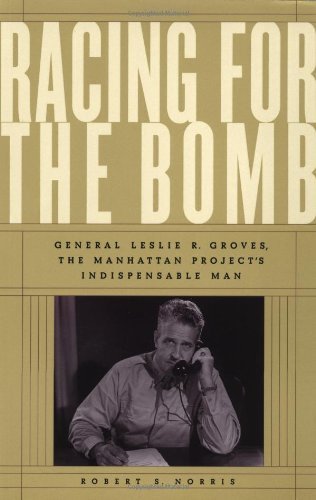
- Voice: Peter Johnson carries the credit alone across a file long enough to count as a semester.
- Big ideas: The Manhattan Project from the management side, engineering as power, wartime secrecy, the biographer's admiration problem.
- Atmosphere: Methodical, granular, institutionally patient.
- Worth it?: A definitive-scale life of Leslie Groves for listeners who want the procurement and the politics rather than the physics.
Nothing on this page says who the book is about. The title field reads Racing for the Bomb and stops, the description field sits empty, and no release date is recorded. Twenty-three hours and one minute of audiobook wait behind a listing that will not name its own subject, and the only people who do name it are the buyers who already read it.
The Unintended Comedy of Racing for Real Estate
One response supplies everything the listing withholds. This is a biography of Leslie Groves, written by Robert S. Norris, and it landed in a crowded field: accounts of the Manhattan Project had been arriving since the war, several lives of Groves already existed, and Paul Newman had played him on screen in Fat Man and Little Boy. Norris was after the academically definitive book, that entry says, and cannot be accused of failing at it. Thorough is the word it settles on, and it finds unintended comedy in the title along the way, since racing is what the cover promises while as late as page 214 the search for real estate for the project's sites was still under way. A good deal of this file precedes the part most buyers came for, and knowing that in advance turns a complaint into a plan.
An Invisible Character Wedged Into the Publisher Name
Gaps in the record around the book compound the problem. No publisher copy reaches this page at all, so the description a buyer would normally lean on is simply absent. The publisher name arrives with an invisible character wedged in front of it, which is what a listing looks like when a machine has assembled it from a print catalog. Twenty-three hours and one minute is a substantial purchase to make on this little information.
The bare title makes it worse still. Racing for the Bomb names a subject nobody would search for by that phrase, and this listing carries no subtitle to repair it. A buyer arriving from a military biography shelf cannot tell whether the book is a general history, a life of Groves or a life of Oppenheimer until the written column has been read from the top. Publishers put names into subtitles for precisely this reason, and somewhere between the print edition and this page that name went missing.
Spend the Sample on an Administrative Passage
One entry describes exactly the correction the book performs. That reader arrived with a one-dimensional picture of Groves as somebody merely carrying out Oppenheimer's directions and came away with a well-trained engineer who made certain the weapon was built and used as expeditiously as possible, in the conviction that doing so saved US and Allied lives. A harsh taskmaster, that entry adds, and an experienced construction engineer. If your mental image of the project is a room full of physicists, this is the book that puts the builder back into the frame.
The scale is the other argument for it. Twenty-three hours and one minute is a genuine investment, and an undertaking of this size rewards a book willing to spend real time on procurement, site selection, personnel and the machinery of secrecy rather than on the physics alone. Institutional history is what this format handles best, since a listener can carry a long chain of decisions around while walking in a way that skimming a dense page rarely permits.
Reading duties fall to Peter Johnson, alone, for the whole of it. What a file this long asks for is not range but level: a tone that survives hours of committee meetings and land purchases without either flattening into a drone or reaching for drama the material does not contain. Anyone weighing twenty-three hours should spend the sample on an administrative passage rather than on the opening, because the opening of a book like this is always its most performed few minutes.
Too Much Walking on Water for a Biographer
The three-star entry is the one to read before buying. It wanted the development of the bomb and the delivery system, and found half the book given over to a personal life it had not come for. It also names the biographer's occupational hazard directly: too much walking on water, goodness repeated too many times, and nobody being that perfect. Take that as a fair warning about register. A book with academic ambitions can still be an admiring book, and that reader thought this one was.
Two more entries on the page are not about the writing at all. One reports receiving a good clean former library copy and being pleased with it. Another says the book arrived in great condition ahead of schedule and calls it a nice find. Both are honest, both concern a parcel rather than a text, and both sit in the same column as the entries that engage with the argument. The readable part of that column is smaller than the page makes it look.
One structural problem remains, and it belongs to the format rather than to the book. A twenty-three-hour institutional biography works as a reference text as much as a narrative, since you will want to go back to a decision, a date or a name. No chapter list reaches this page, and audio offers no index of its own. Listeners planning to use this as a source rather than only as a story should take notes as they go, because finding a passage again inside a file this size turns into an afternoon's work.
Glad of Every Hour at This Length
Listeners who want the Manhattan Project from the management side rather than from the laboratory are the audience here. So is anyone who has read the physicists and wondered who found the land, hired the contractors and kept the whole enterprise quiet. Readers of long institutional biography, the kind where an appointment or a memo carries as much weight as a test firing, will settle in comfortably at this length and be glad of every hour.
Steer clear if you came for the science. The physics is not the subject, and the machinery of the weapon shares the book with a full life story that begins long before the war and continues after it. Steer clear too if twenty-three hours of administrative detail sounds like a chore rather than a pleasure, since the pace is deliberate and the payoff is cumulative. Admiration is a register this book is comfortable in, so anyone needing critical distance from the subject should spend time on the sample first.
Frequently Asked Questions
How long is the Racing for the Bomb audiobook, and is it abridged?
Twenty-three hours and one minute, which places it among the longer single-volume biographies anywhere in the catalog. Nothing on the listing marks it as abridged, and the length is consistent with a complete reading rather than a condensation. At this scale an abridgment would normally be advertised, since it is the main reason a buyer picks one edition over another.
Does the Racing for the Bomb audiobook belong to a series?
No. Neither series field carries a value, and nothing in the written column points to a companion volume. The filing is biography and memoir with a military and war tag, so treat this as a standalone life rather than as one installment in a sequence. Nothing needs reading beforehand, which is worth knowing for a subject this heavily documented elsewhere.