Key Details
- Narration: Janina Edwards delivers steady, authoritative clarity suited to dense policy history, prioritizing the argument over performance.
- Themes: Redlining's aftermath, predatory inclusion in housing finance, government and industry collusion in Black homeownership.
- Mood: Rigorous and sobering, built on documentation rather than anecdote.
- Verdict: Essential listening for readers of housing policy and urban history, though it demands patience rather than offering a breezy narrative.
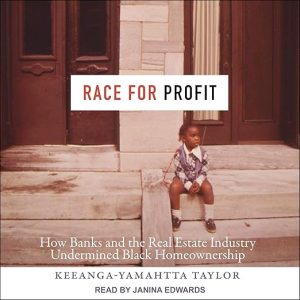
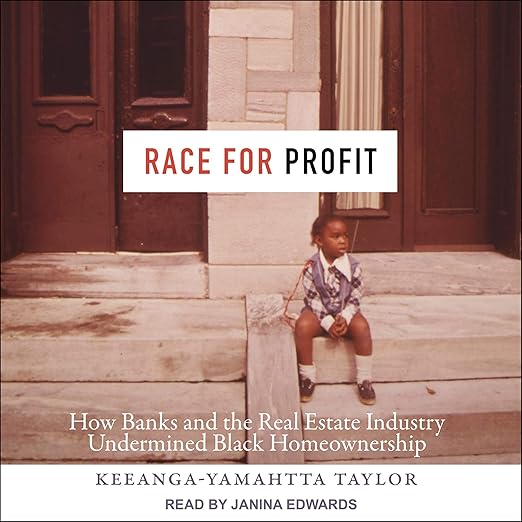
Redlining ending on paper in the late 1960s did not mean housing discrimination actually ended, and this audiobook spends more than twelve hours documenting exactly how that gap opened up. Keeanga-Yamahtta Taylor traces what happened after the Housing and Urban Development Act of 1968 was supposed to fix decades of exclusion: mortgage lenders and the real estate industry, under new pressure to include Black homebuyers, developed what Taylor calls predatory inclusion instead, a system that looked like access from the outside while functioning as a new form of extraction. Race for Profit was a finalist for the Pulitzer Prize in History and won the Pauli Murray Book Prize, and listening to Taylor's argument build case by case, it's easy to hear why.
Taylor Traces How Predatory Inclusion Replaced Redlining
The book's real achievement is refusing the comfortable story where redlining's end represents genuine progress interrupted only by isolated bad actors. Taylor builds a structural argument instead: the same institutions, the same regulatory relationships, and often the same individuals who enforced exclusion simply pivoted to a new business model once exclusion became legally risky. One reviewer summarized this precisely, noting how the book traces racism in lending and real estate 'abetted by the government from 1968 on', which captures Taylor's insistence that this wasn't rogue private-sector abuse operating despite government oversight, but abuse the government's own policy design made possible.
Taylor's evidence is granular rather than impressionistic: she follows specific policies, specific incentive structures between regulators and industry, and specific consequences for the Black homeowners caught inside a system nominally designed to help them. A reviewer who described loving a well-researched social science book called this one exactly that, and the density of documentation is real; this isn't argument by anecdote, it's argument by paper trail.
One of the book's sharpest specific arguments involves FHA mortgage insurance itself: Taylor documents how a program originally designed to reduce lender risk and encourage homeownership got restructured in ways that let unscrupulous actors profit regardless of whether a home purchase actually succeeded for the buyer, effectively removing the industry's incentive to ensure loans were sound in the first place. That mechanism-level detail is what separates Race for Profit from a more general account of housing discrimination.
Taylor is also careful to name the specific government agencies and regulatory bodies involved rather than gesturing vaguely at a broad system, which gives the book's central claim, that predatory inclusion was policy-enabled rather than simply a private-sector betrayal of good intentions, real institutional specificity a listener can actually follow and verify.
Edwards Brings Steady Clarity to a Live Argument
Janina Edwards narrates with a steady, authoritative clarity well suited to dense policy history; she doesn't dramatize the material for effect, letting Taylor's own carefully built case do the persuading. Given how much of this book depends on tracking specific policies and their downstream effects across more than a decade, a narrator who prioritizes clarity over performance, as Edwards does here, is exactly what the material needs.
At twelve hours and twenty-nine minutes, the book has room to actually build its case rather than gesture at it, moving from the legislative moment of 1968 forward through the specific, documented consequences for individual Black homeowners and neighborhoods. One reviewer noted learning how policies from the 1970s are still shaping who can buy a home today, which is the throughline that keeps this from reading as purely historical; Taylor is explicit that this is a story with a live present-day tail.
Taylor, a scholar whose earlier book From #BlackLivesMatter to Black Liberation established her as a major voice connecting historical policy to contemporary movements, brings that same throughline instinct here; she's explicit that Race for Profit isn't simply a history of a closed chapter but an explanation for patterns still visible in homeownership data today.
At over twelve hours, the audiobook also has room for Taylor's own analytical voice to develop across chapters, building toward her closing argument about the urban core's transformation into a new frontier of extraction, a framing that reframes everything documented earlier in the book as part of one continuous, deliberate pattern rather than a series of isolated failures.
Taylor's prose, while academically rigorous, avoids unnecessary jargon, which matters for an audiobook specifically, since listeners can't flip back easily to re-read a dense paragraph the way a print reader could. Edwards' clear pacing and Taylor's relatively accessible sentence structure work together to keep the argument followable in a purely auditory format.
Expect a Rigorously Organized Case File Here
This is rigorous academic history, part of the Justice, Power, and Politics series, not a breezy narrative nonfiction title, and listeners should calibrate expectations accordingly. The prose is clear and the argument well organized, but Taylor is building a sustained scholarly case with real density of policy detail, not a page-turning character-driven story, and the audiobook doesn't try to disguise that.
Because the book focuses tightly on federal housing policy and the real estate and mortgage industries specifically, it assumes some baseline familiarity with how redlining functioned in the first place. Listeners coming to this topic completely fresh may want a shorter primer on redlining's basics before diving into a book more focused on what came after its official end.
The book moves largely city by city and policy by policy rather than following a single narrative throughline or central character, which suits its argument but means listeners expecting a story-driven structure, in the vein of more novelistic narrative nonfiction, should adjust expectations toward something closer to a rigorously organized case file.
The book's scope stays deliberately focused on a specific slice of housing policy history rather than attempting a comprehensive account of American housing discrimination broadly, a distinction Taylor herself is careful to make explicit in her framing. Listeners wanting the fuller, longer arc from earlier property law through contemporary gentrification should treat this as one crucial chapter within that larger story rather than the whole account.
Fans of The Color of Law Get a Companion
Readers of housing policy, urban history, and books like The Color of Law will find Race for Profit a natural, rigorously documented companion, and its Pulitzer Prize finalist status and National Book Award longlist recognition reflect real scholarly weight, not just topical relevance. Anyone trying to understand the actual mechanics behind persistent racial wealth gaps in homeownership should treat this as essential listening.
Policy students, urban planners, and anyone working directly in housing or community development will find this closer to required professional reading than optional history, given how directly its documented mechanisms still echo in current lending and appraisal practices.
This is not a breezy listen, and listeners looking for an accessible general-audience introduction to redlining specifically, rather than its more complicated aftermath, may find the density here better suited to a second or third book on the subject rather than a first.