Quick Take
- Narration: Jan Cramer handles political complexity and emotional range with precision and consistency across nearly 23 hours.
- Themes: Female sovereignty under constraint, the Mary-Elizabeth political dynamic, archival history vs. romantic myth
- Mood: Dense, scholarly, and quietly gripping
- Verdict: The most rigorous and persuasive account of Mary Queen of Scots available in audio, demanding but genuinely rewarding.
John Guy’s biography of Mary Queen of Scots opens with her execution. Not as a dramatic hook or a spoiler, but as a deliberate structural decision: by showing us the end before the beginning, Guy forces the reader to hold Mary’s death in mind throughout the entire account of her life. I spent the first few chapters of this twenty-three-hour audiobook in a peculiar state of doubled attention, following the arc of a young queen who was always moving, consciously or not, toward the scaffold at Fotheringhay. It is one of the more effective narrative choices I have encountered in a historical biography, and it sets the tone for a book that approaches its subject with consistent intelligence rather than sentiment.
Jan Cramer narrates, and the sixteen-year-old Mary is as convincingly present in her voice as the fifty-year-old woman facing execution. Cramer handles the book’s considerable emotional range without theatrics, which is the right instinct for material this complex.
Our Take on Queen of Scots
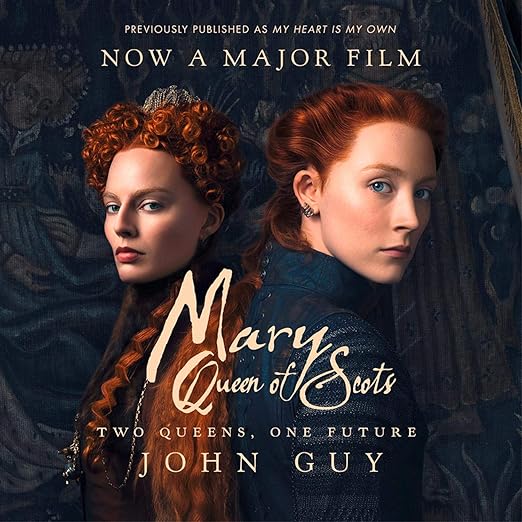
Guy’s biography originally published under the title My Heart Is My Own, and that more intimate framing captures something important about his method. This is a work built on primary rather than secondary sources, and Guy’s reliance on letters, dispatches, court records, and contemporary accounts gives the book a texture of immediacy that distinguishes it from popular biography. The reviewer who described it as “the triumph of scholarship over gossip” is pointing at something real: Guy consistently refuses the easy interpretive moves that have made Mary Queen of Scots such productive material for novelists and filmmakers. He complicates every simple version of the story.
The Mary that emerges from this account is neither the romantic martyr of tradition nor the reckless fool of Protestant propaganda. She is a ruler of genuine intelligence operating in conditions of nearly impossible constraint, navigating the competing demands of her Scottish nobility, the French court where she spent her formative years, her English cousin Elizabeth, and the religious upheaval of the Reformation. Her relationship with Elizabeth is the book’s central tension, and Guy traces it with precision. Both women sought a political settlement, and both were undermined by forces neither could fully control. The outcome was not inevitable, but Guy makes clear how each step narrowed the possible futures.
Why Listen to Queen of Scots
At twenty-two hours and fifty-five minutes, this is a substantial commitment, and it pays out in proportion to the investment. Guy has written a book that genuinely changes how you understand a figure most people think they already know. The received narrative of Mary as beautiful, tragic, and politically naive is so embedded in popular culture that encountering a version of the story built on archival research rather than romantic tradition is genuinely corrective. A reviewer described coming to the book with knowledge of Mary “based on her literary persona” and finding “a new, complex and fascinating Mary” in Guy’s account. That experience is reproducible. The biography earns its length.
Cramer’s narration handles the political complexity with clarity. Sixteenth-century Scottish and English politics involve an extraordinary number of nobles, factions, and shifting alliances, and keeping track of them requires attentive listening. Cramer’s consistency with names and her ability to differentiate voices in the occasional reported speech make the cast of characters manageable without reducing anyone to a type. The Scottish political landscape in particular, with its competing noble factions and religious divisions, requires careful navigation, and Cramer provides it.
What to Watch For in Queen of Scots
The book is dense with political and diplomatic detail, and listeners who approach it expecting narrative velocity will need to adjust their expectations. This is biography as historical scholarship: thorough, argued, and footnoted in spirit if not always in delivery. Some chapters move slowly through legal and diplomatic correspondence that is essential to Guy’s argument but demands active rather than passive listening. One reviewer described it as “a bit lengthy,” which is both true and slightly beside the point. The length is the argument. A shorter book would be a different kind of book.
The coverage of Mary’s final eighteen years as Elizabeth’s prisoner is necessarily grimmer and more constrained than the earlier sections, which move across France, Scotland, and the great courts of Europe. Some readers find the later chapters less engaging for this reason. But the execution scene that opens the book casts everything that precedes it in a particular light, and the final chapters have the quality of inevitability that Guy’s structural choice earned all along.
Who Should Listen to Queen of Scots
History readers who prefer archival rigour over novelistic narrative will find this one of the better biographies in the Tudor-Stuart period. Listeners familiar with the popular version of Mary’s story, whether from film, fiction, or lighter history, will find this a productive complication of everything they thought they knew. The commitment is real at nearly twenty-three hours, but Guy and Cramer make it worthwhile for anyone prepared to engage with the material as history rather than as drama.
Frequently Asked Questions
How does Guy’s portrayal of the Mary-Elizabeth relationship differ from most popular accounts?
Guy frames the relationship as primarily political rather than personal, showing two women who began as potential allies and were pushed into opposition by forces including their advisors, religious factions, and the structural impossibility of two queens ruling adjacent kingdoms. He is skeptical of readings that reduce the dynamic to jealousy or personality conflict.
Is Jan Cramer’s narration accessible for listeners unfamiliar with Scottish history and the many noble names involved?
Cramer maintains consistency with names and locations throughout the twenty-three-hour production, which is essential for a book with this many historical actors. She differentiates characters clearly without making the narration theatrical. Listeners may want to have a cast of characters available for reference if they get lost in the political factions.
The book was originally titled My Heart Is My Own. Does the rebranding as Queen of Scots lose anything from the original framing?
The original title, drawn from one of Mary’s own statements, carries a more intimate and biographical resonance than the film-era rebrand. Guy’s book is fundamentally a study of a woman’s interior life as much as a political history, and My Heart Is My Own captures that dimension more precisely. The Queen of Scots title positions it alongside the Saoirse Ronan film, which may attract new readers but somewhat flattens the scholarly ambition.
Does Guy take a clear position on whether Mary was complicit in the Darnley murder, one of the central historical controversies about her?
Guy approaches this question with characteristic archival rigour, examining the evidence rather than advocating a conclusion. His treatment of the Casket Letters, the primary documentary evidence in the controversy, is among the most careful in the scholarly literature. He does not exonerate or convict but presents the evidentiary landscape in a way that lets readers weigh the competing interpretations.