Quick Take
- Narration: K.C. Wayman delivers a competent, neutral narration suited to beginner instructional content, though the under-three-hour runtime limits how much technical ground can be covered.
- Themes: Python basics for beginners, data analysis foundations, exploratory data analysis
- Mood: Encouraging and accessible, aimed squarely at newcomers to programming
- Verdict: A brief conceptual introduction to Python for data analysis, best treated as a starting point rather than a complete tutorial, and most useful for listeners who have no prior coding exposure.
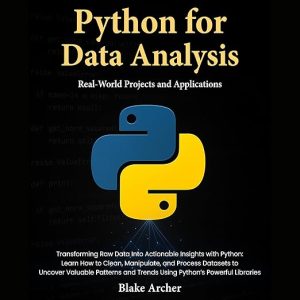
I want to be upfront about the scope of this one before anything else: at two hours and forty-seven minutes, Python for Data Analysis by Blake Archer is not a comprehensive Python tutorial. It is a conceptual orientation, a book that explains why Python matters for data work and what it looks like in practice, without the extended hands-on instruction that learning to code actually requires. Understanding that going in will save a listener from the frustration of expecting something the runtime simply cannot deliver.
The book’s framing is broad and aspirational. The U.N.R.A.V.E.L. framework the synopsis references, and the promises of covering everything from Exploratory Data Analysis to visualization techniques to real-world use cases, are the kinds of marketing claims that a book of this length can only partially honor. What Archer actually delivers is a structured introduction to the concepts involved, the kind of foundation-setting that makes a longer learning resource more navigable once you move to it.
What the U.N.R.A.V.E.L. Framework Actually Delivers
Structured acronym frameworks are a staple of beginner technical books, and their value depends on how well the mnemonic survives contact with the actual content. The U.N.R.A.V.E.L. approach, which the synopsis describes as a way to untangle the complexities and unlock the full potential of Python for data analysis, is designed to give first-time learners a way to organize unfamiliar material. In a nearly three-hour audiobook, each element of the framework gets roughly fifteen to twenty minutes of attention, which is enough to introduce a concept but not enough to develop it.
K.C. Wayman narrates with a calm, professional delivery that is appropriate for introductory content. The material does not call for dramatic inflection, and Wayman does not provide it. For a listener who has never written a line of code, the measured pacing gives each conceptual step enough room to settle before the next one arrives.
The Practical Exercises Problem in Audio
The synopsis promises “practical Python exercises to enhance your coding confidence,” which is a reasonable thing to include in a print or digital learning resource and a very difficult thing to deliver in audio format. Coding exercises require a screen, an environment, and iteration. An audiobook listener cannot type along, run code, see error messages, or debug. What the audio version of practical exercises actually provides is a verbal description of what an exercise would involve, which is conceptually useful but functionally different from what the word “exercise” implies.
This is not a unique problem for this book; it is a structural challenge for any programming instruction in audio format. The listener who gets the most from this version is one who uses the audiobook to build a mental model of what Python data analysis involves, and then moves to a hands-on resource like a Python course, an interactive notebook environment, or a more comprehensive text to develop actual skills.
No Reviews and a Narrow Scope
There are no listener reviews for this title, which limits the social signal about whether its approach lands for its intended audience. The book’s most useful contribution is probably its explanation of Exploratory Data Analysis as a concept, its coverage of how Python’s data tools, the ecosystem of libraries rather than the language itself, make analysis faster and more systematic, and its real-world use case sections that give aspiring analysts a sense of where these skills are applied.
Listen if you have zero coding background and want to understand what Python data analysis involves before committing to a more intensive learning program. Listen if you learn well from conceptual framing before diving into hands-on practice. Skip this one if you are already comfortable with basic Python or if you need actual technical instruction; two hours and forty-seven minutes is not enough runtime to develop usable skills regardless of how efficiently the material is organized.
Frequently Asked Questions
Is this the same Python for Data Analysis as the Wes McKinney book on pandas?
No. The Wes McKinney title is one of the most widely used references for data analysis with Python’s pandas library, written by the creator of pandas itself. This is a separate introductory book by Blake Archer. They share a category and a title but are entirely different works aimed at different levels of prior knowledge.
Can you actually learn Python from an audiobook at under three hours?
Not in any functional, hands-on sense. What you can do in that runtime is build a conceptual understanding of what Python data analysis involves, why Python is used for this work, and what the major tools and approaches look like at a high level. Treat this as orientation material rather than instruction and it will serve its purpose.
How does K.C. Wayman handle the code-related vocabulary throughout?
Wayman delivers technical terms like Exploratory Data Analysis, visualization libraries, and data pipeline concepts clearly and without awkwardness. The narration is professional and consistent. For a beginner audience, the delivery is well-paced enough that unfamiliar vocabulary has time to register before the next concept arrives.
What should I listen to or do next after finishing this audiobook?
For actual Python skill development, an interactive course on a platform like Coursera, DataCamp, or Kaggle Learn will provide the hands-on environment that an audiobook cannot. If you want a more comprehensive audio-friendly treatment of data analysis concepts without the coding, books like Think Clearly or Analytics the Right Way offer deeper analytical frameworks for non-programmers.