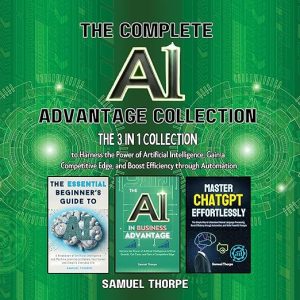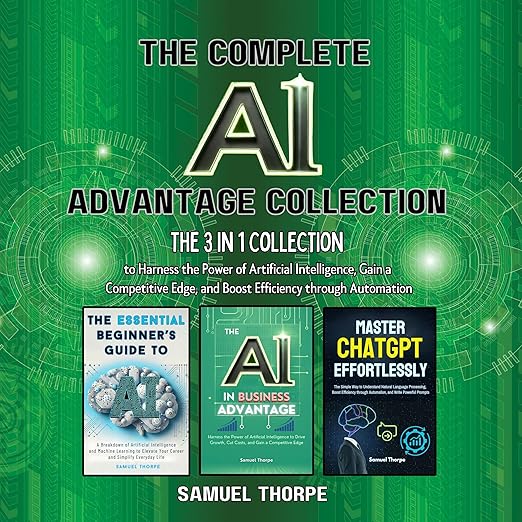
Samuel Thorpe's three-part collection arrives at a moment when AI literacy has become a genuine professional expectation rather than a specialist interest. The Complete AI Advantage Collection bundles three distinct guides into a single 14-hour-and-33-minute audiobook narrated by Tom Brooks: The Essential Beginner's Guide to AI, The AI in Business Advantage, and Master ChatGPT Effortlessly. The design logic is coherent. Each section escalates in specificity, moving from foundational concepts through business strategy to tool-level practice. For listeners who want a structured introduction to the entire landscape without committing to a technical deep-dive, that progression makes sense.
Tom Brooks Narrates at a Note-Taking Pace
The collection works because it does not pretend to be something it is not. This is not a technical primer on how neural networks function; it is an orientation guide for the vast majority of professionals who need to understand what AI can do without needing to know how it does it. One reviewer described the beginner's guide as clear and approachable and the business section as offering useful insights while noting the collection could go deeper. That assessment is accurate. The depth ceiling is real, but it is appropriate to the stated audience. The ChatGPT section is the most immediately actionable component, walking through practical prompt strategies, content generation workflows, and integration patterns that can be applied the next working day. Reviewers consistently flag that section as the strongest of the three.
Tom Brooks narrates at a pace suited to note-taking. The material is conceptual rather than code-heavy, which means the audio format suffers none of the translation problems that affect technical programming titles. Brooks keeps the tone confident without veering into the hype-adjacent register that plagues many AI business books. That restraint is welcome given how saturated the market for AI productivity content has become. One reviewer called it a great resource for anyone looking to gain a competitive edge through AI, while another appreciated its value for people who feel they can no longer ignore the technology. Both responses reflect what the collection actually delivers.
Skip Between Sections Based on Your Need
The audiobook format suits this material particularly well. Unlike deep learning or data science texts, the content here is conceptual and narrative rather than formula-dependent, meaning listening while commuting or working out produces genuine retention. At just under fifteen hours across three books, the runtime is dense enough to feel substantial without demanding the multi-week commitment of a technical textbook. The bundled structure also means you can skip between sections based on your current professional need. A business professional already comfortable with AI fundamentals can go straight to the AI in Business Advantage section; a complete newcomer benefits from working through sequentially. The progression from fundamentals through business applications through specific tool mastery gives the collection a satisfying arc for listeners who go cover to cover.
The collection earns its 4.8 rating from 24 reviews by setting honest expectations and meeting them. It does not promise to make you a machine learning engineer. It promises to make you a more informed professional in an environment where AI fluency is increasingly assumed, and it delivers on that narrower but genuinely useful claim. The ChatGPT section in particular reflects how quickly the practical landscape has evolved: the guidance on integrating AI tools into writing, brainstorming, and research workflows is concrete and applicable rather than aspirational.
Attention Drifts Most in the Middle Section
The collection's limitations are worth being clear about. Listeners with existing AI or data science backgrounds will find the first third of the audiobook covers familiar ground quickly and the business applications section may feel general rather than sector-specific. The AI in Business Advantage guide covers efficiency gains and workflow automation at a level that applies broadly but may feel thin for listeners in specialized industries who need more granular guidance. One reviewer noted the content could be more in-depth, and that critique is fair at the beginner-to-intermediate boundary.
The pacing across the three books is worth noting. The beginner guide is the shortest and most accessible section; the business applications middle section is the densest conceptually; and the ChatGPT section returns to a more practical, step-by-step cadence. That structure creates a satisfying arc for listeners who work through sequentially, but it also means the middle section is where attention is most likely to drift. Brooks's narration helps here: the measured delivery gives the business strategy passages more weight than they might carry from a more hurried reader. Listeners who engage actively with the business section, asking how each concept applies to their own professional context, will extract more value than those who absorb it passively.
The title claims advantage in its name, The title claims advantage in its name, and while the foundational and tool-level sections earn that framing, the business strategy content stops short of the sophisticated competitive analysis the word advantage might imply. This is an orientation guide, not a strategic playbook.
Clear Enough to Work as a First Pass
This audiobook is calibrated for professionals who feel they have fallen behind on AI and want a single structured catch-up rather than scattered blog posts. Small business owners, managers, and marketers who want to understand how to use ChatGPT practically and where AI fits in their workflow will find exactly what they need here. Listeners already publishing AI research or working in machine learning professionally will find the material too introductory to add value. Students new to technology careers who want to understand the landscape before going deeper technically will find this a useful orientation before moving on to more rigorous resources. Tom Brooks's narration is clear enough that the audiobook works well as a first pass before more technical reading.
In Brief
- Narrator: Tom Brooks brings a clear, approachable delivery to Samuel Thorpe's three-part collection, keeping the practical framing accessible without dumbing down the business applications.
- Subjects: AI fundamentals for non-specialists, ChatGPT workflow integration, business automation and competitive strategy
- Tone: Practical and forward-facing, mildly urgent
- Bottom line: A serviceable three-in-one primer on AI literacy and ChatGPT use that works best for professionals who need a rapid orientation rather than deep technical understanding.
Does this audiobook require any technical background to follow?
No. Samuel Thorpe's collection is explicitly designed for beginners and non-specialists. The AI fundamentals section assumes no prior knowledge of machine learning, programming, or data science, and the practical ChatGPT section is structured around workplace applications rather than technical implementation.
Is The Complete AI Advantage Collection audiobook best listened to in order or by section?
Listeners with no AI background benefit from the sequential structure, which moves from fundamentals through business applications to tool-specific guidance. Professionals already comfortable with AI basics can skip directly to the AI in Business Advantage or ChatGPT sections without losing context.
How practical is the ChatGPT guidance in this audiobook for immediate professional use?
Reviewers consistently rate it as the most actionable section of the collection. The guidance covers prompt strategies, content generation, brainstorming workflows, and time-saving integration patterns that apply across most professional contexts without requiring technical setup.