Quick Take
- Read by: Li Webster delivers this technical material with a clear, professional cadence that suits the instructional register well. The narration does not add personality to the content, but it handles terminology consistently and keeps the pacing appropriate for an active listening experience.
- At its heart: prompt engineering, large language model communication, AI productivity for non-technical users
- Vibe: Brisk and practical, with the energy of a well-organized professional workshop
- Short version: A focused, well-structured primer on prompt and context engineering for anyone who has struggled to get reliable results from AI tools and wants a principled framework for improving them.
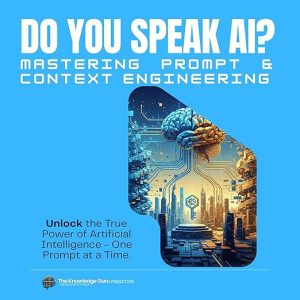
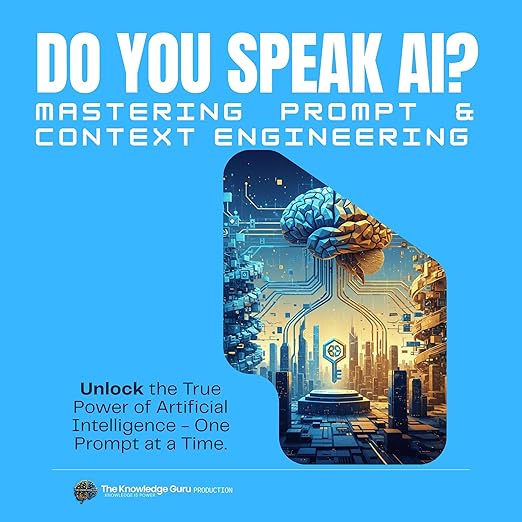
Clement Pereira's Do You Speak AI? Mastering Prompt and Context Engineering arrived at a moment when most audiobooks about artificial intelligence were either breathlessly optimistic or narrowly technical. This one occupies a different register: it is a practical communication guide. The central premise, that the quality of your results from large language models depends almost entirely on how precisely you formulate your requests, is not glamorous. But it is accurate, and Pereira builds a disciplined framework around it across three hours and twenty-eight minutes that the listening format handles particularly well for professionals who can apply concepts immediately after absorbing them.
The book is organized from fundamentals through advanced technique. The prompt anatomy section covers instructions, context, input data, and output formats as the building blocks of effective communication with AI systems. From there, Pereira introduces chain-of-thought reasoning, self-correction strategies, and decoding parameters, before moving into context engineering: how to provide background information, define roles for the AI system, and use conversation history to shape outputs across multi-turn interactions. The practical case studies draw from business, education, and content creation rather than from narrow technical domains, which broadens the book's applicability significantly for a professional audience that is not primarily technical.
Short, Dense, and Built for CPD Credit
At three hours and twenty-eight minutes, this is a short but dense audiobook. Pereira does not pad the material with extended examples or theoretical background beyond what the framework requires, which is a genuine virtue in a genre prone to inflation. The optional advanced track and worked examples sections reward listeners who engage actively rather than passively, and the CPD certificate inclusion signals that the author envisions professional development use as well as casual learning. That CPD framing is accurate: this is the kind of material that benefits from note-taking and immediate application rather than passive commute listening, and the content density reflects that intended use.
The target audience, entrepreneurs, writers, educators, and professionals using AI tools daily alongside students and business leaders preparing for an AI-integrated workflow, is well-defined and the content serves it directly. The absence of heavy technical prerequisites makes the material accessible to professionals who work with AI outputs rather than professionals who build AI systems. Li Webster's narration handles the terminology cleanly and moves through the framework sections without losing momentum in the more technical passages. The delivery is professional without being warm, which suits the workshop-like tone of the content.
Webster's Measured Delivery Lets the Contrast Land
The audiobook format suits this material better than it might initially seem. Prompt engineering is fundamentally about how you structure language, and Webster's clear, measured delivery of the framework sections gives listeners time to process the logic of each element before the content advances. The examples of effective versus ineffective prompts land differently in audio than on the page: hearing the contrast between a vague request and a precisely engineered one reinforces the lesson through the auditory register in ways that reading silently does not always achieve for practically-minded learners.
The chain-of-thought reasoning section deserves particular attention for listeners who have found AI outputs frustratingly inconsistent. Understanding why asking an AI to show its reasoning steps before providing an answer reliably improves output quality is one of the more counterintuitive insights in the field, and Pereira explains it without resorting to technical jargon about how language models function internally. The practical framing keeps the explanations grounded in what listeners can do immediately rather than in abstract theory about the systems themselves. The CPD self-attesting certificate component adds professional legitimacy for listeners who need to document continuing education hours.
Principles Stay Stable While Parameters Age
The three-and-a-half-hour runtime means this book covers its terrain efficiently but not exhaustively. Listeners already familiar with basic prompt engineering, who have read structured resources from leading AI providers or worked through structured tutorials, may find the fundamentals section covers familiar ground before arriving at the more nuanced context engineering material. The advanced track is positioned as optional, which suggests a tiered depth that some listeners may wish was developed further in the main content arc.
The AI landscape moves quickly, and some specific technique recommendations may reflect the behavior of particular AI systems at a particular point in their development. The underlying principles of clear instruction, rich context, and structured output requests are stable and transferable across providers. The specific parameter recommendations and behavioral descriptions of particular models may age. Listeners using this as a practical guide should treat the principled frameworks as durable and the specific model-behavior descriptions as illustrative examples rather than definitive current specifications.
Aimed at AI Users Rather Than Builders
Professionals who use AI writing, research, or analysis tools daily but have not formalized their approach to communicating with those tools will get the most from this audiobook. Writers who rely on AI assistants for drafts and editing, educators building AI-integrated curriculum, and business professionals who want more reliable and consistent outputs from AI tools already in their workflow are all well-served by Pereira's framework. The CPD certification eligibility makes it particularly suitable for professionals in sectors where continuing education documentation is required or valued.
Listeners with significant existing knowledge of prompt engineering, or developers who work at the technical level of model fine-tuning and deployment, will find the material pitched below their existing understanding. This is a practitioner's guide for users of AI tools, not a technical resource for builders of AI systems.
Frequently Asked Questions
Is this audiobook appropriate for someone with no technical background in AI or programming?
Yes. The book is aimed at practitioners who use AI tools rather than professionals who build them. The frameworks presented require no programming knowledge and are explained in terms of communication principles rather than technical architecture.
At only three and a half hours, is this audiobook long enough to cover prompt engineering meaningfully?
Pereira uses the runtime efficiently, covering fundamentals through advanced techniques without significant padding. The optional advanced track and worked examples sections add depth for listeners who want to go further. The core framework is complete within the main content.
How quickly might the specific AI recommendations in this audiobook become outdated?
The underlying principles of clear instruction, context provision, and structured output requests are stable and not model-specific. Specific behavioral descriptions of particular AI systems may age as those systems are updated. The principled framework is the durable content; treat specific examples as illustrative rather than definitive.