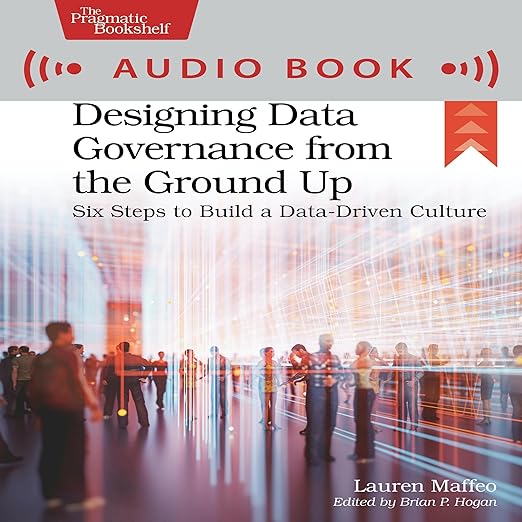
Lauren Maffeo's Designing Data Governance from the Ground Up arrives at a moment when nearly every organization claims to be data driven and most are not. The statistic Maffeo leads with lands hard: fewer than one in four business leaders say their organizations actually deploy data well. That gap between ambition and execution is exactly where this audiobook, narrated by Anna Katarina, plants its flag. Katarina's delivery is measured and authoritative, carrying over three hours of structured frameworks without ever tipping into the robotic cadence that haunts so many tech titles read aloud.
Maffeo, a senior content strategist with deep roots in the DataOps world, structured the book around six concrete steps rather than around abstract principles, which matters enormously for the audio format. Because you cannot flip back to a diagram or skim a bullet list while listening, a book that follows a numbered framework keeps you oriented even when the subject matter grows dense. At three hours and twenty minutes, the runtime is short enough that the six-step scaffold stays fresh throughout, and the audiobook never outstays its welcome.
Ninety Percent of Projects Never Reach Production
The central thesis is that most data projects fail at the governance level, not the technical one. Maffeo cites a striking figure: ninety percent of projects trained on big data never reach production, and the culprit is almost always a missing governance layer rather than poor modeling or insufficient compute. That reframing is the book's most valuable gift. Technical teams often treat governance as a compliance afterthought. Maffeo argues, convincingly, that it is the prerequisite that makes everything else possible.
What the audiobook offers is a practical framework for a chief data officer, a data steward, or even an individual contributor who needs to make the case upward and build a program from nothing. The six steps move from identifying a data framework through assembling a team of stewards, defining a roadmap, weaving governance into the development cycle, and then monitoring data once it is live in production. Glenn Street, one listener who used this book as the centerpiece of a staff discussion group on data management, described it as a genuine teaching tool. That endorsement says something specific: the structure holds up under scrutiny, not just under solo reading.
Paul Turpin, a database professional who attended one of Maffeo's All Things Open sessions before picking up the book, noted that it confirmed and expanded what her live talk covered. That companion relationship between speaking and writing suggests Maffeo has thought carefully about what each format can deliver, and the audiobook inherits that clarity of purpose.
Katarina Avoids the Text-to-Speech Trap
Anna Katarina earns real credit here. Data governance writing is prone to corporate jargon that becomes almost surreal when read aloud, and Katarina navigates the terminology with enough expressiveness to keep the prose from flattening out. She gives the material the tone of a competent senior colleague explaining something important, rather than a text-to-speech engine working through a slide deck. For a technical subject on audio, that distinction is not trivial.
The book's coverage of the buy-in problem is particularly well handled. Maffeo acknowledges frankly that building a data governance program requires managing upward, finding the right colleagues to co-create the practice, and keeping those people engaged over the long term. These are human and organizational challenges, not technical ones, and the audiobook treats them with the same rigor it applies to data stewardship mechanics. The result is a title that speaks equally to technical implementers and to the non-technical stakeholders they need to persuade.
Three Hours Buys Orientation Over Deep Reference
The brevity is both a strength and a constraint. At three hours and twenty minutes, this is a focused introduction rather than an exhaustive reference. Maffeo covers the full arc from strategy through production monitoring, but each stage gets treatment calibrated for awareness and direction-setting rather than deep implementation detail. For someone who has never encountered data governance as a formal discipline, it functions as an excellent orientation. For a senior data architect looking for nuanced case studies of governance at scale, the depth may feel thin in places.
The amount of data people produced grew three thousand percent in the last decade, as Maffeo notes, and most organizations still lack the strategy to clean, collect, organize, and automate it for production-ready use. That context makes this book timely. But the speed of change in data infrastructure means some platform-specific guidance described here will evolve. The governance principles are durable; any tool-specific recommendations should be verified against current practice before implementation depends on them.
Experienced Practitioners Get a Calibration Check
This audiobook belongs in the queue of anyone who has been handed a mandate to build a data governance function and does not know where to start. It is particularly strong for professionals moving from individual-contributor data roles into leadership positions where cross-functional alignment suddenly matters. Chief data officers looking for a framework to share with non-technical stakeholders will also find Maffeo's language accessible enough to quote directly in those conversations.
Listeners who should approach with adjusted expectations include experienced data governance practitioners who have already built and iterated on programs at multiple organizations. For them, this serves more as a calibration check than a genuine revelation. The short runtime and structured approach also make it less suitable for anyone who prefers rich narrative or case-study-driven business books. As a practical, honest, and well-narrated introduction to a discipline that organizations routinely underinvest in, it earns its place.
At a Glance
- Voice: Anna Katarina delivers Lauren Maffeo's dense technical content cleanly and without affectation, pacing the material well for an audiobook format that suits commute or focused listening equally.
- Big ideas: Data stewardship, organizational buy-in, cross-functional collaboration
- Atmosphere: Practical and methodical, with genuine urgency
- Worth it?: A compact, actionable framework for anyone trying to build data governance where none currently exists.
Does this audiobook cover both technical and organizational aspects of data governance?
Yes. Lauren Maffeo addresses both the structural mechanics of building a governance program and the human side, including how to get executive buy-in, identify the right data stewards, and keep a cross-functional team engaged over time.
Is the audiobook suitable for listeners without a data science background?
Maffeo designed the book for a wide audience, from chief data officers to individual contributors. Anna Katarina's narration keeps the material accessible, though some familiarity with data workflows will help you apply the six-step framework more immediately.
At three hours and twenty minutes, does this audiobook deliver enough depth to be actionable?
It covers the full arc from defining a framework through monitoring production data, but each stage is treated as an orientation rather than an exhaustive playbook. It gives you a working roadmap; deeper implementation will require additional resources.
Has anyone used this audiobook as a teaching or training tool in a professional context?
One reviewer, Glenn Street, used it as the centerpiece text for a staff discussion group on data management at his organization. The structured six-step format holds up well under that kind of group scrutiny and collective application.