Cultural Readiness Decides Whether Copilot Succeeds
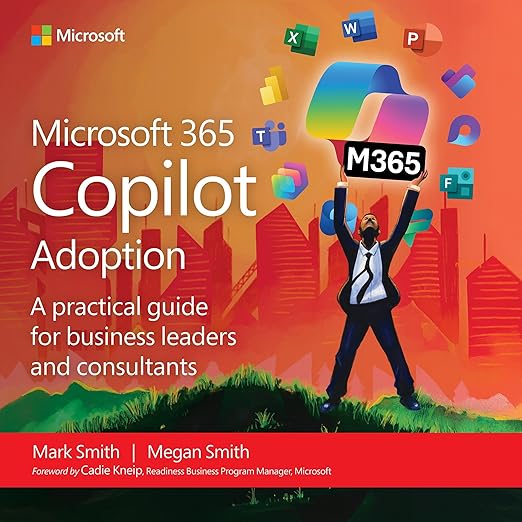
Mark Smith and Megan Smith's Microsoft 365 Copilot Adoption: A Practical Guide for Business Leaders and Consultants addresses a problem most technology implementation books ignore: getting AI tools deployed is far easier than getting organizations to actually use them well. This audiobook, narrated by Larry Jordan and running twelve hours and twenty-one minutes, draws on Microsoft's early adopter program data and real-world case studies to build a framework for what the authors call successful AI integration, a term they define primarily through change management and organizational culture rather than through technology configuration alone. That reframing is the book's most important move, and it is one that a significant portion of the target audience genuinely needs to encounter before making costly implementation decisions.
One Microsoft architect reviewer described the book's focus precisely: it is about people and processes, not just tech. That framing captures what makes this guide distinctive in a category crowded with books that spend most of their pages on feature explanations and prompt engineering tutorials. Smith and Smith open with the premise that leadership alignment and cultural readiness are the actual determinants of Copilot adoption success, and they maintain that premise throughout twelve hours of structured, example-grounded guidance. The technical dimensions of the Microsoft 365 ecosystem are present and handled competently, but they are subordinate to the human dimensions that actually determine whether an AI rollout generates lasting productivity gains rather than a brief burst of enthusiasm followed by quiet disengagement.
Jordan Carries Twelve Hours Without Condescension
Larry Jordan's narration is well-suited to the material. Business guides of this kind require a voice that carries authority without condescension, that makes complex organizational concepts feel navigable without oversimplifying them. Jordan manages that balance consistently across the full twelve-hour runtime. The technical sections, covering Copilot Champions networks, data privacy frameworks, and communication plan construction, are read with the same engaged clarity as the more narrative case study passages, which makes the full audiobook feel more coherent than many technology guides of comparable length and density. Jordan never sounds like he is merely reading a list, which matters enormously for a book with as much structured content as this one contains.
The case study foundation is the book's most concrete asset. Rather than offering principles derived from theory or vendor marketing, Smith and Smith ground their framework in what actually happened during Microsoft's early adopter deployments. This means the book contains specific accounts of what went wrong and how organizations recovered, what executive sponsorship actually looked like in practice, and where the commonly predicted adoption barriers, data privacy concerns and job role uncertainty, materialized in real deployments and where they did not. A reviewer with a Microsoft architect background described it as clear and practical, focused on what really matters in real organizations rather than on what vendors hope will matter.
The Copilot Champions model is worth noting specifically. Smith and Smith argue that building an internal network of enthusiastic and credible early users is more durable as an adoption mechanism than top-down mandates or externally delivered training programs. The audiobook walks through how to identify, recruit, and support these champions, which is actionable guidance for change managers who have watched technology rollouts collapse after the initial launch energy dissipates and no internal advocates remain to sustain momentum. This section alone justifies the runtime for most change management professionals.
Download the PDF Before You Begin Listening
The accompanying PDF, noted in the synopsis as available in the Audible Library, is a meaningful supplement for this audiobook in particular. Microsoft 365 Copilot involves specific interface elements, governance configurations, and workflow integrations that benefit from visual reference. The authors have clearly structured the book to work in audio format, but listeners who want to move from conceptual understanding to practical implementation will get considerably more from the PDF alongside the audio than from either format in isolation. Download it before you begin listening rather than searching for it afterward.
The book's scope is also worth calibrating expectations around. This is a strategic and cultural guide rather than a technical configuration manual. IT professionals who need step-by-step Copilot setup instructions will find the coverage too high-level for their immediate needs. Business leaders and change managers who need to understand how to build the organizational conditions for successful AI adoption will find it directly applicable to the decisions they are being asked to make right now, as organizations across every sector navigate their first serious AI tool deployments.
One Reviewer's Favourite Read of the Year
Business leaders managing digital transformation, change managers responsible for technology adoption programs, and consultants advising organizations on Microsoft 365 strategy will find this the most immediately useful entry point in the Copilot adoption literature. The book is also well-suited to IT professionals who want to understand the non-technical dimensions of Copilot rollouts, specifically the leadership, culture, and communication elements that determine whether a technically successful deployment actually generates measurable productivity improvements across the organization rather than simply adding another tool to the toolbar.
Those looking for a technical deep-dive into Copilot's capabilities, API integrations, or prompt engineering best practices will need to look elsewhere. This is a guide to the human system that surrounds the technology, not to the technology itself, and it is valuable precisely because that human system is where most AI deployments actually succeed or fail in practice and in the long run.
A reviewer who described the book as one of their favourite reads of the year specifically cited the combination of cutting-edge theory with real-world examples and practical labs, which gives a sense of how the audiobook manages to be both conceptually substantive and operationally relevant at the same time. That combination is rarer in the technology leadership literature than it should be.
In Brief
- Narrator: Larry Jordan reads with the measured authority the business-guide format requires, handling technical terminology and real-world case study material with equal composure across twelve hours.
- Subjects: AI adoption strategy, organizational change management, leadership alignment and cultural readiness.
- Tone: Systematic and forward-looking, grounded in real deployment experience.
- Bottom line: A genuinely useful guide for business leaders and IT professionals navigating Microsoft Copilot deployment, notable for centering human and organizational factors over technical configuration.
Good to Know
Does this audiobook assume the listener already has Microsoft 365 Copilot deployed in their organization?
No. The book is useful both for organizations considering adoption and those in early deployment stages. The framework covers pre-adoption readiness assessment, executive sponsorship, and cultural preparation as thoroughly as it covers sustaining adoption post-deployment.
How does the accompanying PDF supplement this audiobook?
The PDF contains visual frameworks, process diagrams, and reference materials that complement the audio content. For implementation planning specifically, having the PDF available while listening to the relevant sections significantly increases the actionability of the guidance, particularly for governance and communication plan development.
Does this audiobook address concerns about data privacy and employee job security with Copilot adoption?
Yes, directly. Smith and Smith identify data privacy and job role uncertainty as the two most common adoption barriers in early adopter organizations, and they dedicate specific coverage to addressing both through communication planning and governance frameworks.