Quick Take
- Narration: Neil Gardner delivers a composed, accessible narration that suits the book’s journalistic data literacy tone, handling statistical concepts without making them feel clinical.
- Themes: Data-driven decision-making, quantitative thinking, statistical reasoning in everyday life
- Mood: Intellectually engaging and accessible, with a journalist’s knack for making numbers human
- Verdict: A fresh and readable guide to thinking with data, strongest for curious general readers who want to understand what numbers actually tell us without a statistics course.
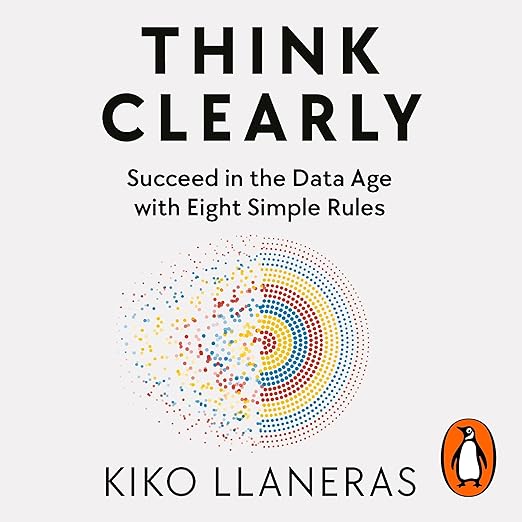
Think Clearly arrived in my queue through a recommendation from a friend who covers data journalism in Europe, who described it as the book she hands to people who ask how she thinks about numbers when she’s reporting. That’s a specific enough endorsement that I went in with real curiosity. Kiko Llaneras is a renowned data journalist whose work at El Pais has covered electoral predictions, sports analytics, COVID-19 modeling, and economic inequality, and the breadth of that applied experience shapes every chapter.
The John Burn-Murdoch endorsement that appears in the synopsis, calling Llaneras “one of the most consistently interesting data journalists to have emerged in the last decade,” is significant. Burn-Murdoch is the Financial Times’ chief data reporter and arguably the most respected data visualization journalist currently working. That kind of peer endorsement signals that this is not a popularization of statistics for people who find numbers scary, but a book about how someone who works with data professionally actually thinks.
Cases Before Methods: The Journalist’s Organizing Principle
What Llaneras does differently from most data literacy books is that he organizes around cases rather than methods. The Chernobyl disaster, Barack Obama’s decision-making process, and the January birthday distribution among elite footballers are not illustrative asides; they are the actual argument. Each example is doing real work in developing the book’s larger case for what a quantitative perspective can offer, and for where it misleads you if you apply it without care.
Neil Gardner’s narration fits this case-driven approach well. His voice carries the slightly conspiratorial quality of someone sharing genuinely interesting findings, which is appropriate for material that is organized around surprising insights. When the narration moves from case to principle and back, the pacing is smooth enough that the listener rarely feels like they’re being lectured, which is the perpetual risk for books in this category.
The Chernobyl Example and What It Signals About the Book’s Ambition
Using the Chernobyl disaster as a data-thinking case study is an ambitious choice. It signals that Llaneras is interested in the consequences of bad quantitative reasoning at institutional scale, not just the individual cognitive biases that most popular decision-making books address. The book is as much about how organizations and systems fail to use data well as it is about personal decision-making improvement, and that expanded scope makes it more interesting than its self-help category positioning might suggest.
The footballers-born-in-January observation, which relates to relative age effects in youth selection systems, is used to illustrate how statistical regularities that appear inexplicable become obvious once you identify the mechanism. Llaneras is good at that move: showing the puzzle, sitting with the confusion, and then providing the explanation in a way that makes the reader feel like they’ve genuinely understood something rather than just received information.
Scope, Depth, and the Right Audience
Think Clearly runs to just over seven hours, which is appropriate for its scope but means that individual topics are treated at breadth rather than depth. Listeners who come in with significant statistics or data science backgrounds will find the material accessible to the point of being elementary. The book’s target audience is the curious general reader who makes consequential decisions using data but has no formal training in statistical thinking, and it serves that audience well.
The twelve reviews and 4.4 average reflect a small but satisfied audience. The single published review notes the examples as strong and the book suited to quick reading, which tracks with the listening experience: this is a book that moves efficiently and does not overstay its welcome.
Listen if you are a curious non-specialist who wants to understand what data journalists and quantitative analysts mean when they say someone is thinking clearly about numbers. Listen if you want to improve your own decision-making using a practical rather than academic framework. Skip this one if you already have formal training in statistics or data science; the material will be familiar and the examples, however well-chosen, will not present you with new frameworks.
Frequently Asked Questions
Is Think Clearly translated from Spanish, and does anything get lost in translation?
Yes, the book is translated from Spanish; Llaneras writes for El Pais and is a Spanish data journalist. The translation is smooth enough that the English text reads as originally composed rather than translated, and Neil Gardner’s narration does not reveal any awkwardness. The cultural examples, including the footballer birthday data which relates to European youth football selection systems, are explained with sufficient context for non-European readers.
How does this compare to books like How to Lie with Statistics or The Art of Statistics?
Think Clearly is closer in spirit to those books than to most business data literacy titles, but it is more journalistically organized and less pedagogically structured than David Spiegelhalter’s The Art of Statistics. Llaneras works from cases outward rather than from principles inward, which makes the book more immediately engaging but less useful as a systematic reference.
Does Neil Gardner’s narration work for a book with Spanish cultural origins and European examples?
Gardner handles the material naturally, and the translation quality means there are no awkward moments where the narration has to carry the weight of cultural translation. His voice has the right combination of accessibility and intellectual engagement for a book that is asking readers to think carefully about data without making them feel like they’re in a classroom.
The synopsis mentions Barack Obama’s decision-making as one of the examples. Is that section substantial or just a passing reference?
Based on the book’s methodology, it is used as a substantive case study for how a decision-maker operating under extreme uncertainty with incomplete information can use a quantitative mindset to maintain clarity and composure. Llaneras tends to use his examples to make genuine argumentative points rather than as illustrative decoration, so Obama’s approach is likely treated with more depth than a passing mention would suggest.