In Brief
- Voice: Colby Elliott's performance is clean and well-paced for a game design text, handling the shift between mechanical instruction and philosophical discussion without losing momentum across eleven hours.
- Big ideas: Monster design philosophy, challenge rating balance, the relationship between creatures and narrative in tabletop RPGs
- Atmosphere: Enthusiastic and craft-focused
- Worth it?: A genuinely useful resource for game masters who want to think more carefully about how monsters function in storytelling, with a social advocacy chapter that has divided its audience sharply.
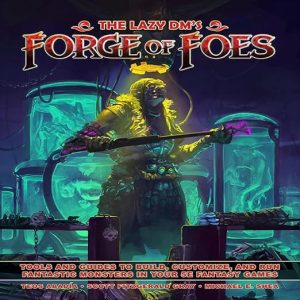
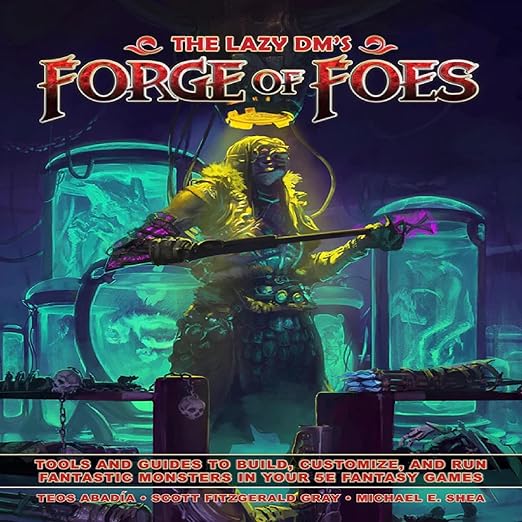
Teos Abadia's audiobook on monster design for tabletop roleplaying games occupies a specific and underserved niche: the space between raw mechanical statistics and the craft of making creatures feel genuinely dangerous, strange, and story-relevant. The Lazy DM's Forge of Foes, narrated by Colby Elliott, is not a monster manual. It is a design philosophy text with practical applications, and at eleven hours and twenty minutes it covers that ground with considerably more depth than most game master resources attempt. A PDF companion is included with the purchase, which provides reference material for the tables and visual structures that work better in print than audio.
Monsters That Feel Real Outside Our World
The book's opening argument, that we love monsters because they exist outside our world and yet feel real within it, sets the tone for everything that follows. Abadia is interested in the phenomenology of the encounter as much as its mechanics. He wants game masters to understand why a dragon creates a different kind of fear from an undead creature, and why that difference matters for the stories their tables will remember. The Forge of Foes covers reskinning techniques, new attack and ability creation, the philosophy of monster design as a narrative function, and the considerable complexity of challenge rating when building encounters that are genuinely interesting rather than merely punishing. These sections represent the book's clearest value and will be immediately applicable to any game master running published or homebrew campaigns. Abadia also addresses how to create entirely new creatures from shared imagination, giving the design process a collaborative and generative quality that supplements the more analytical material. Colby Elliott handles all of this with consistent energy, which matters considerably across an eleven-hour text that covers both abstract philosophy and concrete game mechanics.
Colby Elliott's Pacing Lets Big Ideas Settle
The Lazy DM series has built a reputation for making game mastering more intuitive and less laborious, and this volume fits that philosophy while going deeper into specific craft than previous entries. For the conceptual and philosophical sections, the audio works well standalone. The included PDF companion handles the reference material that benefits from visual layout: tables for challenge rating adjustment, ability creation frameworks, and reskinning guidelines are all easier to engage with as static reference than as audio. The discussion of monster design as narrative function, specifically what Abadia calls the all-important relationship between monsters and story, is the kind of thinking that separates a competent game master from a genuinely skilled one. The point is not that a monster should be mechanically balanced. The point is that a monster should mean something within the story being told at that table. Hearing that argument developed over multiple hours, with Elliott's pacing giving each idea room to settle, is a different experience from reading equivalent advice in blog-post format, and the sustained development makes the principles more likely to carry into actual game preparation.
A Chapter on Anti-Colonialism Divides Reviewers
Reviews are notably divided on one specific chapter, and listeners should have that information before purchasing. Multiple reviewers identify a section dealing with what they characterize as anti-colonialism as out of place with the rest of the material. One reviewer described it as preachy and said it has nothing to do with the rest of the book and should have been removed. Another called the social conditioning content dated and said it would leave a bad taste for most players. A third gave the book its lowest possible rating on the basis of that chapter. The chapter in question is genuinely a departure from the mechanical and philosophical content that surrounds it, and listeners who prefer their game design texts to stay focused on craft and game function will find the digression jarring. Listeners who see the cultural dimensions of fantasy monster design as inherently part of the design conversation may find that section the most substantive and interesting in the book. The divide in the reviews reflects a genuine tension in the material rather than a simple misunderstanding of content, and it is fair to each potential listener to name that tension clearly.
Dungeon Masters Moving From Published to Homebrew
Game masters who run D&D or other tabletop RPGs and want a systematic framework for designing, modifying, and presenting monsters as genuine narrative agents will find this one of the most substantive resources currently available in that specific area. Dungeon masters who have been running published adventures and want to move toward more confident homebrew creature design will get both concrete techniques and the philosophical scaffolding to know when to apply each one. The included PDF companion makes the audio a more complete package for listeners who expect to reference creation frameworks during active session preparation. Skip this one if you are looking for a pure monster stat block compendium to use at the table: this book is about the thinking behind the stats, not the stats themselves. Listeners with strong feelings about social advocacy content in gaming texts should review a few of the lower-rated reviews before purchasing so they can make an informed decision about whether that chapter will affect their overall experience of the material. The sustained discussion of why a monster matters narratively, rather than simply what it can do mechanically, is the kind of long-form argument that the audiobook format handles well: it is cumulative and developmental in a way that a reference book or a blog post cannot fully replicate, and game masters who engage with it seriously will find that it changes how they approach encounter preparation at a fundamental level.
Before You Listen
Does the Lazy DM's Forge of Foes audiobook include a PDF companion, and how essential is it?
Yes, a PDF companion is included with purchase. For the conceptual and philosophical sections, the audio works well independently. For the monster creation tables, challenge rating adjustment frameworks, and visual reference material, the PDF is a meaningful addition that makes the overall package significantly more useful for active game preparation.
What is the controversial chapter in this audiobook about, and how much does it affect the experience?
Multiple reviewers identify one chapter dealing with anti-colonialism or social advocacy as a significant departure from the book's design focus. Opinions are sharply divided: some found it disruptive, others found it the most interesting part. The chapter represents a minority of the eleven-hour runtime but has driven the majority of the lower ratings.
Is this audiobook useful for game masters running systems other than D&D?
The core principles of monster design, challenge rating philosophy, and the relationship between creatures and story are broadly applicable across encounter-based tabletop RPG systems. The specific mechanical sections lean D&D-adjacent, but the design philosophy translates to most systems where game masters create or modify adversaries.
How does Colby Elliott's narration handle the blend of game mechanics and design philosophy in this audiobook?
Elliott maintains consistent energy across both the mechanical instruction sections and the more abstract design philosophy discussions, which is a real achievement across eleven hours of varied material. The narration is clear and functional without being dry, and it keeps the longer conceptual passages from losing momentum.