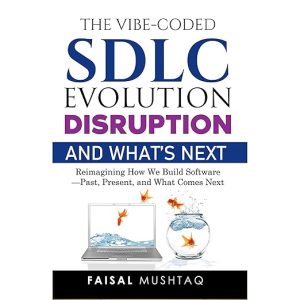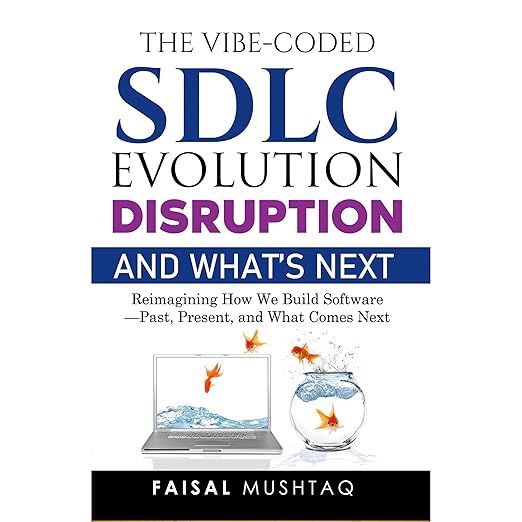
Twenty-seven minutes is the number the description opens on, the time it supposedly took one team to ship a production fix that would have needed three weeks two years earlier. That is the pitch, and this audiobook makes a great many of them. What it does not have is a person reading it: the reader credit is filled by Virtual Voice, a machine-generated performance rather than somebody in a booth.
Fifty-Five Years of Methodology Get a Historical Review
Faisal Mushtaq's argument is that the distance between wanting software and having it running has collapsed, and that the winners will be developers who orchestrate AI rather than compete with it. The description positions this as the bridge from traditional development to what it calls vibe coding, translating intent into working software through AI collaboration, and it claims to cover fifty-five years of methodology from waterfall onward.
A. Usman's five-star notice describes the strongest element: a historical review tracing methodology from early structured processes through waterfall, agile and beyond, connecting how each stage shaped the way software gets built now. That is a genuinely useful spine for a short book, and it happens to be the part least dependent on any prediction holding up. Methodology history does not expire, and a listener who takes away only that has still gained something durable.
Precise Numbers With Nothing to Check Them Against
The claims arrive fast and they arrive precise. An exact 8.3-second loop from intent to tested code. Elite performers deploying 208 times more frequently and recovering 2,604 times faster. Delivery lead time cut by more than seventy percent. A market moving from 3.97 billion dollars to a projected 27.17 billion by 2032. Precision at that resolution invites checking, and a recording hands you nothing to check it against.
Underneath the figures, the prose is selling hard throughout. The description asks whether you have felt the anxiety of watching AI generate in seconds what takes you hours, warns that within five years only two kinds of professional will exist, and signs off with four imperatives in a row. Copy this aggressive usually signals a book written toward a market rather than toward a reader. Whether the same pressure continues past the sales pitch and into the chapters is a fair question, and the written record turns out to be no help at all in answering it.
Governance Is the Section No Reviewer Mentions
James L. Stephenson's five-star notice is the most enthusiastic in the record, and it describes a book about people. A model that honors both the technical and emotional rhythms of a team. A framework accounting for team energy, burnout cycles and creative sync. The proposition that a low-vibe sprint can do more harm than good. That reader wanted this five years earlier, while scaling a startup team.
If that is what the book contains, it is considerably more interesting than the description suggests. Development methodology written around burnout and team energy occupies a much thinner shelf than development methodology written around tooling, and it would explain the word vibe far better than a chapter on prompt engineering patterns manages to.
Four and a half hours is a sensible size for an argument like this one. Long enough to lay out the historical progression and the governance material the description says no competing book covers, short enough that a working developer can finish it across a couple of sittings without committing to a reference volume they will never open twice.
The genuinely differentiating claim is about governance. The description promises frameworks for navigating legal, ethical and security risk while keeping delivery moving, and asserts that no other book covers them. That is the section a team lead would actually reach for, and it is also the one that none of the written responses mentions even in passing.
Every Written Response Predates This Recording
Colette Dunlap's five-star notice praises something the description never promises: vibe-coding each stage of the lifecycle, tuned to how people actually think, create and connect, and the power of syncing team energy. The description sells AI pair programmers, GitHub Copilot, prompt engineering patterns and DORA metrics. Morale and tooling are not the same subject, and the written record leans toward the first while the sales copy leans entirely toward the second.
Every written response predates the recording. The five of them landed between the fourth and the eleventh of August 2025, four months ahead of an audio edition dated the tenth of December. That 4.7 across ten ratings belongs to a text and not to this production of it, and one of them says only Nice, under a heading praising the topic.
Acronyms and Decimal Figures Strain Machine Reading
Synthetic narration matters more here than it would on a novel. The material is thick with acronyms, product names and figures read to two decimal places: SDLC, MLOps, DORA, REST endpoints, 8.3 seconds, 2,604 times. Machine reading handles ordinary sentences well and handles dense technical strings unevenly, and a listener who mishears a figure in this book has no page to check it against.
The scope claim and the running time do not fit each other. Fifty-five years of methodology, prompt engineering patterns, human-and-AI collaboration playbooks, governance, platform engineering, MLOps, DevOps and a forecast running out to 2035 amounts to a reference-book table of contents delivered in under five hours. Something has to be thin, and the description declines to say which part.
Someone Early in the Shift Gets a Short Listen
An unnamed buyer's five-star notice credits the author's research, calling the groundwork meticulous and the result credible. Anyone who wants an orientation rather than a manual is the right audience for that: a developer or a team lead who has watched the tooling arrive and wants the historical context, the vocabulary and a sense of where the argument is heading.
It suits somebody early in the shift far better than somebody already inside it. A developer who has been running an AI pair programmer daily for a year will find the framing familiar and the numbers unverifiable. A team lead who has been putting the decision off gets the terms of the argument, the governance questions and the historical progression in one short listen.
The book that two of its own reviewers describe is not the book the description sells. Until that resolves, treat this as an orientation to a fast-moving subject, delivered by a machine, rated by people who read it months before the recording existed. Verified figures, a named human reader and certainty about the contents are three good reasons to wait for a clearer listing than this one.
Good to Know
Who narrates The Vibe-Coded SDLC audiobook?
Nobody does. The reader credit reads Virtual Voice, a synthetic label rather than the name of a person in a studio. On a book this dense with acronyms and decimal figures, that is worth establishing before you commit four and a half hours to it.
Is this audiobook about AI coding tools or about team culture?
The description says AI tooling: pair programmers, prompt engineering patterns, governance frameworks and DORA metrics. Two of the five written responses describe morale, burnout and the emotional rhythms of a team instead. The two accounts do not reconcile, and the honest answer is that the public record disagrees with the sales copy.
Are the statistics in this audiobook verifiable?
Not from the recording itself. The figures arrive at high precision: an 8.3-second loop, deployment 208 times more frequent, recovery 2,604 times faster, a market projected at 27.17 billion dollars by 2032. Audio supplies no notes, no citations and no way to trace a source while listening, so verify anything you intend to repeat.