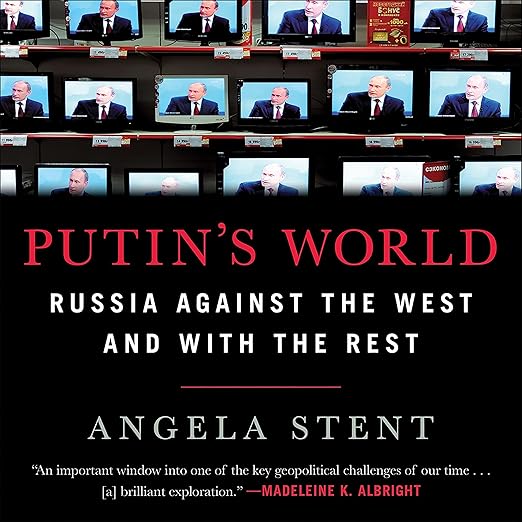
Quick Take
- Narration: Kevin Stillwell provides clean, authoritative delivery suited to Stent’s sober analytical register, he handles the transitions between geopolitical analysis and historical narrative without losing the listener’s orientation.
- Themes: Russian foreign policy under Putin, post-Cold War grievance, great power competition
- Mood: Serious and methodical, like a very well-organized intelligence briefing from someone who has read everything
- Verdict: The most even-handed and comprehensive account of Putin’s foreign policy thinking available in audiobook form, essential background for anyone trying to understand the Russia-Ukraine conflict or the broader structure of current geopolitics.
I listened to Putin’s World in two concentrated sessions, the first during a week of heavy Ukraine-related news and the second a few months later when I wanted to revisit Stent’s framework with fresh eyes. The experience of returning to it was notable: the book had aged well in ways that academic foreign policy analysis often doesn’t. Stent’s central argument, that Putin’s behavior is legible as a response to a specific historical understanding of Russia’s post-Soviet humiliation, not as the action of a uniquely irrational actor, was as clarifying on the second listen as the first.
Angela Stent is not a journalist or a polemicist. She is a Georgetown professor and former National Intelligence Council officer who has spent her career studying Russia, and Putin’s World reflects that institutional depth. The endorsement from US Ambassador William J. Burns, now CIA Director, is not incidental. This is a book that serious people inside foreign policy institutions treat as a reference, and that quality of reliability runs through every chapter.
Our Take on Putin’s World
The book’s structure follows Putin’s key foreign relationships chapter by chapter: the downward spiral with the United States, the complicated relationship with Europe and NATO, the deepening partnership with China, the engagement with the Middle East, and the especially fraught ties with former Soviet states, particularly Ukraine. That organizational logic is useful because it allows Stent to apply a consistent analytical framework, Russia’s desire for great-power recognition, its resentment of Western condescension, its opportunistic exploitation of Western internal divisions, across very different geographic and institutional contexts.
What Stent does better than most Russia analysts is explain the Russian perspective without endorsing it. She is clear about where Putin’s historical narrative is self-serving or factually distorted, but she also conveys why that narrative has internal coherence and why it resonates with significant portions of the Russian population. That dual clarity, here is what Russia believes, here is where that belief diverges from verifiable fact, is the analytical posture that makes the book useful rather than merely satisfying.
Why Listen to Putin’s World
Kevin Stillwell’s narration is clean and well-suited to the material. He reads Stent’s carefully structured prose without adding drama it doesn’t need, this is a book that earns its weight through accumulated analysis, not through rhetorical escalation, and Stillwell understands that. The fifteen-and-a-half-hour runtime is substantive, but Stent’s writing is dense enough that you get value from every hour rather than wondering why the book hasn’t ended yet.
One reviewer noted that their interest in Russia-Saudi Arabia oil dynamics was what brought them to the book, and that once they started, they went back to the beginning and read it all. That’s an accurate account of how the book works: it’s organized so that you can enter through any of its regional chapters and find your way, but the argument is cumulative enough that the full arc repays the full listen.
What to Watch For in Putin’s World
The book was published in 2019, before the full-scale invasion of Ukraine in 2022. Stent’s analysis of the Russia-Ukraine relationship is present and prescient, she describes the trajectory clearly, but the book necessarily doesn’t include the events that have dominated the news cycle since. Listeners coming to Putin’s World primarily for Ukraine context should supplement with more recent sources. What Stent provides is the historical and psychological foundation for understanding how the invasion happened; the events themselves are for other books.
This is also not a casual listen. Stent’s analytical register is precise and occasionally dense, particularly in the chapters on Russia’s engagement with China and the Middle East where she covers a great deal of diplomatic history quickly. Passive listening while exercising or driving is possible, but the book rewards the kind of attention you give to something you intend to remember.
Who Should Listen to Putin’s World
Anyone who has followed the Ukraine conflict and wants to understand the historical and ideological conditions that produced it will find this essential background. Readers of books like Timothy Snyder’s The Road to Unfreedom or Anne Applebaum’s Twilight of Democracy will recognize the analytical seriousness and find Stent’s foreign policy focus a useful complement to those works’ more domestic emphasis. The book is equally valuable for listeners who want to understand Russia’s relationships with China, the Middle East, and its near abroad, it is a genuinely comprehensive account of how Putin thinks about Russia’s place in the world, and that thinking didn’t begin with Ukraine.
Frequently Asked Questions
How does Putin’s World handle the Ukraine relationship specifically, does Stent predict the 2022 invasion?
Stent doesn’t predict the full-scale 2022 invasion, because the book was published in 2019. But her analysis of the Russia-Ukraine relationship is prescient, she describes the historical Russian conviction that Ukraine is not truly separate from Russia, the NATO expansion tensions, and the trajectory of Russian policy toward Ukrainian sovereignty with enough clarity that readers in hindsight will recognize the path. Supplement with more recent sources for the events themselves.
Is Angela Stent sympathetic to Putin, or does the book make a clear critical argument?
Stent is even-handed in a specific way: she explains Russian grievances and the internal logic of Putin’s historical narrative with genuine seriousness, while being clear about where that narrative is self-serving or factually distorted. She is not sympathetic to Putin’s authoritarianism or his foreign policy choices, but she refuses to treat him as simply irrational, which makes her analysis more useful than either cheerleading or simple condemnation.
Does the book cover Russia’s relationship with China in detail?
Yes, and it’s one of the chapters reviewers cite as particularly illuminating. Stent covers the deepening Russia-China partnership in the context of both countries’ desire to push back against US-led international order, while also being clear about the asymmetries in the relationship, China is the larger economic power and Russia cannot afford to become a junior partner. This section has held up well given how central the Russia-China relationship has become since 2019.
Is Putin’s World accessible to readers without a background in foreign policy or Russian history?
Yes, though it helps to have a baseline familiarity with Cold War history and the broad outlines of post-Soviet politics. Stent explains her terms and provides historical context rather than assuming specialist knowledge. One reviewer described gaining a ‘vivid understanding of Putin and his motivations’ without a prior Russia background, which suggests the book works for intelligent general readers willing to give it focused attention.