Quick Take
- Narration: Jennifer Jill Araya handles the dense financial and geopolitical material with clarity and authority, keeping the pace from collapsing under the weight of names and institutions.
- Themes: Economic statecraft as warfare, oligarch networks and offshore money, the limits of Western sanctions
- Mood: Urgent and investigative, like a long-form piece of financial journalism come to life
- Verdict: The most thorough audiobook account of the post-2022 sanctions war, essential for anyone trying to understand whether economic pressure on Russia actually works.
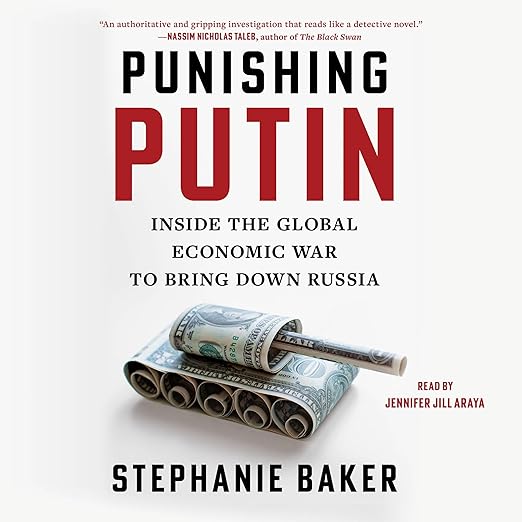
I finished Punishing Putin on a Tuesday evening after the kind of day that makes geopolitics feel abstract and far away. By the time the final chapter ended I was sitting in my kitchen taking notes, which is not something I do lightly. Stephanie Baker has written the kind of book that reminds you how much is happening just out of view of the daily news cycle, and Jennifer Jill Araya’s narration carries that urgency without tipping into melodrama.
The setup is familiar enough: Vladimir Putin orders the full-scale invasion of Ukraine on February 24, 2022, and within hours Western governments are scrambling to deploy economic tools as a counter. What Baker does that distinguishes this book from the general commentary is get inside the machinery. She has access to the people who were actually in those backroom deliberations, and the result reads, as Nassim Nicholas Taleb noted, like a detective novel. The immobilization of $300 billion in Russian central bank reserves. The effort to manipulate the global price of oil. The superyacht seizures. The army of white-collar investigators. Each chapter builds the picture of what Baker calls a new era of economic statecraft, and the portrait is neither triumphalist nor despairing.
Our Take on Punishing Putin
Baker is scrupulous about the limits of what the sanctions have achieved. One reviewer accurately noted that the book is sobering because it reveals why sanctions have largely failed to deter Russia. Baker does not flinch from this conclusion. The structural reasons, the ability of oligarchs to layer dummy companies, the reluctance of certain European governments to enforce their own rules, the complexity of secondary sanctions, are all examined in detail. But the book is also genuinely alive to the moments where the pressure worked, where an investigator found a yacht, where an asset freeze landed. The tension between those two realities is what makes this more than a policy document.
Why Listen to Punishing Putin
At twelve hours and forty minutes, this is a substantial listen, and it rewards patience. The early chapters establish the historical context for Putin’s relationship with the West and with his own oligarch class, which is necessary foundation even if it occasionally feels like it is delaying the main event. Once Baker gets into the mechanics of the 2022 response, the book becomes propulsive. The fly-on-the-wall details she describes, specific people, specific arguments, specific moments of hesitation in Washington, Brussels, and London, give the listener a sense of how contingent these decisions were. Things that look like policy choices in retrospect were often arguments between individuals with very different risk tolerances.
What to Watch For in Punishing Putin
The book was published in 2024 and covers events through roughly the same period, so some of the forward-looking analysis has already been complicated by subsequent developments. A reader who noted hoping for a revised edition after the war concludes is making a fair point: the sanctions picture continues to evolve, and Baker’s conclusions about the effectiveness of the measures will need updating as the situation changes. This is a limitation of any timely journalism-adjacent book rather than a flaw in Baker’s reporting, but it is worth knowing before you begin. The cast of characters is also large, with diplomats, intelligence officials, bankers, oligarchs, and investigators cycling through, and Araya works hard to distinguish them, but listeners who are new to this subject may find themselves rewinding occasionally to place a name.
Who Should Listen to Punishing Putin
Anyone tracking the intersection of finance and geopolitics will find this essential. It pairs naturally with Catherine Belton’s Putin’s People, which one reviewer specifically recommended reading alongside Baker’s book, as the two cover complementary ground: Belton on the construction of Putin’s economic empire, Baker on the West’s attempts to dismantle parts of it. Listeners who came to this expecting a straightforward political thriller may be surprised by the level of financial detail, but Baker explains the mechanisms clearly enough that no specialist background is required.
Frequently Asked Questions
Does Punishing Putin argue that Western sanctions have been effective against Russia?
Baker’s conclusion is nuanced and sobering. She documents real moments where pressure worked, but the overall assessment is that the sanctions have not achieved their primary goal of deterring Russian military aggression, largely because of enforcement gaps, oligarch workarounds, and political inconsistencies among Western governments.
Is this book current enough to reflect what has happened with Russia sanctions since 2024?
The book covers events through approximately 2023-2024. Sanctions developments since publication are not included, and the situation continues to evolve. Baker provides essential context and history, but listeners following the current state of affairs will need to supplement with recent reporting.
How technical is the financial content in Punishing Putin? Do I need a background in finance or international law?
Baker explains the mechanisms, including asset freezes, secondary sanctions, and price cap structures, clearly enough for a general listener. The book is written as narrative journalism rather than policy analysis, so technical vocabulary is introduced and contextualized rather than assumed.
How does Punishing Putin compare to Catherine Belton’s Putin’s People as background reading?
They cover complementary ground. Belton traces how Putin built his financial and political empire over two decades; Baker examines the West’s post-2022 attempt to apply economic pressure to that empire. Reviewers who have read both suggest Punishing Putin is most rewarding after Putin’s People, though it functions well as a standalone.