The Short Version
- Voice: Traber Burns reads James Joyce's Vietnam memoir with the steady authority that military memoir warrants, though the narration cannot fully compensate for passages where the writing retreats into summary rather than scene.
- Big ideas: Helicopter combat flying in Vietnam, the dual roles of defense and offense in Huey operations, the distance between combat experience and civilian understanding
- Atmosphere: Reflective and anecdotal, closer to a veteran's firsthand account than to a shaped literary memoir
- Worth it?: An honest account of one helicopter pilot's Vietnam service that will satisfy readers hungry for direct experience but may disappoint those expecting the narrative intensity of the genre's strongest titles.
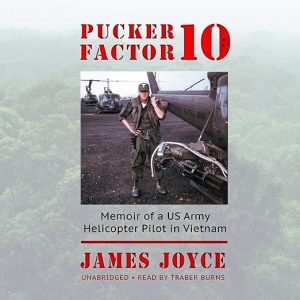
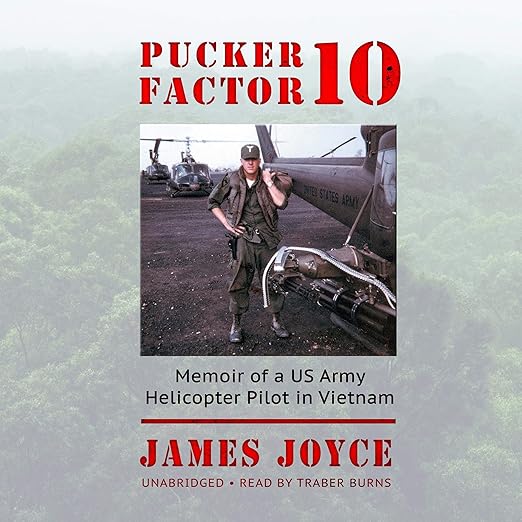
James Joyce's opening line in Pucker Factor 10 is one of the memoir's most effective moments: the image of a young man in a classroom in Ohio raising his hand in 1963 without knowing that the gesture would take him to Vietnam and to things most people cannot imagine. Narrated by Traber Burns in an eight-hour-and-29-minute audiobook, this is a first-person account of flying both Huey Slick and Huey Gunship helicopters in Vietnam - a dual perspective that is genuinely unusual, since most pilot memoirs cover one type of mission rather than both the troop-transport defense role and the attack-mission offense role. That structural distinction is the book's most legitimate claim on a reader's attention.
Joyce's dual-mission coverage gives the book a range that many combat memoirs sacrifice for narrative focus. When Joyce is in the cockpit - describing the particular sensory experience of low-altitude helicopter flight in contested airspace, the relationship between pilot and co-pilot under pressure, the specific mechanics of a gunship run - the material finds its footing. The difference between the role of a Slick pilot delivering troops into a hot landing zone and the role of a Gunship pilot actively prosecuting a target involves different psychological demands, different relationships to risk, and different ways of processing what you are doing and to whom. Joyce covers both with the authority of direct experience.
The reviews for this audiobook are polarized in a way that needs honest acknowledgment. Three reviewers gave it one star, and their criticisms are substantive. The reviewer who compared it unfavorably to Robert Mason's Chickenhawk - widely considered the defining Vietnam helicopter memoir - made a fair point: Mason's book places the listener inside the cockpit with an immediacy that Joyce's more anecdotal approach does not consistently match. Another reviewer noted that the book reads like an old veteran telling tales, which is both a description and a critique. The anecdotal texture is real, and whether it satisfies depends heavily on what you need from the genre.
The Disneyland detail - the nickname given to a US Army-sponsored compound near base - is the kind of specific, unglamorous fact that official histories sanitize and that first-person accounts preserve. These moments, scattered through the audiobook, are where the recording earns its place in the genre even against stronger competitors. Joyce's accounting of fellow pilots who survived and went on to commercial airline careers, and those who did not, carries the weight of someone reckoning with the people he flew alongside rather than simply cataloguing his own experiences.
Burns's Steady Gravity Skips Theatrical Embellishment
Traber Burns handles the narration with the steady gravity that military memoir warrants, and his reading does not inflate the material beyond what it is: a pilot's account, delivered in the mode of personal reminiscence rather than polished narrative. Burns's restraint is appropriate - the material does not need theatrical embellishment, and the passages where the writing itself is strongest benefit from a narrator who trusts the content rather than decorating it.
The audiobook works best for listeners who value direct testimony over literary craft - those who want to hear what Joyce saw, heard, and did, without the shaping and pressure that more formally constructed memoirs apply to the same material. For Vietnam veterans and their families, there is value in an account that does not reconstruct events through the filter of retrospective meaning-making. Joyce's memory is his memory, with all the selectivity and gaps that implies, and Burns's narration delivers that honestly across the eight and a half hours.
Focused on Joyce, Light on His Door Gunners
The criticism that the book is too focused on Joyce himself, at the expense of the door gunners and crew members who shared his missions, is worth taking seriously. Memoirs of this type carry an implicit responsibility to account for the other people present in the stories being told, and the reviewer who noted the absence of named crew members raised a genuine point about the book's scope. This is a pilot's memoir in the strict sense - it centers the pilot's perspective and does not substantially widen to include the experience of those alongside him.
The 4.4 average rating on a polarized review distribution - three one-star reviews pulling against five-star enthusiasm - suggests that listener experience here depends significantly on expectation calibration. Joyce is writing from memory rather than from notes, and the episodic structure reflects that. This is not a continuous narrative arc but a collection of connected incidents remembered by a man who flew through something extraordinary and found that the language for it came out anecdotally rather than architecturally. Knowing that going in shapes the experience considerably.
The section covering the smoke bombing of Disneyland - the US Army compound - provides a window into the base culture that surrounded helicopter operations in Vietnam, and it is the kind of detail that broader military histories tend to pass over in favor of strategy and body counts. Joyce's attention to that human texture, imperfect and incomplete as his account is, preserves something the official record does not.
A Different Personal Lens Beyond Chickenhawk
Vietnam veterans and their families, listeners specifically interested in helicopter aviation in combat, and readers who approach military memoir for the direct human testimony rather than the literary ambition will find this audiobook worthwhile. If you have already read Chickenhawk and are looking for something that covers similar ground with a different personal lens, Joyce's dual Huey perspective adds something that Mason's book does not specifically address. Skip it if you need a memoir that sustains narrative momentum and emotional intensity across the full eight-plus hours - the anecdotal mode that defines the book's strengths also defines its limits, and those limits are real.
Is Traber Burns's narration a good fit for this Vietnam combat audiobook?
Burns reads with appropriate gravity and steady authority, which suits the military memoir register. He does not overplay the material, and his restraint is the right call - the passages where Joyce's writing is strongest benefit from a narrator who trusts the content. He cannot compensate for passages where the writing retreats into summary rather than scene, but he does not make those passages worse.
Why are the reviews of this audiobook so polarized?
The one-star reviews reflect unmet expectations from listeners wanting the narrative intensity and cockpit immediacy of the genre's strongest titles. The five-star reviews come from listeners who value direct personal testimony over literary craft. The book delivers honest first-person recollection rather than a shaped memoir - that distinction accounts for most of the rating spread.