Key Details
- Read by: JD Jackson brings real authority to Richard Pryor's story, finding the register that balances the memoir's humor with its considerable darkness, a skilled match for material that ranges from abject poverty to Hollywood excess to physical devastation.
- At its heart: comedy as survival, the cost of genius, Black American experience in the twentieth century
- Vibe: Raw and candid, funny and grieving in the same breath
- Short version: Pryor Convictions is a memoir that earns its honesty precisely because Pryor does not spare himself, and as an audiobook, JD Jackson's narration gives that honesty a delivery worthy of its subject.
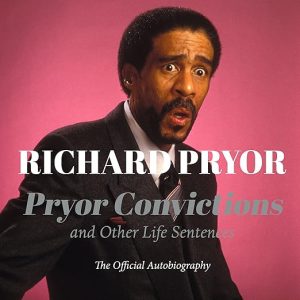
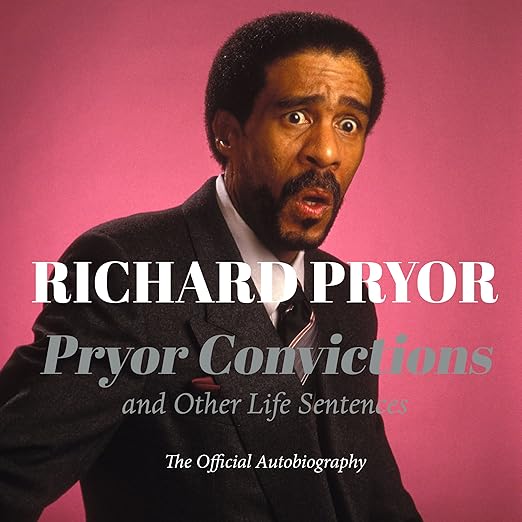
Richard Pryor's Pryor Convictions is an audiobook built around a fundamental truth about the most influential stand-up comedian of the twentieth century: the life was the material. This was not a man who observed human suffering from a safe distance and translated it into art. He was raised in the whorehouses and bars where his family worked. He processed multiple marriages, multiple addictions, and an eventual multiple sclerosis diagnosis through the only medium he ever fully trusted: performance and, later, the written word. Pryor Convictions is the written account of that process, and it reads like a man who is still figuring out what all of it meant.
The memoir's value as a document rests on Pryor's refusal to perform respectability. A reviewer noted that the book takes a deep dive into his lifestyle but also sets the stage in his earlier years to see what would lead him to greatness, and that framing is accurate: Pryor understood that the childhood needed explanation, not because it excused anything, but because no account of his comedy would make sense without it. The connection between his upbringing in a Peoria brothel run by his grandmother and his ability to render human shame, hypocrisy, and desire on stage with such precision is not incidental.
Another reviewer, who could not say with certainty whether everything in the memoir was true, described it as a fun and fast read before noting the strangeness of how funny a man could be who had so little to laugh about in the raw facts of his biography. That observation gets at something central: Pryor's comedy was not a defense mechanism in the conventional sense. It was a form of radical honesty that happened to be devastatingly funny, and this memoir is his attempt to explain how that happened without turning it into a redemption arc or a cautionary tale.
Why Pryor Convictions Works as an Audiobook
JD Jackson narrates, and he is a careful and considered choice for this material. Pryor's voice was so singular that any narrator faces the obvious problem of comparison. Jackson does not attempt to replicate Pryor's distinctive delivery: that would be both impossible and misguided. Instead, he reads the written memoir as written memoir, finding the rhythms of Pryor's prose rather than mimicking his performance. This allows the book to stand as a literary document rather than a pale imitation of a stage act.
At seven hours and forty-one minutes, Pryor Convictions moves at the pace Pryor wrote it: direct, unsparing, sometimes funny in ways that land unexpectedly given the surrounding context. The memoir covers the Hollywood years with the same unflinching honesty as the Peoria years. The money, the women, the drugs are present without glamorization or false remorse. Pryor consistently describes his life as something that happened to and through him rather than a series of choices that could have easily gone otherwise, and that perspective gives the memoir its particular texture and prevents it from settling into the standard celebrity autobiography shape.
Weak Spots in Pryor Convictions
The memoir does not cover the full arc of Pryor's career in the exhaustive way that authorized celebrity biographies typically do. It is a personal account, sometimes elliptical about specific professional details, more interested in emotional truth than in the chronological completeness a dedicated Pryor scholar might want. The multiple sclerosis diagnosis, mentioned in the synopsis, is treated with characteristic directness: Pryor does not pivot into inspirational survivor narrative. He describes the disease as one more thing life did to his body, consonant with a memoir that never sentimentalizes its own subject.
A reviewer noted the book gave them more information on Pryor's childhood specifically, which suggests the earlier material is where Pryor is most expansive and most illuminating. The Hollywood sections, while present, are treated with somewhat less interiority. Listeners looking for behind-the-scenes film industry detail will find what they want less thoroughly covered than Pryor's internal life. Those interested in the biographical conditions that produced his comedy will find the early chapters the richest material in the book.
The Right Listener for Pryor Convictions
This audiobook belongs on the list of essential comedy memoirs, though it operates in a completely different register from the craft-focused accounts of comedians like Steve Martin. Where those books focus on the development of technique, Pryor Convictions is interested in the cost of being the person who makes the material. Listeners who want to understand why Richard Pryor represented something genuinely different in American comedy, and who want to hear the story of where all that fearlessness came from, will find this memoir essential rather than supplemental.
It is not a comprehensive biography, and listeners who want the full documented account of Pryor's career will want to seek out more exhaustive biographies alongside this one. As a primary source, as a document of how Pryor understood and expressed his own life, it is irreplaceable. JD Jackson's narration makes the audiobook the version to choose for first-time readers of the memoir, giving the prose a vocal presence that complements Pryor's own conversational, direct writing style throughout the full seven-hour runtime. The memoir's brevity is also part of its honesty: Pryor was not interested in the comprehensive accounting, the full filmography, the complete interview record. He was interested in the question of what produced him, and he answers that question with a directness that most celebrity autobiographies, far longer and more comprehensive, fail to match.