Quick Take
- Narration: George Jack delivers a serviceable, professional reading appropriate for technical reference material, clear diction, no dramatization.
- Themes: policy structure and exclusion logic, legal liability and contractual risk transfer, coinsurance and claims valuation
- Mood: Dense and methodical, this is a reference tool, not a narrative listen
- Verdict: A genuinely useful professional reference for insurance practitioners looking to close knowledge gaps, less suited to exam preparation or casual learning.
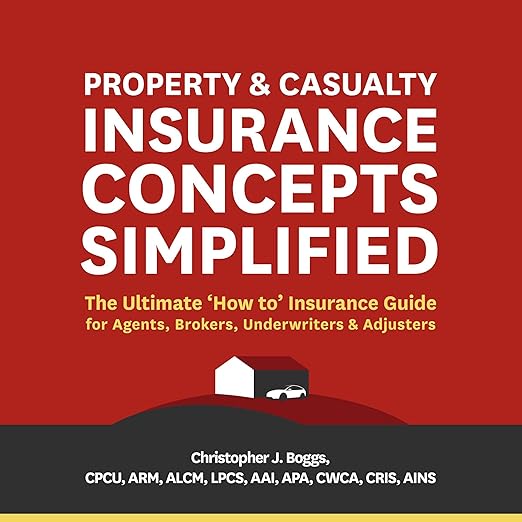
I want to be honest about what this audiobook is, because the gap between what it is and what some listeners expected accounts for most of the mixed reviews. Property and Casualty Insurance Concepts Simplified by Christopher J. Boggs is not a textbook replacement, not an exam prep guide, and not a consumer explainer. It is a practitioner reference, specifically, a codification of industry knowledge that, as the author notes, is often left to be discovered over time. That is a specific and legitimate gap to fill, and Boggs fills it with genuine expertise.
I listened to this over two mornings while doing something else, which is the wrong approach for this material and I knew it going in. The four-hour-and-twenty-four-minute runtime is compact for the range of topics covered, policy reading rules, exclusion logic, contractual risk transfer, legal liability theories, COPE details, coinsurance, and a glossary of industry terms. That density means every section requires active attention, not background listening.
Our Take on Property and Casualty Insurance Concepts Simplified
Boggs’s strength is what one reviewer identified: an impressive holistic summary that gives the reader a great intro or refresher of the core subject matter. The book works for both entry-level practitioners who need foundational framework and experienced professionals who want to codify what they have accumulated through practice. That dual usefulness is genuinely rare in technical reference material, which tends to pitch at one level or the other.
The chapter on rules for reading any insurance policy is particularly useful for newer practitioners, it provides a transferable framework rather than a policy-specific breakdown, which means it remains relevant across different coverage types. The coinsurance explanation, which is a concept that generates consistent confusion in industry training, is handled with the clarity the title promises.
Why Listen to Property and Casualty Insurance Concepts Simplified
George Jack’s narration is clean and professional. For technical content, that is the right call, you want someone who reads accurately and clearly without any affectation that might make complex terminology harder to follow. The audio format works reasonably well for this material as a supplement to the print version; one reviewer’s praise suggests that practitioners across distribution, underwriting, and claims functions can all extract value.
The extensive glossary is a practical asset. In audio format, glossary sections are harder to navigate than in print, but having the terminology formally defined and read aloud can reinforce retention for listeners who are building their professional vocabulary.
What to Watch For in Property and Casualty Insurance Concepts Simplified
One reviewer had a specific frustration with the Kindle version, illustrations not rendering correctly, that does not apply to the audiobook, but it does point to a relevant limitation: the audiobook cannot fully replicate any visual reference material in the original text. Some concepts that Boggs illustrates will be purely verbal in the audio version, which may or may not be sufficient depending on how visually you process technical information.
One reviewer gave two stars specifically because the book is written for consumers and not for course takers, and lacks an index. That frustration is worth taking seriously: if you are preparing for a licensing exam, this is not structured around exam frameworks and will not serve that purpose. It is conceptual, not test-oriented. The distinction matters before you purchase.
Who Should Listen to Property and Casualty Insurance Concepts Simplified
Insurance practitioners across distribution, underwriting, claims, and finance who want to systematize their conceptual understanding will find genuine value here. It is also useful for those new to the industry who want framework before they accumulate the informal knowledge Boggs is codifying. Exam candidates looking for structured test preparation and consumers trying to understand their own policies should look for purpose-built resources instead.
The four-hour runtime also makes it viable as a professional development listen during a commute, provided the listening is active rather than ambient. The material does not reward distracted attention, but it is compact enough to revisit specific chapters when a concept, coinsurance calculations, say, or the logic of exclusion hierarchies, comes up in practice and needs to be freshly understood.
Frequently Asked Questions
Is this audiobook useful for someone preparing for a P&C insurance licensing exam?
Not specifically. The book codifies practitioner concepts and theories rather than mapping to exam frameworks. One reviewer explicitly noted it was not designed for course takers. Dedicated exam prep materials would be more appropriate for that purpose.
Does the audiobook version lose significant value from any visual or illustrated content in the original print edition?
Some visual reference material does not translate to audio. One reviewer noted illustration rendering issues in the Kindle version, and any charts or tables in the original would be purely verbal in audio. The core conceptual content translates well, but visual aids are absent.
Who is the primary audience for this book, is it aimed at entry-level or experienced insurance professionals?
Both, according to one reviewer who found it works as an intro or a refresher. The material is pitched at practitioner level across distribution, underwriting, claims, and finance, not at consumers or exam candidates.
How does George Jack’s narration handle the technical terminology and industry-specific language?
Jack reads the technical content clearly and without affectation, which is appropriate for reference material. The narration prioritizes accuracy and diction over performance, which serves the material’s purpose.