Quick Take
- Narration: Terence Michael narrates his own book with the conviction of someone who has lived the argument, occasionally earnest to a fault, but the directness reads as authenticity rather than salesmanship.
- Themes: Bitcoin as monetary philosophy, the case against fiat currency, financial sovereignty and decentralization
- Mood: Confident and propulsive, sometimes verging on evangelical
- Verdict: The clearest and most philosophically grounded Bitcoin primer currently in audio, valuable for skeptics and believers alike, though listeners should bring their own critical framework.
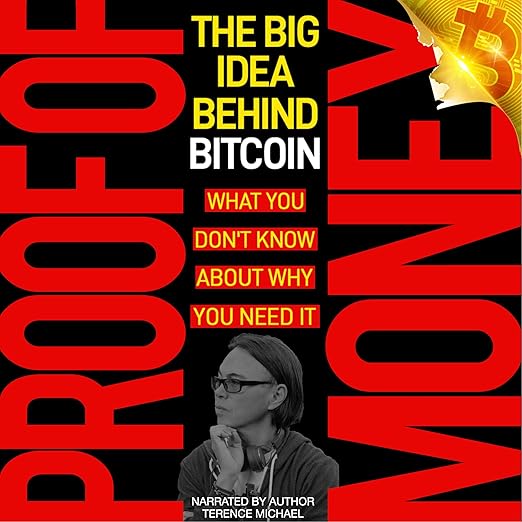
I am not a Bitcoin maximalist. I want to say that upfront, because Proof of Money is a book written by someone who is, and that shapes every page. Terence Michael believes in Bitcoin with the conviction of someone who has not merely studied the argument but reorganized his understanding of money, value, and freedom around it. What makes the book worth listening to despite, or because of, that conviction is the quality of the argument itself, which is considerably more rigorous than the genre average.
Michael self-narrates, which is both the book’s clearest strength and its occasional liability. The strength is that you are hearing someone articulate a position they have thought about at length, not a professional narrator performing text. The liability is that Michael’s enthusiasm for his subject can tip into repetition, the book’s synopsis itself reads like a manifesto, with its stacked bullet points about what Bitcoin is not. That rhetorical habit shows up in the audio too, where certain arguments are revisited from multiple angles in ways that will feel thorough to a sympathetic listener and redundant to a skeptical one.
Our Take on Proof of Money: The Big Idea Behind Bitcoin
What Michael does unusually well for a Bitcoin book is situate cryptocurrency within a broader history and philosophy of money. He does not start with blockchain mechanics and work outward; he starts with what money is, what properties have historically made certain things good stores of value, and why the departure from the gold standard matters. This framing, Bitcoin as the digitization and improvement of gold’s properties rather than a speculative technology, gives the argument a coherence that many cryptocurrency primers lack.
The environmental sections are likely to be the most contested for general listeners. Michael argues that Bitcoin improves the environment, stabilizing electric grids, consuming only wasted or renewable energy, emitting zero carbon. These claims are significantly more optimistic than the mainstream scientific consensus on Bitcoin’s energy footprint, and listeners approaching this as a balanced assessment of the technology should be aware that Michael is making the strongest possible case for his position rather than weighing evidence from all sides.
Why Listen to Proof of Money: The Big Idea Behind Bitcoin
Even readers who have spent time with other Bitcoin literature will find value here. Multiple reviewers who identified as already knowledgeable about the space described it as the book they are recommending to friends, specifically because Michael’s explanations are clear and his analogies are fresh. The comparison of Bitcoin to gold, making gold portable, divisible, verifiable, and frictionless, is one that illuminates the technology’s design philosophy in a way that technical explanations often fail to do.
The self-narration adds something unexpected: Michael’s passion is audible in the audio format in a way that a page cannot quite convey. When he talks about Bitcoin as freedom for eight billion people, for the unbanked, the oppressed, those living under authoritarian financial systems, there is a quality of genuine belief in his voice that goes beyond pitch. Whether you share that belief or not, the sincerity is real, and it gives the argument weight it would not have from a neutral narrator.
What to Watch For in Proof of Money: The Big Idea Behind Bitcoin
This is an advocacy work, not a balanced assessment. Michael is making a case, and he does so effectively, but he does not engage seriously with the strongest counterarguments, the energy debate, the volatility problem, the regulatory risk, the environmental costs of proof-of-work mining. Listeners who want a balanced picture of Bitcoin’s tradeoffs will need to supplement this with other sources. Used as one input among several, however, it is one of the clearest articulations of the Bitcoin philosophy currently available in audio.
The book’s 7.5 hours is a comfortable length, long enough to develop the argument with depth, short enough to maintain focus. Michael structures the material clearly, and the chapter-by-chapter progression from monetary history through Bitcoin’s technical properties to its social implications is well-designed for a listener building a mental model from scratch.
Who Should Listen to Proof of Money: The Big Idea Behind Bitcoin
This works best as an entry point for intelligent adults who have been Bitcoin-curious but unconvinced, and who want the philosophical case rather than a technical manual. Existing Bitcoin holders looking for a book to recommend to skeptical friends will find this more persuasive than most. Listeners who are already skeptical of cryptocurrency should approach with awareness that the counterarguments are not given serious airtime.
Frequently Asked Questions
Do I need to understand blockchain technology to follow Proof of Money?
No. Michael deliberately structures the argument around monetary philosophy rather than technical mechanics. He explains Bitcoin’s properties and advantages in accessible terms without requiring knowledge of cryptography, distributed ledgers, or consensus mechanisms. It is designed for a general audience.
Is this book balanced in its treatment of Bitcoin’s risks and criticisms?
Not particularly. Michael is a Bitcoin advocate making the strongest possible case, and he does not engage seriously with the counterarguments around energy consumption, volatility, regulatory risk, or the limitations of proof-of-work systems. It is best understood as a persuasive case for Bitcoin rather than a balanced assessment.
How does Terence Michael’s self-narration compare to professional audiobook narrators?
Michael is an engaged and articulate narrator with obvious conviction in the material. He lacks some of the technical polish of professional narrators, pacing is occasionally uneven, and his enthusiasm can shade into repetition. But the authenticity of hearing the author argue their own case is a genuine asset for a persuasion-oriented book like this one.
Who should listen to this first: a Bitcoin skeptic or someone who already holds Bitcoin?
Both can get value from it, but in different ways. Skeptics will find the clearest available audio articulation of the philosophical case for Bitcoin’s monetary design. Existing holders will find it useful as a book to recommend to people in their lives who are curious but unconvinced, multiple reviewers describe using it exactly this way.