Quick Take
- Narration: Virtual Voice handles the security-technical content without major distortion, though the case study sections and real-world breach scenarios lose dramatic clarity through synthetic delivery.
- Themes: LLM security vulnerabilities, prompt injection attack patterns, defensive AI architecture
- Mood: Technical and urgent, aimed squarely at security and development professionals
- Verdict: A focused, practical security guide for AI developers and cybersecurity professionals integrating LLMs into production systems, though the no-ratings, no-reviews status makes independent quality verification impossible.
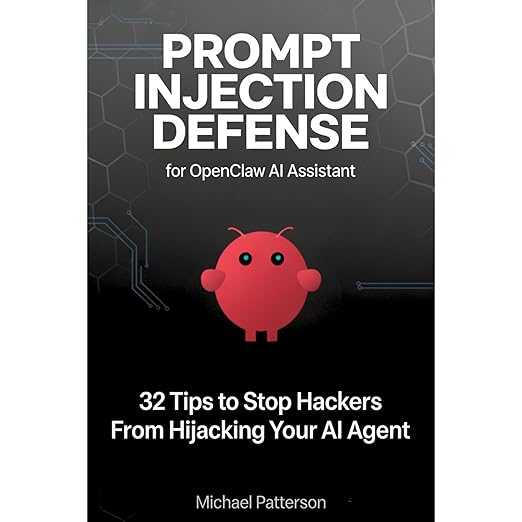
Prompt injection is the kind of security problem that is underestimated until it isn’t. The basic concept sounds almost quaint: an attacker embeds malicious instructions in content that a language model processes, and the model follows those instructions rather than the developer’s intent. In practice, this attack vector has been used to exfiltrate data, manipulate outputs in customer-facing applications, and circumvent safety controls in production AI systems. Michael Patterson’s book exists because the security community has not yet produced a canonical technical reference for defending against it.
The book carries no ratings and no reviews. That absence is a meaningful data point: this is a niche technical security text covering a specialized emerging field, and it has not accumulated the general listener base that would generate review volume. That is not a quality signal in either direction. It is a scope signal.
The OpenClaw Frame and What It Signals
The title’s reference to an OpenClaw AI Assistant, described in the synopsis as a subject of specific configurations and code examples, is worth noting. OpenClaw is not an Anthropic product or a widely recognized commercial AI system at the time of writing. The book appears to use it as a worked example or demonstration framework for prompt injection defense principles. The broader applicability to ChatGPT, Claude, Gemini, and other production LLMs is addressed explicitly in the synopsis, which positions OpenClaw as a teaching vehicle rather than a proprietary system.
This framing has advantages and limitations. The advantage is that a dedicated worked example allows more specific configuration guidance than a platform-agnostic treatment would permit. The limitation is that readers may spend time learning OpenClaw-specific conventions that require additional translation when applying the principles to their actual production environment. For practitioners already working with a specific platform, supplementary platform-specific documentation remains essential.
The Core Technical Content: Direct and Indirect Injection
Patterson structures the content around the distinction between direct and indirect prompt injection. Direct injection happens when an attacker controls the user-facing input to an AI system and embeds malicious instructions there. Indirect injection happens when malicious content enters the model’s context through data it retrieves, documents it summarizes, or web content it processes. Indirect injection is the harder problem, and the synopsis suggests Patterson covers defensive architectures for both categories.
Virtual Voice narration delivers the technical content at a consistent pace. Security documentation has a natural affinity with text-based formats, where you can reference command syntax and code examples directly, and the accompanying audio format requires more attention from listeners to retain multi-step defensive procedures. The case study sections, which should carry the practical weight of the technical guidance, lose some of their instructional value through synthetic narration that cannot modulate the urgency of a real breach scenario the way a human narrator would.
OWASP Alignment and Framework Positioning
Patterson explicitly references the OWASP Top 10 for LLM Applications, which is the closest thing to a consensus framework for LLM security that currently exists. Aligning the book’s content with OWASP standards is a sound positioning decision: it gives security and compliance professionals a reference point for how Patterson’s guidance maps to the frameworks their organizations may already be using, and it anchors the content in community consensus rather than purely individual perspective.
The testing methodology section, which the synopsis describes as covering how to identify AI assistant vulnerabilities before attackers exploit them in production, is the section most likely to be directly actionable for security practitioners. Defensive security work depends on understanding the attacker’s toolkit, and a systematic approach to red-teaming your own LLM implementations is valuable regardless of which specific platform you are securing.
Who Should Listen and Who Should Skip
Listen if you are an AI developer, cybersecurity professional, or technical leader responsible for LLM integration in production environments, and you need a focused, practical reference on prompt injection defense. The OWASP alignment and platform-agnostic applicability make this relevant beyond OpenClaw-specific implementation. Skip if you are looking for introductory AI security content: Patterson’s material is written for practitioners with existing context, not for listeners new to either AI development or security concepts. Skip also if you rely on audio narration for technical content requiring frequent code reference, where a text format will serve you more efficiently.
Frequently Asked Questions
What is OpenClaw AI Assistant, and does this book apply to ChatGPT, Claude, or other commercial platforms?
OpenClaw appears to be a worked example framework used to illustrate prompt injection defense principles concretely. The book explicitly addresses applicability across ChatGPT, Claude, and Gemini, so the defensive techniques are not limited to OpenClaw-specific deployments.
Is this book appropriate for cybersecurity professionals who are new to AI systems, or does it assume LLM development experience?
The synopsis positions it for both cybersecurity professionals expanding into AI security and AI developers building production systems. Some familiarity with how language models work contextually is assumed, but deep LLM development experience is not required.
Does the book cover indirect prompt injection, where malicious content enters through retrieved data rather than user input?
Yes. The distinction between direct and indirect injection is a central structural element of the book. Indirect injection, where content from processed documents or web retrieval carries malicious instructions, is addressed explicitly.
How does Virtual Voice narration affect the usability of technical security content with code examples?
For conceptual and procedural content, Virtual Voice is adequate. For multi-step defensive procedures and code-adjacent configurations, the audio format is less efficient than text. The book includes a PDF companion, which is essential for any code examples referenced in the narration.