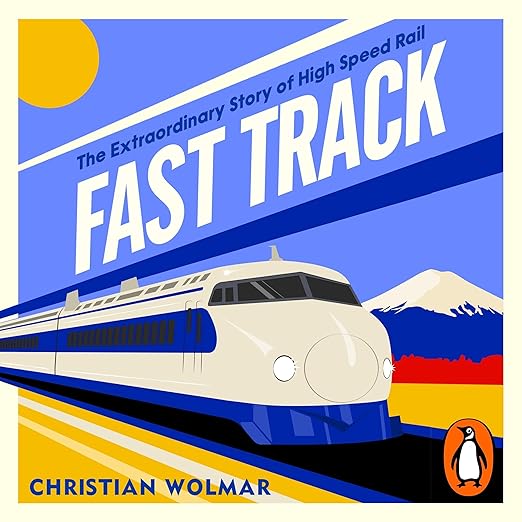
In Brief
- Themes: High speed rail as a global project, engineering set against politics, national ambition compared across borders.
- Mood: Expect comparative, explanatory nonfiction rather than nostalgia for trains.
- Verdict: A promising title on an unfinished record, so wait for a reader credit and a runtime before committing.
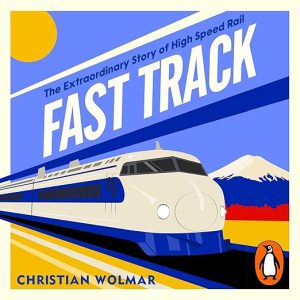
Penguin has put a book about high speed rail into audio, and this audiobook record does not yet say who reads it. The description runs to three lines. One is a publisher tag. One is a single sentence describing the subject as the global history of high speed rail, carrying a press quote that calls the author the railways' wisest and most detailed historian. One is a copyright notice dating both the text and the audio production to 2026. That is the entire brief a buyer receives, and the buying decision has to be made on the strength of it.
Three lines is not a description, it is a placeholder, and it is worth being precise about what that costs. Nothing here says how the book is organized, whether it moves country by country or decade by decade, where the story begins, or how much of it is engineering as against politics as against economics. A global history of anything can be a survey, an argument or a set of case studies, and those are three completely different listening experiences. The copy commits to none of them. It does commit to Christian Wolmar's standing, which is a real thing to sell, and to a subject with genuine reach.
Production details are missing exactly where a buyer needs them most. The narrator field on this record is empty and the duration field reads Not Yet Known, on a listing whose release date has already come and gone. For an audio product, those two fields are the product. Runtime tells you whether this is a brisk survey or a fourteen-hour treatment, and a reader's name is the strongest single predictor of whether nonfiction like this becomes a pleasure or a chore. Penguin Audio holds the recording copyright according to the same description, so the information exists upstream. It simply has not reached the page.
No Reader Credited on This Listing Yet
Speed is a better audio subject than it first appears. High speed rail sits at the junction of engineering, national ambition and public money, and the story of how different countries decided to build it, or decided against it, is comparative by nature. A global history has to explain why one technology produced such different outcomes in different places, and that is a narrative problem rather than a technical one. Anyone who has enjoyed infrastructure history knows the specific pleasure involved: enormous decisions taken by identifiable people, with consequences you can still go and ride.
Praise on this page belongs to the author rather than to the book. The Observer line calls Wolmar the railways' wisest and most detailed historian, which is a verdict on a career, collected elsewhere and reprinted here as a selling point. That distinction matters more than it usually would, because with no other description available a buyer could easily read the quote as a review of this title. It is not one. Nothing has yet been said about this particular book by anybody, which is ordinary for a new release and worth stating plainly rather than letting a borrowed compliment fill the space.
No reader is credited anywhere on this listing, which means no assessment of the reading is possible and none should be attempted. What can be said is what the material will demand. Comparative history of this kind moves constantly through place names, dates, distances and speeds, and whoever reads it has to keep numbers intelligible without letting them flatten the prose around them. Wolmar's reputation rests on detail, and detail is precisely what a careless reading destroys. Anybody who cares about that should wait for the credit to appear rather than buying on a publisher's name.
Zero Ratings, Zero Words, and a Bad Tag
Zero ratings and zero written responses sit under this record. Both feedback fields are empty rather than merely low, which for a recent release is expected and is still a genuine constraint on what anyone can tell you. No listener has reported the pace, the structure, the level of technical assumption, or whether anything visual from the printed edition is missing from the audio. Every judgment available on this page today is a judgment about a publisher, a subject and a reputation, and that includes mine.
Computers and technology is one of the three categories this record sits in, alongside history and science and engineering. Two of those are defensible. The third is not, since a global history of high speed rail is not a computing title in any sense, and that tag will surface the book to people looking for something else while burying it under software titles that dominate the shelf. The record carries no subtitle either, and Fast Track on its own tells a browser nothing whatever about trains, which makes a discoverability problem into a compounding one.
Waiting Is the Sensible Course for Now
Rail enthusiasts will find this first and matter least here, because a book framed this way is aiming considerably wider. Anyone drawn to how large public projects get argued over, funded and delivered has a reason to listen, and so does anyone who has followed a domestic rail debate and wanted the international comparison that news coverage never supplies. The subject rewards listeners who like systems: one idea, attempted in many countries, producing very different results for reasons that are rarely technical.
Waiting is the sensible course. Everything about the title is promising, from the publisher to the author's standing to a subject with real narrative potential, and almost nothing about the listing itself is finished. Once a reader is credited and a runtime appears, this becomes an easy recommendation to make or to refuse on the merits. Until that happens, a buyer is paying for a reputation, a one-line summary and a copyright notice, which is a fair gamble for somebody who already knows this author's work and a poor one for everybody else.