Quick Take
- Narration: Virtual Voice delivers flat, undifferentiated technical prose with no sense of how to pace complex RF concepts, a significant obstacle for material that requires patient scaffolding
- Themes: RF engineering fundamentals, wireless standards and protocols, IoT and 6G emerging technologies
- Mood: Dense and reference-oriented, better suited to a printed handbook than an audio format
- Verdict: The content scope is legitimately comprehensive, but Virtual Voice narration makes this a difficult listen for anyone trying to build intuition around complex wireless engineering concepts.
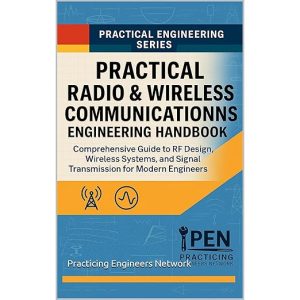
I want to be honest about what kind of listening experience this one offers before getting into what the book itself is trying to do. The Practical Radio and Wireless Communications Engineering Handbook is narrated by Virtual Voice, the AI-generated narrator that Audible uses when no human narrator has been assigned to a title. For straightforward prose in most genres, Virtual Voice is tolerable. For technical engineering content covering RF fundamentals, impedance matching, link budgeting, OFDM, QAM modulation, EVM measurement, and 6G architecture, the flat synthetic delivery compounds the already significant challenge of processing this kind of material through audio alone. I flagged it early so you can plan accordingly.
The book is the fourth entry in the Practical Engineering Series from the Practicing Engineers Network and positions itself as an all-in-one reference for engineers, technicians, and students who want to understand how wireless systems are designed, tested, and deployed. That is an ambitious scope for a two-and-a-half-hour runtime, and it creates an interesting tension between breadth and depth that runs through the entire audiobook.
Coverage Versus Depth: The Handbook Tradeoff
The synopsis is unusually specific about what gets covered, and reading it is essentially a table of contents exercise: RF and signal fundamentals, modulation and multiplexing techniques, wireless standards from Wi-Fi and Bluetooth through ZigBee, LoRa, LTE, 5G, and satellite systems, network architecture, testing and compliance including spectrum analysis and FCC certification requirements, and emerging technologies including 6G, AI-driven cognitive radio, and reconfigurable intelligent surfaces. That is a genuinely comprehensive list for any format. At two hours and thirty-three minutes, it becomes a survey rather than a technical manual, which is not inherently a problem if the listener understands that going in.
The series description promises step-by-step calculations, diagrams, flowcharts, and quick-reference tables. Those elements are part of the printed or PDF companion version of the handbook. In audio, the calculations described verbally without visual reference require either a strong existing background in RF engineering or a willingness to pause and reconstruct the math mentally. For listeners who already work in wireless systems and want a structured audio review of familiar concepts, this format works. For newcomers expecting the audio to build foundational understanding from first principles, the absence of the visual components is a real obstacle.
Where the Content Earns Its Place
The sections covering wireless standards and protocols benefit most from the survey format. The comparisons between Wi-Fi, Bluetooth, ZigBee, and LoRa are accessible at a conceptual level, and the explanation of how different standards address different ranges, power budgets, and data rate requirements is genuinely useful framing for anyone working in IoT system design who needs a quick comparative orientation. The emerging technologies section covering 6G research directions, AI-integrated network management, and reconfigurable intelligent surfaces is the most forward-looking part of the book, and this material translates reasonably well to audio because the concepts are still largely theoretical rather than calculation-intensive.
The testing and compliance section covering RF test benches, spectrum analysis, and FCC and ETSI certification requirements is where the handbook character of the title is most apparent. This is reference material, and it reads as such. In print or PDF, you would use it as a checklist. In audio, it functions more as an orientation to the regulatory landscape than a practical guide you can act on directly.
Practical Limitations of the Audio Format Here
There are no ratings or reviews for this title at the time of writing, which means there is no listener feedback to triangulate against. The book has no narrator credit beyond Virtual Voice, and the Practicing Engineers Network has published multiple volumes in this series using the same approach. For reference-oriented technical content like this, the PDF companion is not optional if you want to get full value. The audio alone gives you the conceptual architecture but strips out the reference tables and quick-lookup material that make an engineering handbook practically useful.
For listeners who are comfortable treating technical audio as a podcast-style orientation rather than a technical course, the runtime is manageable and the coverage is honest about its survey ambitions. For anyone expecting a working audio textbook in RF engineering, this is the wrong format for that goal regardless of how good the underlying content is.
Who Should Listen and Who Should Skip
Listen if you already have a background in RF or wireless systems and want a structured audio review of the standards landscape, testing requirements, and 6G research directions. Also worth a listen if you are a generalist engineer or IoT developer who needs a quick conceptual orientation before going deeper with targeted study materials.
Skip if you are new to wireless engineering and hoping the audio will build foundational RF intuition without visual support. The Virtual Voice narration and the handbook’s survey format both work against that learning objective. The PDF companion is essential if you engage with this title at all.
Frequently Asked Questions
Does the Practical Radio and Wireless Communications Engineering Handbook require prior RF engineering knowledge?
The book is listed as appropriate for both engineering students and working professionals, but the survey format and Virtual Voice narration make it more accessible to listeners who already have some background in wireless systems. Complete beginners will find the conceptual overview useful but may need supplementary materials for the calculation-heavy sections.
Is the PDF companion included with the audiobook purchase, and is it necessary?
Based on the series description, blueprint-style visuals, flowcharts, and quick-reference tables are part of the handbook format. These elements are absent from the audio and are most useful in the printed or digital companion. The audio functions without them but loses much of what makes a handbook practically useful as a reference document.
How does this volume compare to other books in the Practical Engineering Series?
This is the fourth entry in the Practical Engineering Series from the Practicing Engineers Network. The series follows a consistent format combining engineering fundamentals with hands-on examples and visual reference material. The wireless communications volume follows the same structural approach, meaning listeners who have used other volumes in the series will find the format familiar.
Does the book cover 5G and 6G technologies specifically, or is it primarily focused on legacy wireless standards?
The book covers both. Legacy standards including Wi-Fi generations, Bluetooth, ZigBee, LoRa, and LTE are covered as part of the wireless protocols section, while 6G research directions, AI-driven cognitive radio networks, and reconfigurable intelligent surfaces appear in the emerging technologies section. The 6G material reflects research-stage concepts rather than deployed infrastructure.