In Brief
- What it covers: Instagram strategy end to end, hashtags and paid ads, influencer partnerships, selling through a storefront
- Feel: Brisk, list-driven and impersonal
- Our call: A three-hour orientation for people who already use Instagram, sold under one title, described under another, and read by a synthetic voice.
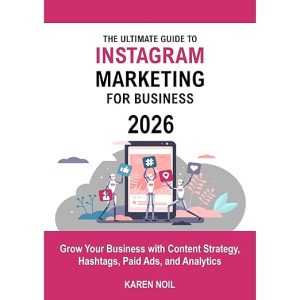
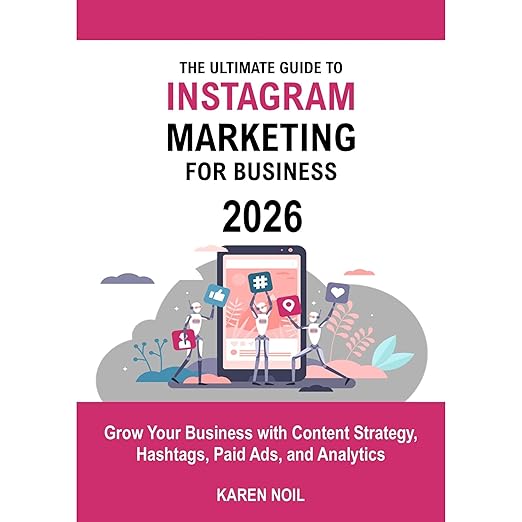
Hashtags do not survive being read aloud, which is the first thing worth knowing about a three-hour audiobook on Instagram strategy. Neither do grid layouts, aspect ratios, the difference between a Reel and a Story, or the four screens it takes to open a shop. Karen Noil's guide promises all of it: profile building, visual content, hashtag strategy, Stories, Reels and Live, paid ads with metrics attached, influencer partnerships, user-generated content, and an Instagram Shop set up to sell. The question the format puts to the material is which of those actually transmits through a speaker.
Twenty-Five Minutes a Subject, the Right Seven
Seven promises are made in a bulleted list high up in the description, and they happen to be the right seven. Anyone selling on Instagram does need a profile that converts, a content practice they can sustain, a hashtag approach that is not superstition, a working grasp of which video format serves which goal, ad spend they can measure, a route into influencer and user-generated content, and a storefront. That is a real curriculum. Two hours and fifty-nine minutes is what has been allotted to teach it, which works out at roughly twenty-five minutes a subject.
Karen Noil is self-published here, with Independently Published in the publisher field and a release dated December 30, 2025. The record shows a 3.0 average resting on a rating count of one, and that pairing is worth reading precisely: a single person clicked once, and everything the page reports about how this performs comes out of that one click. It is less a low score than no score, statistically speaking. Buy on the description or on the sample, because the number sitting underneath them is carrying no information at all.
Emphasis Is Information, and This Format Has None
Compression is the real argument for this format. A three-hour overview will not teach you to shoot a Reel, but it will hand you the vocabulary and the shape of the discipline in one afternoon, which is a genuinely useful thing to own before you start anything longer. The copy is honest about the level it pitches at: a comprehensive guide covering everything you need, aimed at people assembling a strategy more than at people executing a campaign. Understood as orientation and not as training, the length turns into a feature.
Reels, Stories and Live get grouped in the copy under telling your brand's story, and that is the section most likely to hold up spoken, because it is strategic and not procedural. The same goes for the influencer and user-generated content material, and for the brand loyalty and trust argument attached to it. Deciding whether to run a creator partnership, what to pay for it and what to expect back is a business judgment you can reason through with your hands nowhere near a keyboard. Deciding on a crop, a caption length or a posting time is not, and the copy makes no distinction between the two kinds of advice.
Machine reading is what this record ships with. The reader field says Virtual Voice, the platform's own automated narration and not a hired performer, and the listing states as much plainly, which is more than some do. For a guide this procedural the consequence is practical, not aesthetic: a synthetic voice reads a list of seven metrics in exactly the shape it reads a warning about ad spend, and no human judgment sits behind the emphasis to tell you which of the two should worry you. On instructional material, emphasis is information, and this format has none to give.
A Three-Star Reader Narrows the Doorway
Two different titles are attached to one product. The header sells The Ultimate Guide To Instagram Marketing For Business 2026, while the description opens by announcing The Ultimate Instagram Marketing Guide under an entirely different subtitle, then names that second title again at the close as the roadmap you are buying. The subtitle carried in the copy is the informative one, and it appears nowhere in the field a search engine actually reads. Whatever went wrong upstream, a buyer hunting for either version will struggle to land on the other.
The single written response on the record is the most useful sentence attached to it, and it is a caveat. Not for people new to Instagram, it says, because you need a fundamental understanding of how Instagram works first. That is a three-star reader telling you the copy's promise is off by one level. The description holds the door open to anyone new to Instagram marketing. The one person who has reported back says the doorway is narrower than that, and on a runtime this short they are almost certainly right.
Money-finance sits in the genre list beside business-careers and computers-technology, and it has no business being there. Nothing in the copy touches personal finance, investing or accounting; the nearest it comes is return on ad spend. A guide filed on a money shelf surfaces for the wrong searches and disappoints the people who follow them. The 2026 in the title poses a second version of the same problem, because a guide dated to a year and advertising the latest Instagram features begins aging immediately on a platform that ships changes every month.
A Synthetic Reading With Nothing to Pause On
Marketers already posting who want a structured pass across the whole surface are the right buyers here: you have the fundamentals, you want the map, and three hours is a fair trade for it. Small business owners with a working account and no strategy are the second group, provided they treat this as a briefing to act on later and not a manual to follow at the screen. Anyone about to sit down with an agency and needing the vocabulary first will get their money back inside an afternoon.
Look elsewhere if you have never run a business account, because a three-hour overview assumes a working vocabulary it never stops to build, and you will spend the runtime translating. It is also the wrong purchase if you want a workbook. A synthetic reading of a procedural guide leaves nothing to pause on, no screenshots, no links and no checklist you can hold, and the promise of real-life case studies is hard to test in a format that cannot show you a single post. Learn by doing, and you want the written version with the audio kept for the strategy chapters.