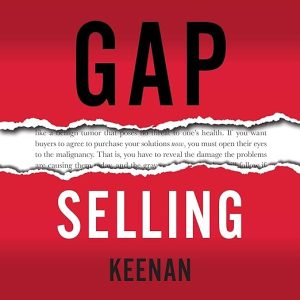
Picture a sales meeting where the rep spends forty minutes talking about the product and five minutes asking questions. Keenan has been in that room, and Gap Selling is the extended argument for why that ratio is exactly backwards. I listened to this audiobook during a week when I was working on pricing and positioning for a nonfiction imprint, which is not traditional sales territory, but the framework clicked in ways I did not anticipate. Keenan narrates his own book, which turns out to be a decision that matters enormously to how the material lands in audio.
The central claim of Gap Selling is both simple and structurally counterintuitive: sales is not about overcoming objections or building rapport, and closing is not a skill that distinguishes good salespeople from weak ones. The actual skill, according to Keenan, is understanding the gap between where a prospect currently is and where they want to be, and then helping them see that gap clearly enough to motivate the change that buying represents. Without that gap, a sale cannot happen. With it, the sale becomes the prospect's logical next action rather than the salesperson's goal.
The self-narration is the production's defining feature. Keenan's voice carries the same unapologetic, irreverent energy that reviewers consistently describe in the text. He is not reading his book; he is presenting his argument directly to you, and the difference is audible. When he says that buyers do not care about salespeople or their products, it comes out with a directness that would be softened by any third-party narrator trying to manage the claim's provocation. When he explains why price is rarely the actual reason a sale is lost, he sounds like someone who has debugged that misconception in hundreds of post-mortem conversations and has no patience for the myth.
At under six hours, the audiobook is tightly structured. Keenan does not pad the content to reach a page count, and no sense exists that the argument has been stretched to justify a book-length treatment. Each chapter advances the framework rather than illustrating it with additional case studies that make the same point three times. For listeners who have spent time in sales-book territory where the first three chapters contain the actual idea and the remaining fifteen chapters restate it, this compression will be genuinely refreshing. The runtime matches the argument rather than publisher expectations.
The Problem Identification Chart Becomes a Coaching Tool
The framework's most useful contribution is what Keenan calls the Problem Identification Chart: a structured way to map the prospect's current state, their desired state, the business problem sitting between those two states, the technical root cause of that problem, and the emotional impact of the gap on the prospect as a human being. Sales training programs typically focus on either technical qualification or emotional rapport. Keenan's argument is that neither works without the full problem map, because you cannot create urgency around a change the prospect has not yet articulated as a problem they own.
One reviewer who used the book as part of a sales team book club notes that it revealed a pattern: reps were pitching before understanding the prospect's situation. That is exactly the use case the audiobook is built for. Gap Selling functions well as shared vocabulary for a team precisely because Keenan's framework is explicit and testable. You can debrief a call against the problem map and identify specifically where the gap conversation was skipped or shortened. The Problem Identification Chart becomes a coaching tool as much as a selling tool.
Keenan's Case Still Needs Trust as a Prerequisite
The book's tone is deliberately provocative, and some of the contrarianism is more useful than other parts. The claim that buyers do not buy from people they like is a useful corrective to the relationship-first school of selling, but taken literally it overstates the case. In long-cycle enterprise sales, trust and rapport do matter as prerequisites for the problem exploration that Keenan describes. The framework works better as a corrective against premature pitching than as a complete theory of the buyer-seller relationship in all its forms.
The audiobook is also more useful for complex-sale environments, where a buyer is changing a process or committing a significant budget, than for transactional retail or volume-based inside sales. Keenan acknowledges this implicitly through his examples, but the framing implies universal applicability that the framework does not fully support in all contexts. Listeners in high-velocity transactional sales will need to adapt the problem-identification approach to shorter discovery windows and compressed timelines.
The audiobook also functions as a diagnostic tool for sales leaders reviewing team behavior. Because the gap framework makes the stages of discovery explicit, managers can listen to call recordings and identify precisely where the problem identification conversation was skipped or rushed. That specificity is what makes the material more useful than general sales philosophy: Keenan gives you a named thing to look for rather than a vague directive to be more consultative.
Founders Doing Early-Stage Sales Without Training
B2B salespeople and account executives in complex-sale environments will get the most immediate value from this audiobook. Sales managers looking for a shared framework to use in team coaching and call debriefs will find the Problem Identification Chart a practical tool that translates well from audio to whiteboard sessions. Listeners who have found traditional consultative selling frameworks like SPIN Selling or Solution Selling overly academic will appreciate Keenan's more direct and colloquial presentation. Founders who are doing early-stage sales without formal training will find the framework a useful shortcut into structured discovery. Listeners in transactional or retail sales environments should expect to do significant adaptation work before the framework applies directly to their specific context.
Does Keenan narrating his own audiobook add to the experience?
Significantly. Keenan's delivery carries the irreverence and directness of the argument in a way that a professional narrator reading the same words would flatten. The self-narration is one of the audiobook's genuine assets, not a compromise.
How does Gap Selling compare to other sales audiobooks like SPIN Selling or The Challenger Sale?
Gap Selling is less academic than SPIN Selling and more framework-specific than The Challenger Sale. It shares some structural DNA with Challenger's emphasis on insight-led selling, but Keenan's Problem Identification Chart is more explicitly diagnostic. Listeners who found Challenger Sale's research framing dry will find Gap Selling more immediately practical.