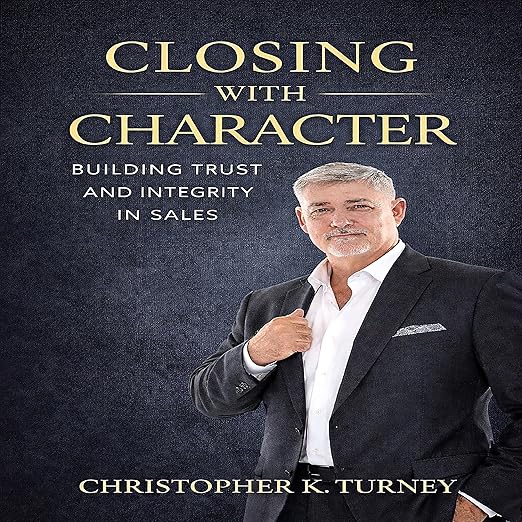
What does it actually cost when a high-pressure close works? Christopher Turney's answer, developed over the two-hour runtime of this audiobook, is that the cost is almost always paid by the relationship, and that a career built on pressure tactics eventually runs out of names who trust it. Closing with Character is not a sales book, as Turney insists from the first pages, and Kevin Abbott's narration carries that distinction clearly. What the book offers instead is a study of the psychology of decision-making under pressure, and an argument for why integrity produces better outcomes than coercion in any professional context.
Features Inform, Benefits Persuade the Heart
Turney's framing is the book's strongest contribution. He distinguishes clearly between securing agreement and producing peace, between the close that ends the conversation and the close that starts a relationship. Most sales training conflates these two outcomes, treating a signature as success regardless of whether the person who signed feels good about it the next day. Turney argues that this conflation is not just ethically wrong but practically counterproductive, because customers who feel pressured into decisions become sources of friction, refund requests, poor referrals, and damaged reputation.
The analysis of fear as the engine beneath hesitation is one of the book's most useful sections. Turney identifies that when a prospect raises objections, what is almost always operating underneath is not skepticism about product features but fear, fear of making the wrong choice, fear of being judged, fear of the change that a purchase requires. A sales approach built around overcoming objections with more pressure addresses the surface while leaving the underlying fear intact. The result is a close that felt hard-won and a customer who remains half-convinced. Turney's alternative, addressing the fear directly without exposing the customer to embarrassment, requires a different kind of skill, and he describes what that looks like in practice.
The distinction between features and benefits receives clear treatment here. Features inform; benefits persuade the heart. Most professionals know this distinction in theory and default to feature-listing in practice. Turney explains why this happens and how to retrain the instinct. The advice is simple at the surface but points to something genuine about how people actually make decisions under uncertainty.
Turney's discussion of how skilled professionals neutralize objections before they surface, through the quality of their early communication, through the trust built before any formal close, is the section I returned to most. The idea that a great close is often invisible because the relationship has been managed so well that no pressure is needed is counterintuitive to anyone trained in conventional sales methodology, but it is accurate and worth sitting with.
At two hours and four minutes, the audiobook is brief enough to be absorbed in a single sitting. It is concise in the way a well-argued essay is concise: nothing feels cut, nothing feels padded. This length was the right choice for the material.
Abbott Commands Attention Without Performing Urgency
Kevin Abbott's narration is clean and appropriately authoritative. The material calls for a voice that commands attention without performing urgency, and Abbott delivers that balance consistently. The audiobook format suits the argument particularly well because the content is built around reframing how listeners think about familiar situations, and hearing a reframe delivered aloud, in someone else's voice, can produce the distance from one's own habits that reading sometimes fails to generate.
The book's principles apply far beyond formal sales contexts. Anyone in a leadership, consulting, negotiating, or advising role will recognize the dynamics Turney describes. The moment when pressure substitutes for genuine alignment, and what that substitution costs, these patterns appear anywhere humans make significant decisions in professional relationships.
Restraint Reads as Confidence, Not Indifference
The book is deliberately principle-focused rather than tactic-heavy. Listeners seeking a specific script for handling specific objections will find the book less immediately actionable than they might want. Turney is explicit that the goal is developing a way of being in professional conversations rather than a set of moves to deploy. That is the right aspiration, but it means the application work falls to the listener rather than the book.
The brevity is also a limitation. Two hours is enough to make the argument and provide illustration, but not enough to develop the nuances in depth. Some readers will want more case studies, more specific examples of the distinction between pressure and integrity in complex selling situations. This feels like an extended essay that would benefit from a companion volume.
The passage on confidence, restraint, and integrity as momentum-builders rather than constraints deserves particular attention. Turney argues that the most effective professionals he has encountered operate with a deliberate unhurriedness in high-stakes conversations, because they are not afraid of a moment of silence or a prospect's hesitation. The restraint comes from confidence in the value being offered, not from indifference to the outcome. That quality is the opposite of what pressure tactics create, and Turney names it precisely. For anyone who has watched a high-pressure close backfire and wondered what the alternative looked like in practice, this section provides a concrete answer.
Readers of Daniel Pink's To Sell Is Human
Sales professionals who have found conventional pressure tactics uncomfortable and want a framework that aligns with their actual values. Leaders and consultants who recognize that the dynamics of influence in their work mirror those in selling. Anyone who has felt the discomfort of winning an agreement and sensing the relationship was diminished by how it was won. And listeners who have encountered books like Daniel Pink's To Sell Is Human and want something that takes the ethical dimension of professional influence further into practical territory.
- Voice: Kevin Abbott reads with clean authority, the right voice for material that asks the listener to reexamine professional habits rather than learn new scripts.
- Big ideas: Trust versus pressure in professional influence, the psychology of hesitation and fear, integrity as a long-term professional asset.
- Atmosphere: Measured and quietly persuasive, like a mentor conversation that reframes something you thought you understood.
- Worth it?: A compact and genuinely useful audiobook for professionals who want to build influence on credibility rather than tactics.
A Few Questions About Closing with Character
Is the Closing with Character audiobook only relevant to salespeople?
No. Turney is explicit that the principles apply to any high-stakes professional conversation, leadership, consulting, negotiating, advising. The underlying dynamic he describes, where pressure substitutes for genuine alignment and both parties pay the cost, is common to any relationship where one person needs to influence another's significant decision.
Does this audiobook provide specific scripts or objection-handling techniques?
No, deliberately. Turney's argument is that a script-based approach is part of the problem, it treats influence as a performance rather than a relationship. The book offers principles and frameworks for how to be in professional conversations rather than what to say in them. Listeners seeking specific tactical scripts will find the book less immediately actionable but more durably useful.
How does the audiobook distinguish between ethical and unethical closing approaches?
Turney's core distinction is between securing agreement and producing peace, between a close that ends the conversation and one that genuinely serves the person who signed. He argues that any approach that addresses surface objections while leaving underlying fear intact is coercive by effect, regardless of whether it was intended to be. The ethical standard is whether the customer feels better or worse about the decision the next day.
Is the audiobook of Closing with Character long enough to develop its argument fully?
Two hours is enough to make the central argument clearly and provide useful illustration, but some listeners will want more depth. Turney is explicit about what the book is not, it is not a comprehensive guide to professional selling or leadership. It is a focused argument about one dimension of professional influence that the broader literature often misunderstands.