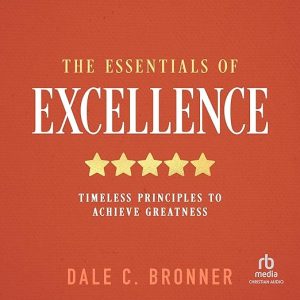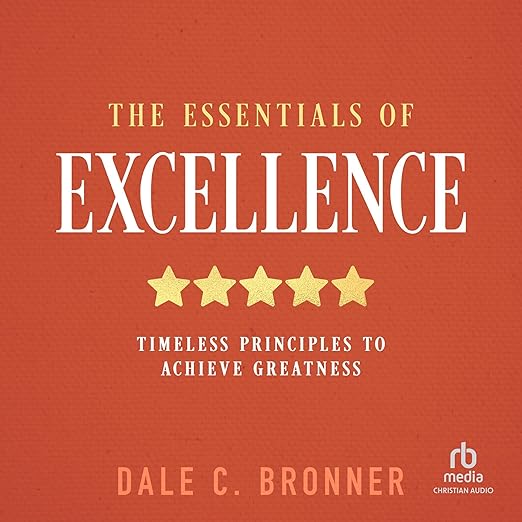
Two hours, fifty minutes: that is the entire runtime, and the promise attached to it is a life organized around excellence in work, relationships, personal projects and spirituality. That is an unusual ratio of ambition to minutes, and it is the first thing worth knowing before you spend a credit on the audiobook. Dale C. Bronner has written something closer to a distilled address than to a treatise, and the recording behaves accordingly: it moves, it lists, it does not linger. Whether that reads as discipline or as thinness depends almost entirely on what you came for.
Bad Meetings May Trace to How Life Is Arranged
Dale C. Bronner builds the book around a single distinction that carries the whole argument: excellence is not perfection. Perfection is a standard you can only fail against, while excellence is described here as maximizing what you actually have and contributing something to the people around you. That framing is old, and it is also correct, because it converts an anxiety into a practice. Most short leadership titles never bother to define their central word and simply assume the buyer already agrees with them. Defining it in the first movement is what lets the rest of the runtime move quickly without turning vague.
Excellence, in this telling, is not a workplace competency that happens to spill over into the rest of the week. Bronner insists on all dimensions at once, and the list on offer puts personal endeavors, work, relationships and spirituality on the same footing. That is an unusual claim for a title shelved under management and leadership, and it changes who the material is aimed at. The person who benefits most is not the one hoping to run better meetings. It is the one who suspects that the reason their meetings are bad has something to do with how the rest of their life is arranged.
The Best Short Books Leave a Splinter
Habit formation is where the book gets closest to something you can act on tomorrow. Bronner promises the science of how habits form, a compelling vision for a life, the power of collaboration and teamwork, competence at problem-solving and communication, and a route past limiting beliefs. Six moves in under three hours means each one gets roughly half an hour, which is enough for a clear frame and nowhere near enough for a method. Take it as a map of territory a serious reader would then go and study properly, and the compression stops being a complaint and starts being a design choice.
Tim Morgan holds the microphone for the full two hours and fifty minutes. The job on a title like this is not character work or atmosphere; it is pacing a text that arrives as a sequence of principles, and keeping the seams between them audible so a listener knows when one idea has closed and the next has opened. A printed copy hands that structure over for free, in headings and white space. A recording has to build it out of pause and emphasis alone, which is a harder assignment than the modest runtime makes it look.
Compression is the defining feature, and the honest way to describe it is as a trade. Nothing here is padded, and a listener with a gym hour and two drives will finish the whole thing inside a week. What compression costs is evidence: the case studies, failure stories and awkward counterexamples that make a leadership argument stick are exactly what disappears when the runtime is this tight. You come away with a well-organized set of convictions and almost nothing to argue with, which is a pleasant experience and a slightly weightless one. The best short books leave a splinter behind. This one leaves a checklist.
The Publisher Never Appears Anywhere in the Description
One vote is the entire statistical basis for the score sitting on this record. A single grade produces a displayed average that is really just one person's click, and it describes a population of one, which is a fact about how recently the title appeared and not a fact about the book inside it. Read it as a signal that nothing has been tested yet by anyone. It neither supports nor contradicts a word of the description, and the sensible move is to set it aside entirely and judge the material on its own terms.
Nobody has written a line underneath that score either. The written column on this record is empty, which on a leadership title matters more than it would on a novel, because the useful question about a book of principles is whether a single reader ever applied one. A novel can be judged from its own pages. A practical manual is judged from what happened afterward, in somebody's week, and so far nobody has reported back at all.
Christian Audio is the publisher, and that fact appears nowhere in the description, which names spirituality exactly once and in passing, as one of four life dimensions. Buyers arriving through a management and leadership shelf deserve to know where the recording comes from, and buyers who specifically want a faith-based treatment deserve to know that the copy never promises one. The listing gives no indication of how much scripture, if any, sits inside those two hours and fifty minutes. That is a gap the product page could close in a sentence and does not.
Morgan Suits a Long Drive With No Patience
Leaders with a long drive and no patience for a three-hundred-page treatment are the natural audience, along with anyone assembling a reading plan who wants an orientation before committing to the heavier titles in the field. A team setting works too: short enough that everyone will genuinely finish it, structured enough to give a discussion a spine, and general enough that nobody has to sign up to a specific methodology to take part. Bronner writes to be quoted, and a group will find plenty worth arguing about in a single sitting.
Without something to hold in front of you, this will slide past; the material is dense with lists and light on story, and a listener who does not stop to take notes will keep the definition of excellence and very little else. Anyone who wants research, citations or a documented method should look elsewhere, because none of that is on offer here. What is on offer is a compact, confident statement of position delivered in less time than a feature film, from a publisher whose name the description never once mentions.
Before You Press Play
- Performance: A single reader, no cast and no music, on a text that arrives as a numbered sequence of principles.
- What it covers: Excellence against perfection, habit formation, vision-setting, collaboration, limiting beliefs
- Feel: Brisk, declarative, sermon-adjacent
- Our call: A useful orientation at under three hours, not a method you can implement from the recording alone.
Common Questions
Does this audiobook need a companion PDF to follow?
Nothing in the record mentions a supplement, and the material is argued rather than tabulated, so no chart is going missing. What you will want instead is somewhere to jot the definitions down, since the value sits in a handful of distinctions that arrive quickly, early, and are never repeated later on.
Is this audiobook better taken in one sitting or spread out?
One sitting works, because the sections build on a single shared definition and the whole thing fits inside a long afternoon. Spreading it across a week suits it better if you intend to test anything, since each area is really a prompt to change one habit, and habits do not respond to a single afternoon.