Quick Take
- Narration: Author-read, which on a forty-six-minute trade manual makes the file closer to a recorded briefing than to a produced audio edition.
- Themes: Dealership standards, daily accountability, inspection and enforcement, deliberate micromanagement.
- Mood: Blunt, declarative and impatient.
- Verdict: Useful to operators already inside the system, close to unusable without the volume it names as a prerequisite.
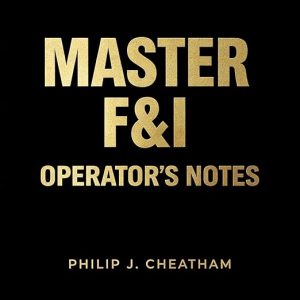
Forty-six minutes and a series that publishes backward: the audiobook edition of Master F&I Operator's Notes is one of the stranger objects on any business shelf. Philip J. Cheatham has written an enforcement manual for car dealerships, pointed squarely at dealer principals and general managers, and reads it personally. The opening line of the description announces that the book was not written for the retailer currently selling it, which sets the register for everything after it.
Micromanagement Is the One Honest Item Listed
Enforcement is the real subject, and naming it that plainly is the smartest thing the book does. Most management titles sell a philosophy and leave implementation to the reader. This one begins from the premise that standards already exist in most dealerships and simply are not held, then offers four mechanisms in reply: business plans tied to a defined standard, daily accountability sessions, inspection of critical process steps, and early-stage micromanagement meant to build habits strong enough to run without supervision. That last item is the honest one, because nobody advertises micromanagement.
Whether forty-six minutes can carry that is a fair question, and the answer depends on what a buyer expects a book to be. This is not an argument. It is a set of instructions issued by somebody who assumes the argument was settled in an earlier volume, and the copy says so outright, listing completion of Master F&I Notes as a prerequisite and stating that this work builds directly on that foundation. Bought as a standalone it will feel thin. Bought as a field manual by people already inside the system, the length is the entire point.
Cheatham Reads This So No Stranger Has To
Four books, released in reverse order, numbered from four down to one, and this is number four arriving first. The copy sets out the whole sequence: Operator's Notes, then Director's Notes, then Born to Lead Black Book, then Closing Mastery Black Book. Publishing a series backward is a real structural decision rather than an accident, and it fits the audience it names, since an owner or general manager needs the enforcement layer long before anybody needs the closing technique sitting underneath it.
Self-narration is not a cost decision on a title like this. The book sells authority over a specific trade, and the person making that claim reading it aloud is part of the claim; a hired performer would place a stranger between the standard and the people expected to hold it. The assignment across forty-six minutes is keeping a stack of imperative sentences from tipping into exhortation, because the text runs on declaratives and non-negotiables rather than on stories or case studies. Run the accountability-session material rather than the opening manifesto.
Brevity has an obvious practical use in this particular workplace. A general manager can put this on between the morning meeting and the first appointment, and the format survives interruption because the units are procedural rather than narrative. Business titles at nine hours get bought and abandoned. A forty-six-minute file that an entire management team can hear before the week starts is a different kind of product, and the industry it targets runs on exactly that cadence.
Final and Forthcoming Are Not Compatible States
A single person has graded this listing, and nobody has written anything underneath it. The displayed average therefore describes a population of one, which is a fact about how new the release is rather than about how the book performs. For a release dated March 2026 that is unremarkable and temporary. What it means in practice is that every claim about results, culture and top-performing dealerships currently rests on the author's own copy and nothing else.
Contradiction sits at the center of the description and deserves flagging. The book is billed as the fourth and final Executor book, while the same page announces Director's Notes as the next release in the series, the one that unlocks the full execution framework built inside this one. Final and forthcoming are not compatible states. More usefully for a buyer: by the copy's own admission, the framework delivered here is incomplete until a book that has not yet appeared does.
Where the record itself is concerned, several fields are doing no work at all. The series name and number are both empty, despite a description that lays out a numbered four-title sequence in detail, so nothing in the catalog data links this to the books it depends on. The publisher field holds a web address rather than an imprint. The displayed title has lost a piece as well: the copy calls it Master F&I Notes: Operator's Notes, and dropping the first half hides the connection to the prerequisite volume.
Written for Operators Done Tolerating Drift
Dealer principals, general managers and finance directors are the stated audience and genuinely the right one, particularly anyone who has written a standard that nobody follows. Managers outside the automotive trade can lift the accountability structure without much translation, since daily sessions and inspection of process steps are not industry-specific ideas. Listeners who have already worked through the foundational volume get the payoff this one was built to deliver, which is the case the copy makes for itself.
Nothing here suits a listener after the sales craft itself, which the copy assigns to the two lower-numbered books that have not been released. Anyone allergic to the register should be warned as well: the writing addresses true Operators who are done tolerating drift, and the confidence never wavers for a sentence. Operators already running a standard will hear a checklist; everybody else will hear the last chapter of a series whose earlier chapters are not out yet.
Before You Listen
Do I need the earlier books before starting this audiobook?
The copy says so plainly. Completion of the foundational volume is listed as a prerequisite, and this work is described as building directly on it. Anyone starting here receives the enforcement mechanisms without the reasoning that produced them, which is workable for a practitioner and confusing for anybody else.
Is this audiobook only relevant to car dealerships?
The vocabulary is automotive throughout, addressing dealer principals, general managers and departments inside a dealership. The mechanisms underneath are ordinary management, though: written plans measured against a fixed benchmark, a meeting every morning, and somebody checking that the steps were actually taken. A manager elsewhere can translate it unaided.
Does the audiobook explain The Wheel Principles it is built on?
The description names them as the foundation and never defines them on the listing itself. A listener who has not worked through the prerequisite book should expect the term to arrive already loaded with meaning, which is one more reason this file behaves like the later half of something.
Is this audiobook worth buying before the rest of the series appears?
That turns on whether you already hold the foundation volume. The copy promises that the book coming next completes what this one starts, so a buyer arriving today receives a working checklist plus an open acknowledgment that the finished version has not been published yet.