The Short Version
- Performance: Author-read, so anybody sampling it is auditioning the coach as well as the coaching before committing seven hours.
- What it covers: Impromptu speaking, anxiety management, reading a room, question and answer sessions, interviews and small talk.
- Feel: Practical, structured, briskly encouraging.
- Our call: A genuinely useful book about the speaking situations nobody prepares for, sold beneath a rating that cannot be what it claims.
One person has rated this audiobook and five people have written about it, which deserves explaining before anything else on a page promising to make you better at thinking on your feet. The rating count on this record reads 1. Underneath it sit five graded responses running from five stars down to three. Both figures cannot be describing the same audience, and the arithmetic is stranger than a simple mismatch, so I will come back to it. What the book itself promises is narrower and more useful than most communication titles attempt.
Two Comparatives Separate the Book From the Podcast
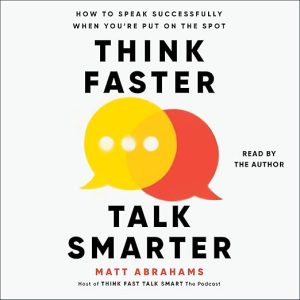
Spontaneous speech is the entire subject, and narrowing to it was the smart decision. Most public-speaking books work on the prepared performance, the slide deck, the pitch, the formal talk, all of which can be rehearsed. Matt Abrahams, a Stanford lecturer and communication coach, points out that the great majority of professional and personal speaking happens without warning: question and answer sessions, job interviews, feedback conversations, small talk, and the moment every eye at a dinner table turns toward you. The book offers science-based strategies for managing anxiety, responding to the mood of a room, and making an answer concise, relevant, compelling and memorable, drawn from work with clients and students. Charles Duhigg supplies the jacket line, calling it a road map to thinking quickly and speaking confidently.
Naming deserves a paragraph, because it will send buyers to the wrong place. The book is Think Faster, Talk Smarter. The podcast Abrahams hosts, which the copy calls popular and which is where most listeners will have met him, is Think Fast, Talk Smart. Two comparatives separate the two products, and the description runs the podcast title together with its own words awkwardly enough that a reader could easily mistake it for a subtitle. Anyone who heard an episode, liked it and came looking for the show in book form has indeed arrived at the right page, but will need to keep track of which version of each word belongs to which product.
Abrahams Reads His Own Book on Speaking
Impromptu is the key word, and one five-star response identifies the value precisely. It credits the book with focusing on what to do in the specific moment when you do not know what to do, and argues that even highly successful speakers will find value in it while novices absorb its clear, actionable approach. That is a fair account of the design. Advice for prepared speaking is abundant and mostly obvious. Advice for the ninety seconds after somebody asks an unexpected question is scarce, because it has to be simple enough to run under pressure. That entry is cut off exactly as it reaches its recommendation, and the record does not carry the rest of the sentence.
Abrahams reads his own book, and on this subject that is not a neutral production decision. A communication coach recording seven hours of advice about speaking is submitting a demonstration alongside the argument, and a listener will be assessing whether the technique is sound and whether the person selling it can perform it. The structure of the material helps, since short frameworks, named strategies and worked scenarios hold together by ear better than a continuous argument would. Set against that is the risk every author-read business title carries, which is that a lecturer's cadence sustained over seven hours can settle into something a listener stops registering. The trade runs both ways and a buyer should know it is being made.
4.5 Needs a Base That Can Divide by Two
Now the number. The badge on this record reads 4.5 and the rating count beside it reads 1. Half a star cannot emerge from a single vote: 4.5 in lowest terms is nine over two, so the base has to divide by two before the value can exist at all, and a base of one does not divide by anything. A lone voter chooses among five whole options and four and a half is not among them. Two different populations are being reported inside a single box, and the written column proves it, because five people have graded this book in writing, at five stars, five, four, five and three, which averages 4.4. Whatever the badge measures, it is not the five opinions printed below it.
Length is the objection that actually matters, and it arrives from the lowest grade on the page. Three stars, under a headline saying the book could have been half the size, with a body calling it a bit too wordy at times and arguing that less filler and a clearer focus on the core content would have produced a great book. That complaint lands harder in audio than on paper. A reader skims a padded chapter in ninety seconds, while a listener pays for every one of the seven hours and eleven minutes at the speaker's pace. Notice as well what the rest of the column is grading. Purchase language runs all the way through it, recommendations to buy, recommendations to read, headlines celebrating a wonderful purchase, which marks these as people endorsing a decision rather than describing an experience.
Ignore the Score, Use the Written Column
Introverts are the audience this book is built for, and one five-star response says so from the inside: a self-identified introvert who had always wanted to speak spontaneously and found it complicated, reporting that the book supplies several strategies for getting past that fear. Bring exactly that expectation. Nobody gets converted into an improviser by seven hours of audio, but the specific terror of being asked a question in a meeting is a solvable problem, and it gets solved with structures you rehearse in advance and deploy without warning. Managers who run meetings, teachers, anyone facing interviews, and people recently promoted into visibility will all find something they can use by Monday.
Confident speakers hunting advanced technique should probably pass. The material is pitched at people who dread the moment, and a practiced presenter will already recognize much of it. Anybody who dislikes framework-driven business writing, with its named models and its acronyms, will meet plenty of both, and should budget for a fair amount of padding around the parts that genuinely work. Buyers who decide by reading a score should be careful here as well, since the score on this page cannot be doing what it appears to be doing. Ignore it entirely and use the written column instead, which is thin but at least describes a book somebody actually finished.
A Few Questions About Think Faster, Talk Smarter
Does Matt Abrahams narrate the Think Faster, Talk Smarter audiobook?
Yes, the author is credited as the reader, which is not the standard arrangement for a business title from a house this size. What a buyer gets in exchange is the emphasis landing where the writer intended it, with no professional smoothing over the passages a coach would want somebody to slow down and sit with.
Why does this audiobook show 4.5 stars from only one rating?
It cannot, and that is the honest answer. Values ending in half a star require a base of at least two votes before they become possible, while a solitary voter picks a whole number. Five graded written responses sit beneath a count of one. The badge and the column are counting different groups of people.
Who is this audiobook actually for?
One five-star response answers that well, recommending it to anybody who struggles to communicate thoughts clearly and fluently, and naming presenters, teachers, pastors and people speaking at events. Add interviewees, newly promoted managers and anyone whose job has started to involve unexpected questions asked in front of colleagues.