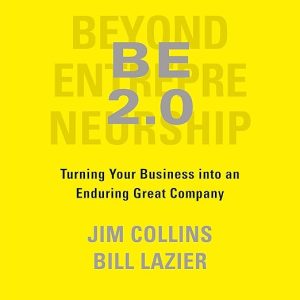
Two books occupy one audiobook here, decades apart, and the seam between them is the whole proposition. BE 2.0 contains the complete original text of Beyond Entrepreneurship, written by Jim Collins with his mentor Bill Lazier nine years before Good to Great made Collins a household name in business publishing, and then wraps it in new chapters and essays written from a 2020 vantage point. Thirteen hours and fifty-three minutes covers both layers. Knowing which one you are inside at any given moment turns out to matter more than the marketing suggests.
A Bridge Between Theory and Actual Practice
Beyond Entrepreneurship had an unusual afterlife. Published before Collins became the name attached to Good to Great, it circulated among the people building what the description calls the technology revolution then being born in Silicon Valley, and it kept circulating long after its author moved on to bigger research programs. The upgrade does not retire it. Collins reexamines the old text rather than replacing it, and pulls thirty years of subsequent research into a single integrated framework the book calls The Map. That is a genuinely different structure from the usual second edition, which quietly overwrites what it disagrees with.
A five-star response written by an MBA graduate makes the strongest case for why the layering works, describing the book as a bridge between theory and the actual practice of leadership and company building, and singling out how the updated version blends durable principles with newer thinking. The same entry contrasts it with the frameworks and case studies of a graduate program, and finds that this one adds depth by concentrating on building a company that lasts and leads with purpose. Coming from someone who has just worked through a graduate business curriculum, that is a useful verdict.
One Voice for Two Very Different Decades
Collins narrates his own text, which sets up the specific problem this recording has to solve. On a printed page, a reader always knows which stratum they are standing on, because typography, section breaks and running heads do that work silently. In audio all of it collapses into one continuous voice, and the difference between a passage from the original book, written with a co-author, and a 2020 essay commenting on that passage has to be signaled aloud or not at all. Sample one of the new essays back to back with a stretch of the original text, since that boundary is where the recording either helps you or leaves you guessing.
Written in Spanish, one of the five responses gives the book a cleaner summary than the publisher copy manages, describing Collins's insights applied to emerging companies and to what separates the ones that manage to consolidate from the ones that never do. That is the actual subject. This is not a startup manual about getting funded or getting launched; it is about the far less glamorous problem of what a company has to become in order to still exist in twenty years, which is why the original text aged as well as it did.
Newcomers are well served, and one enthusiastic entry recommends it specifically to the new entrepreneur who is just starting out, calling it a source of ideas and motivation. Both halves support that. The original was written as practical guidance for people running small companies rather than as research reporting, so it stays concrete about hiring, decisions and culture, and the essays layered on top supply the evidence base Collins spent the following three decades assembling. Few business titles this long are this consistently applicable.
A Co-Author the Byline Leaves Out Entirely
Authorship is where this record goes wrong. The byline carries one name. The description carries two, stating plainly that Beyond Entrepreneurship was written by Jim Collins and Bill Lazier together, that BE 2.0 includes the original text of that book, and that Collins wrote the new material partly to honor Lazier, who died in 2005. A co-author whose prose makes up the bulk of the product is simply missing from the credit, and a listener who never reads the description would finish thirteen hours without learning that a second writer exists.
Arithmetic is the second problem. The badge reads 4.8 above a rating count of one, and a tenth of a star is a resolution a single vote cannot produce: reaching 4.8 as an average requires a base of at least four votes, so the counter and the score are describing different populations. The written column carries its own format tell, too. One five-star reports that the first ninety pages are life changing, which is a page reference on a listing that sells hours, and the publisher copy calls the result a singular reading experience.
An Origin Story for Good to Great Readers
Founders past the launch stage are the sweet spot, especially anyone running a company that has survived its first years and now has to decide what it wants to be. Operators and second-line leaders get the most reusable material, since the original text was written for people making hiring and culture decisions rather than for strategists. Readers who already know Good to Great get something closer to an origin story, because the ideas that book made famous are visible here in an earlier and rougher form, with the author annotating his own younger thinking.
Skip it if you want a lean, current playbook. A commitment of this length is a lot to ask for a text whose core is decades old, and buyers who dislike repetition should know that the essays deliberately revisit ground the original chapters already covered. It is also a poor fit for anyone shopping for tactics on fundraising, growth marketing or product, none of which is the subject. Anyone who wants Collins at his most compressed would be better served by the research books this one quietly stands behind.
- Read by: the author reads his own work, so the 1980s text and the 2020 commentary reach you in a single voice with no typographic help.
- At its heart: building companies that last, mentorship and inherited thinking, principles versus playbooks
- Vibe: Measured, practical, quietly personal
- Short version: Worth the length if you run something that already exists; not the book for getting one started.
Frequently Asked Questions
What exactly does the audiobook contain that the original Beyond Entrepreneurship did not?
According to the description, the complete original text plus four new chapters and fifteen new essays written from a 2020 perspective. The additions also consolidate roughly thirty years of Collins's later research into a single named framework, The Map, so the new material comments on the old rather than replacing it.
Is this audiobook aimed at startups or at established companies?
Established ones, mostly. The framing question is how a company survives infancy and then keeps changing the world for decades, which puts the emphasis on durability rather than launch. Founders at the earliest stage will still find usable material on hiring and culture, but the arguments assume an organization that already exists.
Do you need to have read Good to Great first?
No, and chronologically it is the other way around. The original text here predates Good to Great by nine years, so the concepts that book later made famous appear in an earlier form. Reading order does not matter much, though knowing the later work makes the new essays more interesting.