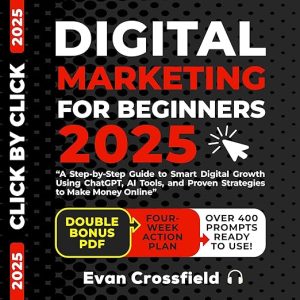
A book with a year in its title is making a promise it cannot keep for long. This audiobook arrived in July 2025 selling up-to-date strategies for a field its own copy describes as one where algorithms change overnight, and more than a year has gone by since. That is not a small problem for a guide organized around what works now. It is also not the strangest thing about the record, which reads in several places as though nobody ever converted it out of an ebook.
Quinteros Must Orient a Listener With Nothing Visible
Crossfield promises a great deal inside a hundred and ninety minutes. The bulleted contents run to strategies for capturing attention and building authority, AI-powered tools and workflows, step-by-step frameworks for content creation, social media, email marketing, funnels and automation, real-world case studies, and sustainable methods for growing without burnout. Any one of those is a book on its own. Together they describe a survey, and a survey is what this runtime can honestly deliver: an orientation for somebody who does not yet know what a funnel is, rather than an implementation manual for somebody who does.
Frameworks are the part that suffers most in audio, and the record half-admits it by promising an accompanying PDF alongside the file. That is the honest arrangement for material of this kind, and it doubles as a warning, because the step-by-step sequences the title advertises are not things a voice carries unaided. Millian Quinteros takes the reading, and the job is specific: keeping a listener oriented inside numbered procedures with nothing visible to look at. Test it on one of the framework chapters, where the numbering does the work, rather than on the motivational passages, which any competent reader can carry.
Only One Tool Is Actually Named Here
Currency is the actual value proposition, and it deserves examining. The copy leans on artificial intelligence as its differentiator, promising tools and workflows that amplify productivity and precision, and it names exactly one of them: ChatGPT, which is already in the title. Everything else is AI tools in the plural. For a genuine beginner that may be enough, since the useful lesson is the habit rather than the product. For anyone who already keeps a subscription and a workflow, the absence of named tools leaves little to weigh against what they are doing now.
Nobody needs another guide explaining that attention is scarce, and this one mostly declines to. The strongest thing in the copy is a framing sentence: the point is not chasing trends but embracing the tools of the moment and using them with intention. That is a defensible position for a beginner's book, and it explains why the promised case studies are described as showing how successful marketers combine intuition and innovation rather than as templates to copy out. A hundred and ninety minutes spent installing a way of thinking is a better use of the format than the same time spent listing tactics that expire.
The Copy Calls This Product a Book, Repeatedly
Copy is where this record gives itself away. It calls the product a book, tells you what this book gives you, promises what you will discover inside it, and signs off by announcing that this is the book you have been waiting for and instructing you to download now and unlock your digital advantage. Only the final note, the one about a PDF arriving with the audio, was written for a listener at all. Everything above it is store copy for a written product, pasted onto an audio listing without a word changed.
Zero people have written anything about this release, and one has clicked a rating. That rating displays 5.0, and nothing about it is broken: the top of the scale is one of the values a single click can land on. The arithmetic is not the problem. The problem is that a perfect score with nothing behind it looks like a verdict and is not one: a single anonymous click cannot distinguish the writing from the reading, the reading from the download, or any of them from a buyer who simply liked the price. Treat the score as absent rather than as a recommendation, because absent is what it functionally is.
Volume one of Click by Click is what the series fields say, and it is a small pleasure to find those fields filled at all. What follows from them is less encouraging: a first entry in a planned sequence, self-published, with the author's own name in the publisher slot, released more than a year ago and still carrying one rating. None of that judges the content. All of it tells a buyer that the usual signals are unavailable here, and that the decision has to rest on the copy and the sample.
Check the Calendar Before You Pay for Currency
Worth owning if you are genuinely at the start: someone with a small business, a side project or a creator account who has heard the vocabulary and cannot yet sequence it. The copy names its audience precisely, solopreneurs, creators, coaches and business owners, and a short orientation aimed at exactly those people has real value. The PDF makes it usable as a reference afterward, which counts for more here than it would on a narrative book.
Practitioners past the beginner stage can stop reading. The copy is explicit that this is a beginner's guide and nothing in the contents suggests otherwise. Steer clear too if you came for specific tooling, since one product is named in the entire description, and a survey that keeps its recommendations generic ages more gracefully but helps a good deal less. Anyone choosing partly on the year printed in the title should also work out what that year now means. Where currency is the whole promise, the calendar is the first thing to check before paying.
- Narration: Millian Quinteros has to keep numbered procedures navigable with no page in front of the listener, which is where a guide built on frameworks either survives audio or does not.
- Themes: beginner digital marketing, AI-assisted workflows, funnels and email as a first system
- Mood: Brisk, encouraging, closer to an orientation than a manual
- Verdict: A fair first pass for a true beginner, with a shelf life the title helpfully dates for you.
Common Questions
How long is this audiobook, and can it realistically cover what it promises?
A hundred and ninety minutes, against a contents list running from content creation and social media through email, funnels, automation, AI workflows and case studies. That arithmetic makes it an orientation rather than an implementation manual: enough to map the territory and name the moving parts, not enough to build anything with them.
Is the audiobook still current, given the 2025 in its title?
Only partly. It was released in July 2025, and its own copy says algorithms change overnight, so anything tied to specific platform behavior deserves caution now. The framing material, about building authority and using AI with intention instead of chasing trends, has aged considerably better than the tactics will.