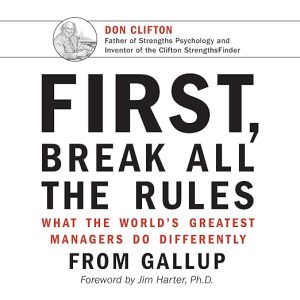
I picked up First, Break All the Rules during a stretch where I was consulting for a mid-sized publisher that had just promoted three of its best editors into management roles without giving any of them meaningful support for the transition. They were all struggling in different ways. The book felt uncomfortably applicable to each of them for different reasons, which is exactly what good management research should do.
The Gallup study that forms the backbone of this book, interviews with more than 80,000 managers across industries and organization types, is one of the most ambitious pieces of management research ever conducted, and the findings that emerged from it genuinely challenged the conventional wisdom of the late 1990s when the book first appeared. The re-release with updated meta-analytic research and access to the Clifton StrengthsFinder assessment makes the audiobook a more complete package than many management titles of comparable vintage.
What Marcus Buckingham Delivers
The book's core argument is counterintuitive in the most productive sense: great managers do not operate by the rulebook. They do not believe that with enough training, anyone can achieve anything. They do not try to fix weaknesses. They play favorites, deliberately. What distinguishes them is not adherence to management orthodoxy but the precision with which they identify and deploy each individual employee's distinct talents rather than trying to develop generic competence across the board.
Mel Foster's narration is professional and unshowy, which is the right call for material that derives its authority from data rather than charisma. This is not a book that benefits from theatrical delivery. The ideas carry the weight, and Foster trusts them to do so, pacing the argument clearly across nearly ten hours without losing the thread between research finding and practical application.
Because the 12 statements Gallup developed to measure what distinguishes the strongest departments from weaker ones remain one of the most practical diagnostic tools in management literature. They are specific, testable, and grounded in outcome data rather than theory. Reviewers who came to the book through military leadership training found it validated what their best mentors had modeled. Reviewers who used it in MBA instruction found it generated genuine debate about conventional wisdom in ways that more theoretical frameworks did not.
The claim that people do not quit their companies, they quit their bosses, has become so widely cited that it now feels like common sense, but the empirical grounding behind it is what First, Break All the Rules actually offers. The book does not just assert that front-line managers are the key lever for retaining talented employees. It demonstrates why, with data drawn from one and a half million hours of interviews to back it up.
Where Marcus Buckingham Loses Some Ground
The re-release framing and the Clifton StrengthsFinder access mentioned in the product description are worth verifying in your specific edition, as audiobook updates sometimes lag behind print versions in terms of supplementary materials. The core content, the research findings and their implications for how you select, develop, and retain talent, is durable and does not depend on any supplementary tools to deliver its value.
Some listeners may find the book's scope narrower than the title implies. It focuses primarily on the manager-employee relationship rather than organizational design or executive leadership. If you are looking for strategy or culture-building frameworks at the organizational level, this operates at a more granular level than you need. It is a book about individual managers and individual employees, not about companies or cultures as a whole.
Who Should Pick Up First, Break All the Rules
Front-line managers and anyone who recently became a manager and is thinking seriously about how to develop their team effectively. Equally useful for employees trying to understand what distinguishes their best managers from the rest. Less useful for senior executives focused on organizational transformation or readers seeking a broader theory of company culture. The research base is strong enough that this is one management audiobook worth revisiting every few years as your team and context change.