In Brief
- Performance: The credit names one author for a book the copy attributes to two, so the voice count is the first thing to verify in the sample.
- What it covers: Receiving criticism, self-image under evaluation, annual reviews, unsolicited input from every direction.
- Feel: Practical and unhurried, closer to a workshop than a pep talk.
- Our call: Still the standard text on the receiving end of criticism, though the numbers on this page deserve none of your trust.
Penguin Audio released this audiobook in March 2014, and twelve years later it still turns up on desks, on a graduate reading list and in the libraries of people who already own it in print. Nine hours and forty-eight minutes on the subject of receiving criticism sounds excessive until you notice how little else exists on it. Most of the shelf teaches you how to deliver feedback well. This one starts from the position that delivery was never the bottleneck.
Feedback books are almost always written for the person holding the clipboard. Stone and Heen turn the telescope around and address the person on the receiving end, which sounds like a small pivot and is not. As the receiver you have no control over how badly the message is phrased, no control over who delivers it, and no ability to stop it arriving. What you do control is what happens next inside your own head. That single reframing carries all nine hours, and it explains why a 2014 title is still being bought in three formats by the same households.
One February 2026 four-star reduces the whole thing to a single sentence: a helpful book that will also be a good reference later. It sounds faint, and it is exactly right about the shape of the object. What the description promises is a set of tools for handling what it calls the blizzard of offhand comments, annual evaluations and unsolicited input, and tools of that kind are not absorbed on a first pass. They get consulted. A buyer should plan on coming back to this rather than on finishing it.
What Works
Usage patterns say more about a reference book than any score can. One five-star from June 2024 describes borrowing the audio from a public library, then buying a print copy in order to study and highlight it, then buying the audio a second time so it could be listened to with a spouse. Three acquisitions of one title for three separate jobs: absorb it, mark it up, share it. Nobody does that with a book they merely enjoyed, and it tells a prospective buyer something no average can, namely that people come back to this one on purpose.
Neuroscience and psychology are named in the description as the underpinning, blended with what the description calls practical, hard-headed advice, and that blend is why the book survives rereading. Its stated promise is to explain why receiving feedback is at once crucial and so difficult, and the science sits there to answer the second half of the sentence. Anyone who has spent a career being told to toughen up will hear the flinch described as a mechanism rather than a character defect, a more useful thing to be told across nine hours than any quantity of encouragement.
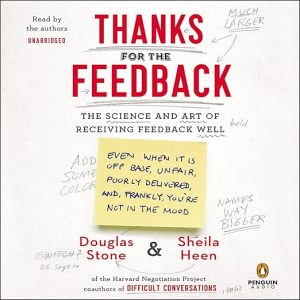
Douglas Stone is the only name in the narrator field, which is where the listing starts to come apart. The description credits Douglas Stone and Sheila Heen as coauthors in every sentence that carries weight, and a 2016 five-star reports having heard the book read aloud by the authors, plural, no fewer than three times. Author-read business writing succeeds or fails on whether the writers can sustain a nine-hour argument without sliding into lecture, and a two-voice reading is a materially different purchase from a one-voice reading. Cue up ten minutes from the section where the tools get explained rather than the opening, and count the voices yourself.
Before You Commit to Thanks for the Feedback
Arithmetic is where the page falls apart. It displays 4.6 stars and, immediately beside it, the number of ratings standing behind that figure: two. Two whole-star votes cannot average 4.6. Two votes can only produce whole numbers and halves, which puts 4.5 and 5.0 within reach and nothing at all in between them. The displayed score is therefore drawn from somewhere other than the two votes it advertises, most plausibly a pool shared with other editions of the same title, and anyone reading it as an audience verdict on this recording is reading a figure that describes something else.
Underneath that two-rating counter sit five signed write-ups, a small contradiction in itself: more people have troubled to write paragraphs than have apparently troubled to click a star. One of the five consists of the single word Nice. Others run to full paragraphs of argument. Flattened into one number they become indistinguishable, and that is the general case against treating any score attached to a decade-old business title as information about the recording. Read the written entries and disregard the figure above them.
A third field deserves a look before you buy: the byline. Every substantive line of the description concerns two people, opening with the coauthors of Difficult Conversations and continuing through fifteen years of work with corporations, nonprofits, governments and families. The author credit on this page carries one name. Sheila Heen is present throughout the copy, absent from the metadata, and therefore invisible to anybody browsing by author. Those fifteen years, incidentally, were all counted before the March 2014 release, so the fieldwork predates a recording that is itself now twelve years old.
Who It's For
Managers and anyone with a performance review already on the calendar are the obvious buyers, but the more interesting audience is people with no direct reports at all. A January 2026 five-star describes being assigned the book in graduate school and using it to look inward and try to improve, which is a fair description of who gets the most out of it: anyone who has noticed they go rigid the moment they are criticized and would like to stop. Couples, teachers and veterans of long-running family arguments will find as much here as any executive.
Anyone hoping for a manual on giving better feedback should look elsewhere, since that is explicitly not the job this book took. Nor is it right for a listener who wants conclusions without homework, because the material keeps asking you to practice on your own life. Nine hours and forty-eight minutes is a real commitment for something you are going to treat as a reference anyway, so the honest recommendation is to buy the audio for the argument and accept that you will eventually want a copy you can write on.